

 DEFENCE INDUSTRYBrahMos export orders: Vietnam deal worth about $100 million, Indonesia $200 million as Akash reaches Tajikistan, Turkmenistan
 DEFENCE INDUSTRYMahindra Embraer Nagpur facility to assemble C-390 if IAF picks the aircraft
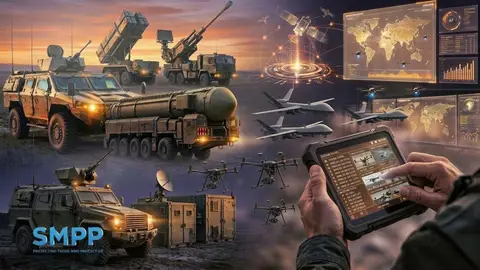 DEFENCE INDUSTRYSMPP Drone Manufacturing Push: Firm Shifts From Ammunition to Unmanned Warfare, Targets Integrated Defence Capabilities
 INDIA DEFENCEDhruv NG Helicopter Explained: What HAL Has Actually Put Into Pawan Hans Service
 INDIA DEFENCELCA FOC Trainers Delivered With HTT 40 and Dhruv NG as Rajnath Singh Asks Engineers for Technologies That Do Not Exist
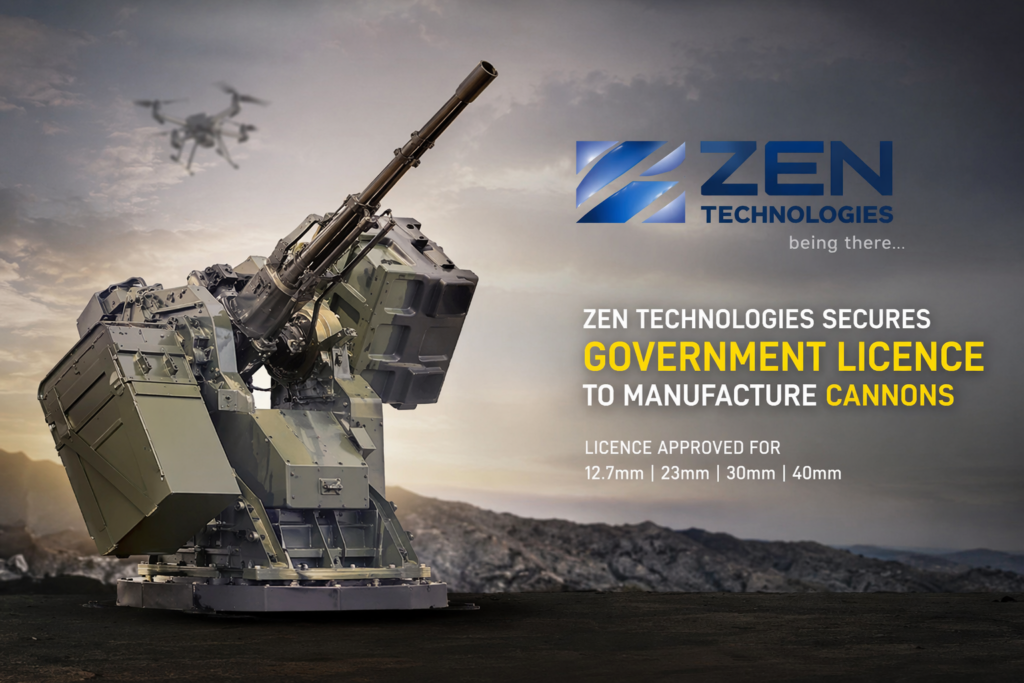
Zen Technologies arms licence to manufacture rapid-fire cannons has been granted by the Government of India, covering four calibres: 12.7mm, 23mm, 30mm, and 40mm.. The licence, issued under the Arms Act, 1959, formally marks the Hyderabad-based company’s entry into platform-level weapon system production, a segment it had not operated in before.
For the company, the Zen Technologies arms licence is more than a regulatory clearance. It is the clearest signal yet that the company is moving well beyond its simulator origins and into the hardware mainstream of Indian defence manufacturing.
The cannons are designed for air defence, naval deployment, and counter-unmanned aircraft system (C-UAS) roles. Company officials describe them as a “last line of defence” against drones, loitering munitions, and low-altitude aerial threats, the categories of threat that have most dramatically reshaped tactical thinking across the world’s militaries over the past four years.
Zen Technologies Arms Licence Opens Door to a Growing Operational Requirement
India has been actively trying to shore up its short-range air defence network, and the gap in rapid-fire cannon coverage at forward positions has been a recurring concern. Expensive missile interceptors are not always the right answer for small, cheap drones. What India’s forward deployments need is volume, reaction speed, and low cost-per-engagement, which is precisely the space these cannons are built for.
When integrated with fire-control systems, radar, and electro-optical/infrared (EO/IR) sensors, and loaded with programmable ammunition, these rapid-fire systems can engage threats at short notice with precision. Potential deployment zones span border regions, military formations, and critical national infrastructure. The strategic value of the Zen Technologies arms licence becomes clearest in this context. India’s DAC procurement push from March 2026, which cleared over Rs 2.38 lakh crore in defence acquisitions including air defence systems, underlines how seriously New Delhi is taking this threat layer.
Zen Technologies already has hands-on experience with the drone threat. The company has delivered anti-drone systems with hard-kill capability to the Indian Army under Mission Sudarshan Chakra, India’s layered national air defence programme. That operational track record gives the company a meaningful head start in understanding how these cannon systems will need to perform in practice.
From Training Simulators to Weapon Manufacturers
Zen Technologies built its reputation on defence training simulators and C-UAS solutions. That base is not unrelated to what comes next. The disciplines of target tracking, sensor fusion, and threat response that underpin its simulator and anti-drone work translate directly into the engineering requirements for cannon-based air defence platforms. The company is not walking into unfamiliar territory.
The expansion also places Zen Technologies in a group of Indian private sector firms that have moved up the defence value chain into hardware production. India’s indigenous cannon manufacturing capacity has historically been limited, and domestic production of these calibres addresses a genuine supply gap while reducing dependence on foreign original equipment manufacturers for a category of system that the armed forces will need in considerable numbers.
India’s broader push into C-UAS and offensive unmanned systems adds further context. The Vayu Baan helicopter drone programme, launched by the Indian Air Force to develop helicopter-deployed strike drones, and the Ghatak stealth UCAVapproved for 60-unit procurement under the same DAC session, both reflect a military that is thinking in integrated, layered terms. Rapid-fire cannon systems are the close-in complement to those longer-range platforms, and domestic production of both ends of that spectrum is exactly what Aatmanirbhar Bharat is meant to achieve.
The development aligns with India’s Integrated Deep Dive Model (IDDM) framework, which prioritises equipment that is domestically designed and manufactured. Zen Technologies’ latest clearance sits squarely within that policy architecture.
No Orders Confirmed Yet
The Zen Technologies arms licence authorises manufacture but does not constitute a procurement contract. Zen Technologies will need to put these systems through official trials, meet qualification standards set by the armed forces, and compete through the standard acquisition process to secure orders. As of now, the company has not announced production timelines, named any specific customers, or disclosed expected order volumes.
Those steps will take time, and the defence community will be watching. What has changed with this licence is that Zen Technologies is now formally authorised to be in the race. Given the company’s existing credibility with the Indian military and the urgency of the short-range air defence requirement, the starting position is a reasonable one.





COMMENTS
JOIN THE DISCUSSION