

 DEFENCE INDUSTRYBrahMos export orders: Vietnam deal worth about $100 million, Indonesia $200 million as Akash reaches Tajikistan, Turkmenistan
 DEFENCE INDUSTRYMahindra Embraer Nagpur facility to assemble C-390 if IAF picks the aircraft
 DEFENCE INDUSTRYSMPP Drone Manufacturing Push: Firm Shifts From Ammunition to Unmanned Warfare, Targets Integrated Defence Capabilities
 INDIA DEFENCEDhruv NG Helicopter Explained: What HAL Has Actually Put Into Pawan Hans Service
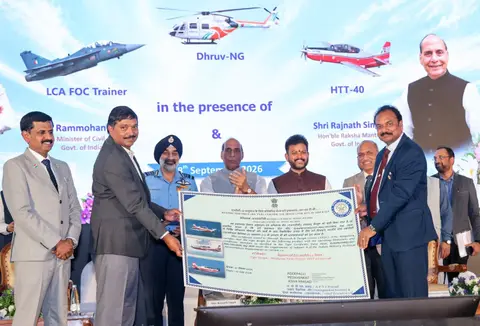 INDIA DEFENCELCA FOC Trainers Delivered With HTT 40 and Dhruv NG as Rajnath Singh Asks Engineers for Technologies That Do Not Exist
The IOS SAGAR Indian Navy initiative has wrapped up its Harbour Training Phase at the Southern Naval Command in Kochi. Two weeks. Multiple partner nations. A curriculum that covered everything from basic seamanship to live VBSS drills. The message from the Indian Navy is straightforward: capacity building in the Indian Ocean Region is no longer aspirational. It is operational.
The programme brought together multinational crews at some of the Navy’s most capable training establishments. Officials confirmed the focus was squarely on practical skills and interoperability, the unglamorous but essential work that determines whether partner navies can actually function together when it counts.
What the IOS SAGAR Indian Navy Harbour Training Phase Delivered
The curriculum was wide by design.
Core modules covered seamanship, navigation, communication procedures, and safety of life at sea. Firefighting and damage control featured prominently. These are not tick-box subjects. In high-tempo maritime operations, damage control failures sink ships. The Indian Navy treated them accordingly.
Participants also completed specialised training in Visit, Board, Search and Seizure (VBSS) operations and advanced bridgemanship. VBSS in particular is an indicator of serious intent. It is the coalface of maritime law enforcement, counter-piracy and interdiction work. Training partner navies in VBSS is India extending real operational capability, not ceremonial goodwill.
Advanced simulators and modern infrastructure at the Southern Naval Command enabled realistic, scenario-based exercises throughout. Crews rehearsed contingencies under pressure rather than in comfort. That distinction matters when the same crews eventually operate in the Mozambique Channel or the Gulf of Aden.
Flag Officer Sea Training and the Naval Workup Team
Two parallel tracks ran through the programme.
Training under the Flag Officer Sea Training (FOST) framework gave multinational personnel structured exposure to standard Indian Navy procedures. FOST is a rigorous framework. Passing through it builds the kind of procedural muscle memory that holds a mixed formation together when communications are degraded and decisions need to be made fast.
Alongside this, the Naval Workup Team delivered focused sea training inputs aimed at operational coordination and synergy among the participating nations. The combination is deliberate. Institutional training builds the foundation; workup training stress-tests it. India ran both, not one or the other.
IOS SAGAR Indian Navy: Built Around the IOR’s Actual Threat Picture
The IOS SAGAR Indian Navy programme is not a diplomatic showcase. It is structured around the specific, persistent threats that define the Indian Ocean Region’s security environment: piracy, illegal and unreported fishing, maritime trafficking, and the recurring demand for humanitarian assistance and disaster relief operations.
These threats do not respect national boundaries or naval jurisdictions. Addressing them requires partner navies that can coordinate, communicate and operate together without a lengthy calibration period every time they are asked to work jointly. That is precisely what this training is designed to produce.
India has been backing that conviction with procurement. A recent Defence Acquisition Council clearance of over Rs 2.38 lakh crore signals that the maritime capacity-building effort extends well beyond training programmes.
What Comes Next: Operational Deployment Across the IOR
The harbour phase was preparation. The deployment phase is the point.
IOS SAGAR will now transition into joint exercises at sea and port engagements across key locations in the Indian Ocean Region. These are the activities that translate classroom and simulator gains into demonstrated, at-sea capability. Port engagements also carry strategic weight. Every call reinforces India’s presence and its relationships across a maritime neighbourhood that is becoming more contested, not less — as evidenced by the Navy’s recent decision to move warships into the Strait of Hormuz to guard India’s energy supply lines.
The sequencing, harbour training first, operational deployment second, reflects a serious methodology. India is not sending partner navies to sea before they are ready. It is building them up deliberately, then deploying alongside them. That approach builds durable partnerships rather than transactional ones.
One Ocean, One Mission: The Strategic Framework Behind IOS SAGAR
Officials have anchored IOS SAGAR within India’s “One Ocean, One Mission” vision and the MAHASAGAR framework. Both reflect a clear strategic posture: India as a net security provider in the Indian Ocean Region, not simply a regional power defending narrow national interests. This posture is backed by a rapidly expanding fleet. The imminent commissioning of INS Taragiri, India’s latest Project 17A stealth frigate, is one more signal that the Navy’s capacity to lead in the IOR is being built on solid industrial foundations.
The distinction is important. Net security providers absorb costs and extend capability to others. They show up when partners need training, logistics, or operational support. IOS SAGAR is one mechanism through which India is making that posture concrete rather than declarative.
The completion of the Harbour Training Phase in Kochi is not a headline event in isolation. It is one instalment in a sustained effort to build a maritime security architecture in the IOR that actually holds together under pressure.
Conclusion
The Harbour Training Phase is done. The harder work, at sea, across multiple jurisdictions, in real operating conditions, begins now. The IOS SAGAR Indian Navy programme has delivered trained crews, tested procedures and a clearer sense of how partner navies fit into India’s maritime security vision for the Indian Ocean Region. What the deployment phase produces will be the real measure. On current evidence, there is every reason for confidence.
COMMENTS
JOIN THE DISCUSSION