

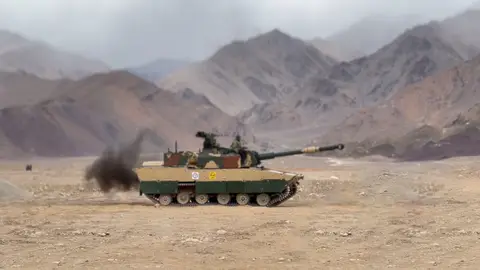
 DEFENCE INDUSTRYTata Zorawar light tank clears Army's L1 hurdle for Rs 20,000 crore contract
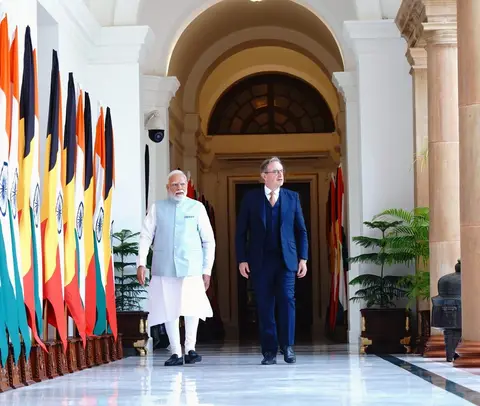 DEFENCE INDUSTRYIndia Belgium Defence Deals Sealed As PM De Wever Visits Delhi
 DEFENCE INDUSTRYAero India 2027 Dates Confirmed for February 8 to 12 in Bengaluru
 DEFENCE INDUSTRYJavelin missile co-production advances as Tata Advanced Systems signs Javelin Joint Venture pact
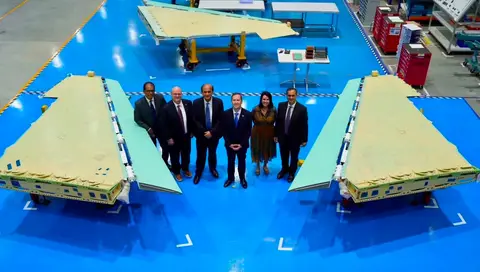 DEFENCE INDUSTRYTata Lockheed Martin MTA push gets a lift from US envoy's Hyderabad visit
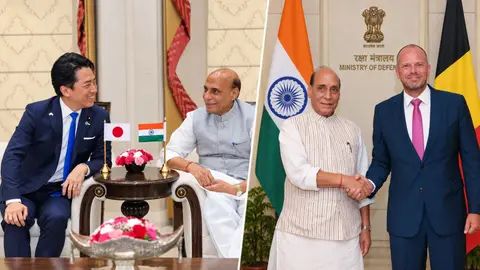
India Belgium defence deals moved from framework to paper on Thursday, as ten industry agreements were signed in New Delhi during a working visit by Belgian Prime Minister Bart De Wever and Minister of Defence and Foreign Trade Theo Francken.
Fifteen Belgian companies travelled with the delegation, most represented by their own chief executives, on a visit the Indian Ministry of External Affairs has tied to the wider Modi-De Wever engagement in New Delhi.
Taken together, the ten India Belgium defence deals span ammunition lines, mine hunting systems and a rocket line now set for Indian soil.
Francken framed the visit in geopolitical terms. India is a rapidly growing economy and a major military power in the Indo-Pacific, sitting along some of the world's most important trade routes, he said, and for an open trading nation like Belgium the safety of those sea lanes matters directly. He pointed to Russia's war in Ukraine, its deepening military ties with Iran and North Korea, and China's growing assertiveness in the Indo-Pacific as reasons Europe and Asia can no longer be treated as separate theatres. Belgium needed to work more closely with strong partners such as India, he said, militarily, technologically and industrially, a position his own Ministry of Defence has been building toward over the past year.
From economic mission to partnership
Thursday builds on an earlier economic mission that opened political doors and put Belgian and Indian companies in touch with one another.
That groundwork showed up in two ways on the day, a meeting with Prime Minister Narendra Modi and a Letter of Intent signed with the Indian Ministry of Defence, setting out a framework for structural cooperation between the two countries' armed forces that covers training, officer exchanges, research and development, seminars, joint exercises and maritime security cooperation.
The two sides also intend to draw up an industrial roadmap. The Belgian Defence College is planning to run its World Study Trip to India in 2027. Francken held a separate bilateral meeting with the Indian Defence Minister on the same visit, a companion engagement to Thursday's industry signings.
"We have built trust. Now we need to translate that into concrete cooperation. Not non-binding declarations, but joint training, industrial projects and opportunities for our companies," Francken said.
Structural cooperation across the sectors
An agreement between Belgian Security and Defence Industry and the Society of Indian Defence Manufacturers, the two countries' sector bodies, was among the day's signings, meant to make it easier for Belgian and Indian firms to participate in co-development under the Make in India push.
It lands alongside a push from the other direction too. India's own defence production establishment has been pressing manufacturers toward indigenous design rather than assembly work, with faster licensing clearances and delegated export approvals.
"The scale is enormous. India is modernising one of the largest armed forces in the world. For companies whose technology gains access to these programmes, this can quickly translate into major orders and major contracts. The agreement between BSDI and SIDM opens that door," Francken said.
Maritime security tops the wishlist
India is looking to strengthen capabilities in mine countermeasures, autonomous maritime systems, underwater robotics, advanced sensors and the protection of critical infrastructure such as ports, pipelines and subsea data cables, areas where Belgian industry carries particular weight.
Weapons systems, ammunition, radar, electro-optical sensors, command and control, and counter-drone systems round out the list.
"With this visit, we are reaping the benefits of what we have built over the past year. Access to major programmes, industrial cooperation and tangible results. Every project that connects our technology with India's growing defence industry strengthens both our security and our economic position. That means expertise, contracts and jobs in our country," Francken said.
Ten India Belgium defence deals now on paper
Liege based New Lachaussee will supply Tembo Classic Engineering a complete production line for two ammunition calibres, plus tooling for two more, with capacity for roughly 100 million rounds a year. The project is worth 50 million euros, with delivery set for 2028 and 2029.
Exail Belgium will supply autonomous toolboxes that detect, identify and neutralise naval mines for the mine countermeasure vessels Larsen and Toubro is building for the Indian Navy.
The first phase covers twelve vessels, with the programme potentially expanding to as many as 59, making it the largest industrial project to come out of the mission. L&T's Kattupalli and Hazira yards have built up a run of Navy deliveries this year, and the Exail tie-up adds a mine warfare line to that record.
Assembling Thales's rockets in Kalyani's plant
Thales Belgium's 70mm rockets will now also be assembled in India, with Indian suppliers brought into the process through Kalyani Strategic Systems. The first rocket produced entirely on Indian soil is due in early 2027.
The arrangement cuts both ways. India builds its own rocket production capacity, while Thales gains an extra supply source for its international orders at a moment of general scarcity, framed on the Belgian side as a boost to European security of supply as well.
FN Herstal is separately exploring a joint production centre in India with Kalyani Strategic Systems, one meant to manufacture FN weapons, integrated weapon systems and counter-drone systems for both the domestic market and export. Access to orders from the Indian armed forces, if it follows from the tie-up, would be considerable for the Belgian firm.
Brussels based Pitagone, which makes mobile barriers designed to stop vehicle attacks, is setting up an India joint venture with Krishna Allied in which Pitagone will hold a 51 percent majority stake.
The new company will manufacture and sell locally, and Pitagone is also eyeing India as a base to serve other markets in Southeast Asia.
Flemish drone maker Sol.One is working with an Indian partner, DGVK Enterprises, to bring its Saboteur drone into the Indian market alongside its Buzzkill and Hitchhiker interceptors. The Indian armed forces have already asked for information and want to test the systems.
Sensors, armour and marine engines
OIP Sensor Systems and India Optel are continuing their electro-optical work on the Arjun main battle tank, building on the 130-plus sights OIP already supplied for the Arjun MK I.
For the newer MK II, the company developed a fire control system capable of launching laser guided missiles of its own, and the current agreement opens the door to further upgrades as fresh generations of Indian armoured vehicles enter service in the years ahead.
John Cockerill Defense is a candidate to supply the turret for the Zorawar, the light tank India is developing for operations at high altitude, a programme tied to the military build up along the border with China and one that has slipped in schedule as the Army pushes for a redesign with more protection. John Cockerill's bid picked up political backing during the earlier economic mission.
Leuven based Octave, a visualisation software specialist, is working with Bharat Electronics Limited, whose technology already sits inside several Indian air defence programmes, among them Akash Teer, ARUDHRA, IPSS and IACCS.
A new Letter of Intent between the two could not be finalised in time.
Ghent based marine engine maker Anglo Belgian Corporation is in talks with Kirloskar Oil Engines, which has been commissioned to build India's first fully domestically developed 6 megawatt marine diesel engine and is looking to ABC's expertise to get there. Cooperation on the engine would give the Belgian company a foothold in future Indian naval programmes.


COMMENTS
JOIN THE DISCUSSION