

 DEFENCE INDUSTRYBrahMos export orders: Vietnam deal worth about $100 million, Indonesia $200 million as Akash reaches Tajikistan, Turkmenistan
 DEFENCE INDUSTRYMahindra Embraer Nagpur facility to assemble C-390 if IAF picks the aircraft
 DEFENCE INDUSTRYSMPP Drone Manufacturing Push: Firm Shifts From Ammunition to Unmanned Warfare, Targets Integrated Defence Capabilities
 INDIA DEFENCEDhruv NG Helicopter Explained: What HAL Has Actually Put Into Pawan Hans Service
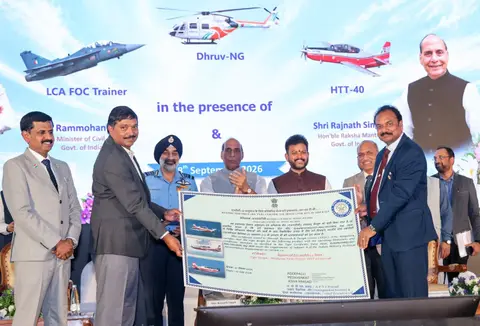 INDIA DEFENCELCA FOC Trainers Delivered With HTT 40 and Dhruv NG as Rajnath Singh Asks Engineers for Technologies That Do Not Exist
India defence design push has to follow the country's manufacturing scale if the sector wants a genuine global leadership position, Secretary, Department of Defence Production Sanjeev Kumar told an ASSOCHAM gathering in New Delhi on Tuesday. Mr Kumar, the chief guest at the National Conference on Aerospace and Defence Manufacturing, said domestic defence production has risen more than four fold in a little over a decade, but argued that scale alone will not carry India into the top rank of global suppliers.
Domestic defence production touched Rs 1.78 lakh crore in FY 2025-26, up from Rs 43,000 crore in 2013-14, Mr Kumar said, crediting the rise to the twin push of Aatmanirbhar Bharat and Make in India. He said the foundation was never only about cutting import dependence, pointing instead to a wider goal of building globally competitive manufacturing capacity and positioning India as a trusted partner inside international defence supply chains.
"For a country like India, this sector has tremendous strategic and economic significance. We have a very strong pool of engineers, scientists, skilled workers, and entrepreneurs," Mr Kumar said, adding that combining this talent pool with modern technology, investment and a conducive policy environment had been the government's task through the last decade.
India defence design push starts with intellectual capital
Policy tools cited by the secretary included 75 per cent of the capital acquisition budget reserved for Indian companies, priority clearance for indigenously designed and developed platforms, and enablers such as the Technology Development Fund, IDEX and the Srijan portal. MSMEs, he said, now contribute 50 to 60 per cent of the value on several platforms delivered by the defence public sector undertakings, a role the DRDO's own MSME-facing technology and test centres have been built to support.
The appeal Mr Kumar pressed hardest ran narrower than the headline production numbers he had just cited. Industry needed to invest in genuine research and take up indigenous design and development on its own account, he said, rather than lean only on technology transfer arrangements to build lasting self-reliance across the sector's supply base.
"No country, no company gives their latest technology to anybody else except their own forces... sometimes, few of us should take the difficult path. And the people who take the difficult path would emerge winners, as has been historically across the world," he said.
Licensing timelines cut to three weeks
The secretary also detailed changes to the ease of doing business for the sector, describing them as a deliberate effort to cut red tape without loosening quality control. The process for granting defence manufacturing licenses has been simplified, he said, with a 19-member evaluation committee disbanded entirely and approvals now cleared directly by the concerned Joint Secretary, working in consultation with DRDO and the Directorate General of Quality Assurance on every application.
"It doesn't require now more than three weeks, unless some information is awaited," Mr Kumar said of the revised licensing timeline. Export licensing has been rationalised on similar lines, he added, with powers delegated to the Joint Secretary level and a one-time, multi-year export authorisation regime under consideration for long-term supply partners of global original equipment manufacturers.
Defence exports have grown to nearly Rs 39,000 crore in the last year, from Rs 686 crore in 2013-14, with over 100 countries now importing Indian defence products, Mr Kumar said. Aerospace products alone accounted for nearly Rs 6,300 crore of that figure, part of a wider export growth trend he said reflected long-term, stable relationships rather than dependence on shifting global situations.
A window opened by shifting supply chains
Global defence supply chains are diversifying, Mr Kumar said, and that shift has opened a window of opportunity for India as advanced countries look to partner with Indian manufacturers. He exhorted industry, and young entrepreneurs and tier 1, tier 2 and tier 3 suppliers in particular, to seize the moment ahead of them.
State and industry voices at the conference
Delivering the welcome address, Anil K Agarwal, Past President of ASSOCHAM, called the aerospace and defence sector a defining point in India's growth story. "India is no longer looking only at meeting its domestic defense requirements. We are increasingly positioning ourselves as a global manufacturing, technology, export and supply chain hub for the aerospace and defense industry," he said, crediting the transformation to the leadership of Prime Minister Narendra Modi and the efforts of the Ministry of Defence and the Department of Defence Production.
The conference ran three thematic sessions after the inaugural address, on building a future-ready manufacturing ecosystem, on moving from Make in India to Make for the World, and on futuristic technologies for defence manufacturing.
At the second session, Dr N Yuvraj, Secretary of the Industries and Commerce Department in the Andhra Pradesh government, spoke about the state's push to build testing infrastructure and supporting facilities across aerospace, space and defence, including ongoing discussions with the Ministry of Defence on common storage infrastructure for munitions.
Khushboo Goel Chowdhary, Commissioner for Industrial Development and CEO of Invest Karnataka, described the state's existing depth in the sector. "We have a deep ecosystem bringing together HAL, BEML, BEL, DRDO and a lot of research institutes. Global OEMs already exist, and not to forget the 2,000-plus MSMEs which are working in this sector," she said.
Rajiv Gupta, Chairman of ASSOCHAM's National Council on Aerospace and Defence, framed the sector's next steps as localisation first, then competitiveness built from the supply chain, MSMEs, IT capability and engineering ability working together.
ASSOCHAM report launched at closing session
The conference closed with the launch of a knowledge report, "Aerospace and Defence Manufacturing: Advancing India's Leadership in Global Market," prepared jointly by ASSOCHAM and Sugosha Advisory, a document meant to carry the India defence design push argument Mr Kumar had opened the day with beyond the New Delhi conference hall.
COMMENTS
JOIN THE DISCUSSION