

 DEFENCE INDUSTRYBrahMos export orders: Vietnam deal worth about $100 million, Indonesia $200 million as Akash reaches Tajikistan, Turkmenistan
 DEFENCE INDUSTRYMahindra Embraer Nagpur facility to assemble C-390 if IAF picks the aircraft
 DEFENCE INDUSTRYSMPP Drone Manufacturing Push: Firm Shifts From Ammunition to Unmanned Warfare, Targets Integrated Defence Capabilities
 INDIA DEFENCEDhruv NG Helicopter Explained: What HAL Has Actually Put Into Pawan Hans Service
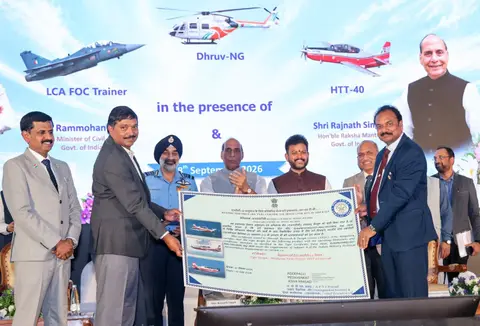 INDIA DEFENCELCA FOC Trainers Delivered With HTT 40 and Dhruv NG as Rajnath Singh Asks Engineers for Technologies That Do Not Exist
Drones, Mines and Cyber Attacks Can Choke Hormuz Without a Single Blockade, Warns India’s Navy Chief
Admiral Dinesh K. Tripathi, Chief of Naval Staff, addresses the India-Japan Cooperation in the Indo-Pacific conference in New Delhi, March 25, 2026. Indian and Japanese flags are visible on the podium. | Photo: Defence Chronicles
Admiral Dinesh K. Tripathi warns that drones, naval mines and cyber tools now threaten the Strait of Hormuz without any formal blockade — with major consequences for India’s energy supply.
India’s Chief of Naval Staff, Admiral Dinesh K. Tripathi, has issued a pointed warning about the growing vulnerability of global maritime choke points — and the Strait of Hormuz sits squarely in the crosshairs.
Speaking at the International Conference on India-Japan Cooperation in the Indo-Pacific, hosted by the India Foundation in New Delhi on March 25, Admiral Tripathi stated that modern technologies have fundamentally lowered the threshold for maritime disruption — no blockade declaration required.
“Drones, unmanned systems and mines now threaten critical choke points such as the Strait of Hormuz even without a formal notice of a blockade.”
— Admiral Dinesh K. Tripathi, Chief of Naval Staff, India
The Hormuz Problem — And Why India Watches Closely
For energy-importing nations like India, the Strait of Hormuz is not an abstract geopolitical concern. Roughly 20 percent of global oil flows through this narrow passage. Any sustained disruption — kinetic or otherwise — translates directly into fuel prices, inflation and supply-chain stress back home.
The timing of the Admiral’s remarks is significant. Tensions involving the United States, Israel and Iran have already pushed crude oil prices up sharply, with reports suggesting a rise of over 40 percent in recent weeks. Iran has maintained that the strait remains technically open, with passage permitted to most vessels — those linked to the US and Israel being the stated exceptions.
India’s own energy interests have been caught in the middle. Four Indian LPG carriers recently transited the Hormuz strait following diplomatic outreach by New Delhi to Tehran. Two have already reached Indian shores. The remaining two — MV Jag Vasant and Pine Gas — are currently en route, sailing under the escort of Indian naval ships.
That India needed to deploy naval escorts to shepherd its own commercial vessels through an internationally recognised waterway speaks volumes about the current state of maritime security in the region. Insurers, meanwhile, have grown increasingly reluctant to underwrite voyages through the area, compounding the cost burden on importers.
Cyber, Spoofing and the New Shape of Maritime Warfare
Admiral Tripathi’s address went beyond conventional threat assessments. He flagged a dramatic surge in maritime cyber attacks — one that doubled through 2025 — and highlighted tactics that do not require a single missile to cause serious damage.
“Denial of satellite services and spoofing have caused vessels to run aground, disrupting trade without even a shot being fired.”
— Admiral Dinesh K. Tripathi
GPS spoofing — where false location signals are fed to a ship’s navigation systems — has emerged as a particularly insidious tool. Incidents in the Black Sea and Persian Gulf have already demonstrated its real-world impact. When combined with targeted denial of satellite services, adversaries can effectively blind or redirect commercial shipping with minimal risk of attribution and near-zero conventional military footprint.
The Indo-Pacific: A New Arena for Normative Competition
Broadening his assessment, Admiral Tripathi characterised the Indo-Pacific as the primary theatre for what he called “normative competition” among major powers. This contest, he argued, is no longer confined to traditional energy resources.
Critical minerals and rare earth elements — indispensable to electric vehicles, semiconductors and defence platforms — are now central to this competition. Nations are jockeying not just for territory and resources, but for influence over the rules and norms that govern access to the region’s maritime commons.
The Admiral also raised concerns about foreign research vessels operating in sensitive maritime zones, including within Exclusive Economic Zones (EEZs), with some reportedly switching off their Automatic Identification System (AIS) transponders before entering. Without naming any country, his remarks align with India’s well-documented concerns about Chinese survey ships operating across the Indian Ocean Region — vessels long suspected of conducting dual-use intelligence collection under the cover of marine research.
Undersea Cables: The Overlooked Chokepoint
Perhaps the sharpest warning in the Admiral’s address was reserved for undersea communication infrastructure — an often-overlooked strategic vulnerability that runs beneath nearly every conversation about the digital economy.
“Undersea cables and associated infrastructure have increasingly become choke points.”
— Admiral Dinesh K. Tripathi
He pointed to last year’s Red Sea crisis as a live example — an episode that disrupted approximately a quarter of all data traffic between Asia and Europe, affecting not just internet speeds but financial transactions, logistics coordination and real-time communications.
The deliberate or opportunistic targeting of these cables — whether through state action, proxy forces or sabotage — represents a threat that sits awkwardly between maritime security policy, telecommunications infrastructure protection and intelligence operations.
The Takeaway
Admiral Tripathi’s address in New Delhi is more than a status update on regional tensions. It is a signal that India’s naval establishment is thinking seriously about a category of threat that conventional deterrence frameworks were not designed to address — disruption without declaration, pressure without provocation, and coercion conducted below the threshold of open conflict.
For a nation that imports the bulk of its crude oil and relies on undersea cables for its digital connectivity, the vulnerabilities the Admiral described are not distant hypotheticals. They are operational realities, and India’s naval strategy is adjusting accordingly.
COMMENTS
JOIN THE DISCUSSION