

 MINISTRY OF DEFENCEDelhi Defence Dialogue 2026: Self-reliance means no hostage to outside suppliers, says Rajnath Singh
 MINISTRY OF DEFENCENext Generation Corvettes contracts worth Rs 53,866.50 crore signed with GRSE and GSL
 MINISTRY OF DEFENCEBDL single tender for anti-tank missile sights goes to firm set up by former CMD Siddharth Mishra
 DEFENCE INDUSTRYBrahMos export orders: Vietnam deal worth about $100 million, Indonesia $200 million as Akash reaches Tajikistan, Turkmenistan
 DEFENCE INDUSTRYMahindra Embraer Nagpur facility to assemble C-390 if IAF picks the aircraft
Indian firing ranges will host live-fire training by Japan Self-Defense Forces for the first time, including training with surface-to-ship missiles, under a Letter of Intent (LOI) welcomed by Defence Minister Rajnath Singh and Japanese Defence Minister Shinjiro Koizumi at their bilateral talks in Tokyo on Thursday.
The two ministers agreed to accelerate coordination between the defence authorities of both countries for its early realisation, the Ministry of Defence said.
The meeting followed the fourth India-Japan 2+2, where the four ministers agreed to speed up India Japan missile cooperation. It was the third Defence Ministers' Meeting between the two within a short period, after August and October this year.
Indian firing ranges open to Japanese surface-to-ship missile training
The 2+2 joint statement also welcomed the LOI.
In late October, General Masayoshi Arai, Chief of Staff of the Japan Ground Self-Defense Force (JGSDF), confirmed that Japanese officials had been sent to India to inspect possible sites. Japanese media reported that the visit looked at facilities for training with the Type 25 surface-to-ship missile, whose range is put at around 1,000 km, and with smaller attack drones.
The ministry did not name the Indian firing ranges, the missiles or a start date. Those details are left to the coordination the two sides agreed to speed up. India's coastal ranges on the Bay of Bengal already host Indian missile tests, with wide safety zones and tracking infrastructure in place.
DRDO and ATLA to take up missile and defence technology research
The ministers affirmed that they would put into practice defence research and development cooperation between the Defence Research and Development Organisation (DRDO) and Japan's Acquisition, Technology and Logistics Agency (ATLA) in state-of-the-art missile and defence technologies.
India's AoN for UNICORN expected by February 2027
They shared their expectation for an early conclusion of the UNICORN related arrangements and for India's Acceptance of Necessity (AoN) by February 2027. UNICORN is a Japanese integrated naval antenna mast meant for Indian Navy ships. An AoN is the first formal approval step in India's capital acquisition process.
Indian firing ranges deal joined by a Working Group on mine countermeasures
On maritime security, the ministers welcomed progress under the Memorandum of Arrangement on Maritime Security Cooperation signed in August. A Joint Secretary and Director General level Working Group will follow up on mine countermeasures and possible joint development in naval shipbuilding and design.
The same Working Group will take up cooperation between the two air services in Air Domain Awareness. Japan's Ministry of Defense had listed mine countermeasures and naval shipbuilding among areas of progress after the October meeting.
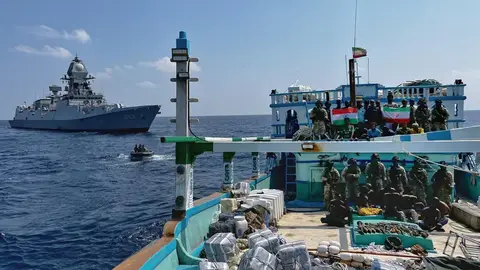
They also agreed to ease information sharing between the Japan Maritime Self-Defense Force (JMSDF) and the Indian Navy.
Special operations forces exchanges to expand
Amid what the ministers called an increasingly complex and uncertain security environment in the Indo-Pacific, they agreed to push multilateral defence cooperation, including trilateral formats, alongside the bilateral track.
They welcomed joint exercises between the services, including the multilateral naval exercise Malabar 2026 with the United States and Australia, and the bilateral JAIMEX26, both held in Japan this month. The two sides will also further advance exchanges between their Special Operations Forces.
COMMENTS
JOIN THE DISCUSSION