

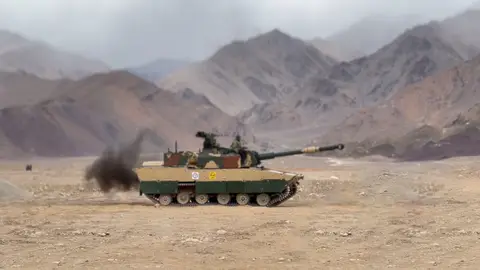
 DEFENCE INDUSTRYTata Zorawar light tank clears Army's L1 hurdle for Rs 20,000 crore contract
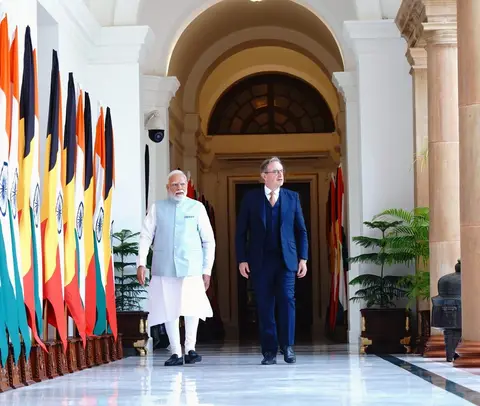 DEFENCE INDUSTRYIndia Belgium Defence Deals Sealed As PM De Wever Visits Delhi
 DEFENCE INDUSTRYAero India 2027 Dates Confirmed for February 8 to 12 in Bengaluru
 DEFENCE INDUSTRYJavelin missile co-production advances as Tata Advanced Systems signs Javelin Joint Venture pact
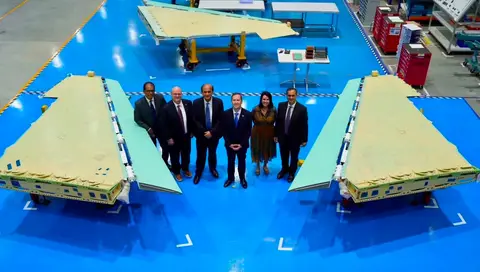 DEFENCE INDUSTRYTata Lockheed Martin MTA push gets a lift from US envoy's Hyderabad visit
Indian Navy Operation Sindoor deployment placed the Carrier Battle Group and submarines forward in the North Arabian Sea in a strong offensive posture, with full readiness and capacity to strike select targets at sea and on land when ordered, the Ministry of Defence's Annual Report 2025-26 said.
The Navy operated as a networked composite force through the deployment, achieving persistent Maritime Domain Awareness across surface, air, space and shore based assets. Its forward presence denied operational space to the adversary and held uncontested control over the seas throughout.
Indian Navy Operation Sindoor deployment is credited with forcing the ceasefire
The sheer threat of overwhelming force from the sea played a vital role in Pakistan requesting an urgent ceasefire on 10 May 2025, the report said. The fleet remained stood to for the length of the campaign, ready at any point to thwart a move by the adversary in the maritime domain.
Naval Special Forces struck terror infrastructure on 6 and 7 May
Indian Navy Special Forces elements armed with precision munitions were part of the strikes on terror infrastructure carried out on the opening night of the operation, 6 and 7 May 2025, the report said, placing the Navy alongside the Air Force in the first wave of the campaign that opened Operation Sindoor, an opening night in which the BrahMos missile also played a part, according to DRDO's own account of the operation.
A role that ran through the full operation
The Navy's account frames the Special Forces action as one part of a continuous posture that held through the operation, from the opening strikes to the ceasefire five days on. A separate account the Indian Air Force has given of the same operation covers the airbase strikes carried out over the days that followed, with the two services' roles recorded as running in parallel, tied together by the Integrated Air Command and Control System that the report credits with holding the wider air picture together.
TROPEX-25 tested the Navy's integrated response ahead of the operation
A validation missile firing by an Indian Navy ship during Operation Sindoor is pictured in the same section of the report, alongside an image from TROPEX-25, the Navy's biennial Theatre Level Operational Readiness Exercise held just weeks earlier. Conducted over three months from January to March 2025 across multiple phases in harbour and at sea, TROPEX-25 brought together ships, submarines, aircraft, Coast Guard vessels, Air Force aircraft and Army troops to validate the Navy's core warfighting skills and its ability to mount a synchronised, integrated response, the kind of readiness the Indian Navy Operation Sindoor deployment then drew on directly when it was called on in the Arabian Sea.
Trishul 2025 closed the year with an amphibious demonstration
A Navy led tri service exercise, Trishul, followed in November 2025 off Gujarat, with more than 60 Navy platforms taking part alongside assets from the Army, Air Force, Coast Guard and Border Security Force. The exercise closed with an amphibious demonstration off Madhavpur Beach, a show of the same tri service coordination the Navy had already demonstrated months earlier through Operation Sindoor and its aftermath, an effort the former Chief of Defence Staff has separately credited to improved jointness and networking across the three forces.
The Navy carried that momentum into its wider partnerships for the year. Guided by the SAGAR vision of Security and Growth for All in the Region, Indian naval ships and aircraft took part in 18 bilateral exercises, eight multilateral exercises, 31 maritime partnership exercises, four Coordinated Patrols and 12 joint Exclusive Economic Zone surveillance exercises through 2025, the Annual Report recorded, work the Indian Navy has framed as establishing it as the preferred security partner across the Indian Ocean Region, a status the Ministry of External Affairs has echoed in its own account of the region's maritime diplomacy.


COMMENTS
JOIN THE DISCUSSION