

 DEFENCE INDUSTRYBrahMos export orders: Vietnam deal worth about $100 million, Indonesia $200 million as Akash reaches Tajikistan, Turkmenistan
 DEFENCE INDUSTRYMahindra Embraer Nagpur facility to assemble C-390 if IAF picks the aircraft
 DEFENCE INDUSTRYSMPP Drone Manufacturing Push: Firm Shifts From Ammunition to Unmanned Warfare, Targets Integrated Defence Capabilities
 INDIA DEFENCEDhruv NG Helicopter Explained: What HAL Has Actually Put Into Pawan Hans Service
 INDIA DEFENCELCA FOC Trainers Delivered With HTT 40 and Dhruv NG as Rajnath Singh Asks Engineers for Technologies That Do Not Exist
When Defence Minister Rajnath Singh chaired an emergency review of West Asia’s deteriorating security situation recently, one question dominated the room: what happens to India’s energy supply if the Strait of Hormuz closes?
The answer, it turns out, was already being prepared at sea.
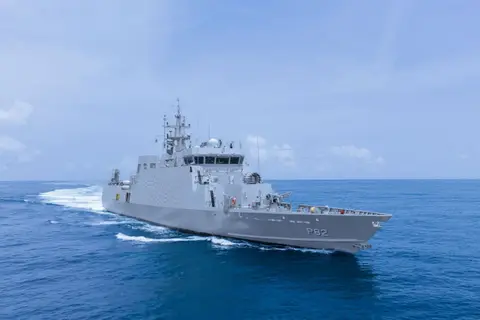
The Indian Navy has deployed multiple frontline warships in and around the Strait of Hormuz under Operation Urja Suraksha, a mission conceived specifically to shield India bound oil and gas shipments from the threat of disruption in one of the world’s most volatile maritime corridors.
A Corridor India Cannot Afford to Lose
Nearly a fifth of the world’s traded oil moves through the 33 kilometre wide Strait that separates Iran and Oman. For India, that statistic is not abstract. The bulk of the country’s crude oil, LNG, and LPG imports pass through Hormuz before reaching Indian shores, making it less a foreign policy concern and more a domestic energy lifeline.
It is precisely that vulnerability that Operation Urja Suraksha was built to address.
The Mission in Numbers
Naval sources say at least 22 India-bound vessels have been earmarked for assisted passage, 20 of them high priority energy carriers, tankers loaded with crude oil, liquefied natural gas, and LPG. Each ship represents not just commercial cargo, but fuel for power plants, cooking gas for households, and feedstock for refineries across the country.
The operation is being run with deliberate restraint. There are no press briefings, no dramatic announcements. Ships move. Escorts hold position. Cargo arrives.
Early Transits Completed
The first visible results are already in. LPG carriers Pine Gas and Jag Vasant, together hauling approximately 92,000 tonnes of cargo, completed their passage through the Strait under naval protection and were due at Indian ports on March 26 and 27.
They were not the first. The Navy had earlier shepherded LPG vessels Shivalik and Nanda Devi through the same waters, along with crude tanker Jag Laadki, a sequence that makes clear this is not a reactive scramble but a planned, rolling escort operation.
Coordinated From Shore to Sea
Behind the naval deployment lies a layered logistics effort. The Ministry of Ports, Shipping and Waterways and the Directorate of Naval Operations are jointly managing vessel routing, real time tracking, and crew safety for every ship operating in the zone. The coordination ensures that if a situation develops, the response chain is already in place rather than being assembled under pressure.
Calibrated, Not Confrontational
What distinguishes Operation Urja Suraksha is its tone. India has not issued warnings, named adversaries, or sought international headlines. The Navy’s presence in the Gulf is large enough to matter, restrained enough to avoid provocation, a posture that reflects both the complexity of India’s relationships in the region and its determination to protect what it cannot leave to chance.
With West Asia showing no clear path toward stability, that presence is unlikely to shrink anytime soon.





COMMENTS
JOIN THE DISCUSSION