

 DEFENCE INDUSTRYBrahMos export orders: Vietnam deal worth about $100 million, Indonesia $200 million as Akash reaches Tajikistan, Turkmenistan
 DEFENCE INDUSTRYMahindra Embraer Nagpur facility to assemble C-390 if IAF picks the aircraft
 DEFENCE INDUSTRYSMPP Drone Manufacturing Push: Firm Shifts From Ammunition to Unmanned Warfare, Targets Integrated Defence Capabilities
 INDIA DEFENCEDhruv NG Helicopter Explained: What HAL Has Actually Put Into Pawan Hans Service
 INDIA DEFENCELCA FOC Trainers Delivered With HTT 40 and Dhruv NG as Rajnath Singh Asks Engineers for Technologies That Do Not Exist
Indian Ocean Region peace rests on India, Rajnath Singh tells the Navy at Visakhapatnam
India stands as the primary guarantor of peace and stability in the Indian Ocean Region, Defence Minister Rajnath Singh told naval personnel at Visakhapatnam on July 10, crediting the Indian Navy with safeguarding the country's maritime interests and keeping the Tricolour flying through an increasingly complicated global security environment.
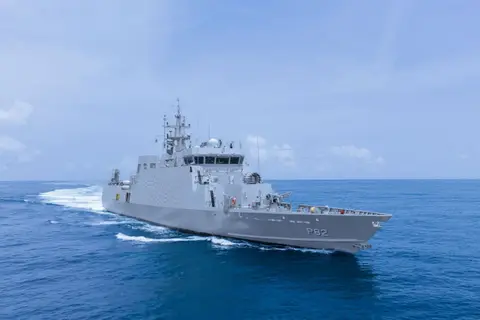
He was speaking at a Barakhana with sailors on the eve of the commissioning of Mahendragiri, the sixth Project 17A indigenous stealth frigate, which joins the fleet at Visakhapatnam on July 11 under the Eastern Naval Command.
Indian Ocean Region is our courtyard, Defence Minister says
The Defence Minister put numbers behind the argument. Over 90 per cent of India's trade by volume moves on maritime routes, he said. Energy security, the Exclusive Economic Zone and the island territories add their own weight, making the sea central to economic growth and national interests. Vigilance on the water, in this telling, is not a service preference but a national requirement.
Growing geopolitical competition and the expanding presence of extra-regional powers have sharpened the need for maritime vigilance, he added. "In such a situation, the Indian Navy is protecting India's maritime borders, securing vital sea lanes and upholding the country's interests across the region," he said.
Then he compressed the whole case into a single line. "The region is our courtyard, and securing the courtyard is our responsibility."
He described India as the largest and most responsible stakeholder in the Indian Ocean Region, restating its commitment to peace, stability and a secure maritime environment, according to the Ministry of Defence release.
Mahendragiri held up as proof of self-reliance
Rajnath Singh called the commissioning of Mahendragiri another shining example of India's growing indigenous defence capability, folding the frigate into the wider Aatmanirbhar Bharat push that has run through the Navy's induction calendar this year, including the tri-commissioning of Dunagiri, Sanshodhak and Agray at Kolkata in June.
Mahendragiri is the fourth and last of the Project 17A ships built at Mazagon Dock in Mumbai. Her sister Dunagiri came from Garden Reach in Kolkata the same summer.
Project 17A is the follow-on to the Shivalik class, seven guided-missile frigates split between the two shipyards with improved stealth shaping, indigenous sensors and a heavier weapons fit. The class has moved through construction at a pace the Navy has been keen to advertise, and each induction has been framed publicly as a marker of shipbuilding capacity as much as of fleet strength.
He credited the valour, commitment and patriotism of the defence forces for protecting the nation, and asked the sailors in front of him to keep upgrading their skills, master cutting-edge technologies and stay prepared for the changing character of modern warfare.
Wars without a declaration
The sharpest passage of the address dealt with what tomorrow's conflict might look like. Warfare is evolving rapidly, the Defence Minister said, and future conflicts could arrive in new and unforeseen forms.
"There are conflicts that are fought without a formal declaration of war. The adversary of tomorrow may not look like the adversary of the past," he said.
The government, he assured the gathering, will leave no stone unturned in providing soldiers with the world's best weaponry, technology and resources. He closed the thought with a caveat of his own. "But weapons alone do not win wars; it is the people who wield them that do."
Physical and mental readiness
He returned twice to the same instruction, urging personnel to remain physically and mentally prepared and to keep pace with emerging technologies rather than wait for doctrine to catch up.
The framing tracks with how the Defence Minister has spoken about grey-zone pressure through the year. The stress on skills over platforms was the connecting thread of the address, delivered to an audience that will man the newest frigate in the fleet within a day.
Navy leadership present at the Barakhana
Chief of the Naval Staff Admiral Krishna Swaminathan, who took charge as the 27th Navy chief in May, attended the address, along with Flag Officer Commanding-in-Chief, Eastern Naval Command Vice Adm Sanjay Bhalla and other senior officers.
https://x.com/SpokespersonMoD/status/2075610063356793018?ref_src=twsrc%5Etfw%7Ctwcamp%5Etweetembed%7Ctwterm%5E2075610063356793018%7Ctwgr%5E664a756258d55cdebea63d00666aa110faa52289%7Ctwcon%5Es1_c10&ref_url=https%3A%2F%2Fpublish.x.com%2F%3Furl%3Dhttps%3A%2F%2Ftwitter.com%2FSpokespersonMoD%2Fstatus%2F2075610063356793018
The Barakhana, a traditional shared meal between commanders and sailors, set an informal stage for a speech that ranged well beyond the next morning's ceremony. The Ministry of Defence released the full text of the remarks on July 10 evening.
Visakhapatnam has carried much of the Navy's eastern seaboard activity this year, and the arrival of a Project 17A frigate at the Eastern Naval Command puts one of the most capable surface combatants in the inventory on the Bay of Bengal side of the map.
Mahendragiri commissions on July 11.
COMMENTS
JOIN THE DISCUSSION