

 DEFENCE INDUSTRYBrahMos export orders: Vietnam deal worth about $100 million, Indonesia $200 million as Akash reaches Tajikistan, Turkmenistan
 DEFENCE INDUSTRYMahindra Embraer Nagpur facility to assemble C-390 if IAF picks the aircraft
 DEFENCE INDUSTRYSMPP Drone Manufacturing Push: Firm Shifts From Ammunition to Unmanned Warfare, Targets Integrated Defence Capabilities
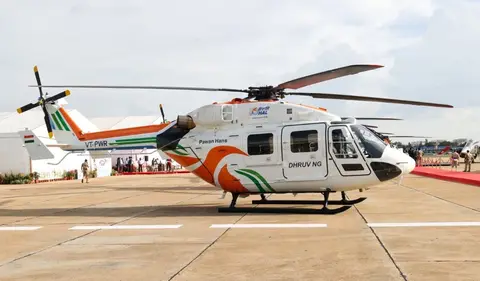 INDIA DEFENCEDhruv NG Helicopter Explained: What HAL Has Actually Put Into Pawan Hans Service
 INDIA DEFENCELCA FOC Trainers Delivered With HTT 40 and Dhruv NG as Rajnath Singh Asks Engineers for Technologies That Do Not Exist
The Indian Air Force has formally initiated work on the Vayu Baan helicopter drone IAF programme, marking India’s first indigenous effort to develop an air-launched unmanned aerial system for both surveillance and precision strike roles. The move is not incremental. It signals a structural rethink of how India intends to employ rotary-wing assets in contested airspace, keeping helicopter crews survivable while pushing their offensive reach well beyond the range of ground-based air defence threats.
What the Vayu Baan Helicopter Drone IAF System Is Designed to Do
The name Vayu Baan translates to “air arrow” in Sanskrit. The programme lives up to that billing.
Once released from a helicopter’s door or hatch during flight, the drone is designed to stabilise itself, deploy folded wings, and transition into guided forward flight within seconds of release. Operators can then control the system from the launching helicopter or from a ground control station, depending on mission conditions and communication availability.
That dual-control architecture matters more than it might appear. In a time-sensitive strike scenario, routing targeting decisions through a remote ground station adds latency. Giving the airborne crew direct control over the drone removes that delay entirely, which in a live engagement environment is the difference between a prosecuted target and a missed window.
The system is also configured for GPS-denied operations, a requirement that reflects how seriously Indian defence planners are now treating electronic warfare threats on the modern battlefield.
Capability Breakdown: What Vayu Baan Brings to the Battlefield
Five capabilities define the Vayu Baan system based on available programme details.
Air-launch compatibility with existing helicopter platforms, requiring minimal structural modification to the parent aircraft. Dual-role configuration covering both ISR collection and direct strike in a single airframe, which means a crew can gather intelligence and act on it within the same sortie without switching assets. Real-time video transmission to operators for target confirmation before any engagement decision is made. Autonomous navigation in GPS-denied environments. And electro-optical and infrared sensors for all-weather, day-night target identification, with the option to carry a small precision warhead depending on mission requirements.
That last point carries a caveat the source material is careful to include: warhead carriage is listed as mission-dependent, not confirmed as a standard fit across all configurations.
Short version: Vayu Baan is a stand-off system, not a close-combat one. Its entire design logic is about keeping the helicopter outside the threat envelope.
Why the IAF Is Developing This Now
Drones have not just changed the battlefield. They have changed what militaries believe is possible with relatively modest platforms at relatively modest cost. Analysts tracking conflicts in recent years have consistently noted that expendable, precision-capable unmanned systems fielded in numbers have repeatedly outperformed expectations against conventionally superior forces.
The IAF has drawn its own conclusions from those lessons.
Helicopters already operate in low-altitude, high-threat environments where man-portable air defence systems and radar-guided weapons present constant crew risk. A drone that can be released outside that threat envelope and guided onto a target without exposing the aircraft solves a tactical problem the IAF has carried for years. The Vayu Baan helicopter drone IAF programme is the institutional response to that problem.
The programme is being led through the IAF’s internal design and development framework rather than through a traditional external procurement route. That choice reflects both urgency and institutional confidence. The IAF is not waiting for a vendor. It is building this itself.
Where Vayu Baan Sits in India’s Broader Unmanned Systems Push
India’s unmanned systems portfolio has expanded substantially over the past decade. Indigenous MALE drone development, stealth UCAV research, and strategic-level drone acquisitions are all advancing in parallel tracks across DRDO and the armed services. Vayu Baan occupies a distinct niche within that landscape: helicopter-integrated, tactically oriented, and designed for the close-to-medium range operational environment rather than the long-range strategic surveillance role.
The distinction matters because it fills a gap. Long-endurance drones operate at altitude and at range. Vayu Baan operates at the tip of the spear, alongside the rotary-wing platforms that fly the IAF’s most kinetically demanding missions. That integration, if successfully demonstrated, gives frontline units a force multiplier that does not require an entirely new aircraft type to enter service before it becomes available.
It also fits squarely within the government’s Make in India framework for defence production. An indigenously developed, IAF-led helicopter drone programme carries significant industrial and strategic signalling value, not just for the capability it delivers but for what it demonstrates about the maturity of India’s internal defence engineering base.
What Comes Next for the Vayu Baan Programme
The programme is early stage. Prototypes and initial testing are expected in the near term, though no formal induction timeline has been announced.
What is notable is the pace at which the IAF has moved to initiate the project internally. The absence of a traditional Request for Proposal process, and the decision to develop the system within the IAF’s own design framework, suggests the service is treating Vayu Baan as a priority rather than a long-cycle procurement exercise.
If the programme reaches operational induction, India joins a small group of nations working on helicopter-launched unmanned combat systems. That group is small not because the concept lacks merit but because it demands a specific combination of miniaturisation, autonomous systems engineering, and rotary-wing integration that relatively few defence industries have yet managed at scale. India developing this indigenously would be a meaningful marker of how far domestic defence engineering has travelled.
The Vayu Baan helicopter drone IAF programme is, at its core, about one thing: putting Indian helicopter crews in a position to prosecute targets without being prosecuted themselves. That is a straightforward operational requirement. The fact that India is now building the answer domestically is the part worth paying attention to.
FAQ SECTION
Q1: What is the Vayu Baan drone programme? Vayu Baan is India’s first helicopter-launched unmanned aerial system, being developed by the Indian Air Force for stand-off ISR and precision strike operations. Once released mid-flight, the drone deploys wings, stabilises, and can be controlled from the helicopter or a ground station.
Q2: Which helicopters will carry the Vayu Baan drone? The IAF has not officially confirmed which rotary-wing platforms will serve as launch hosts. The system is being designed for compatibility with IAF helicopter platforms currently in service, with minimal structural modification required.






COMMENTS
JOIN THE DISCUSSION