
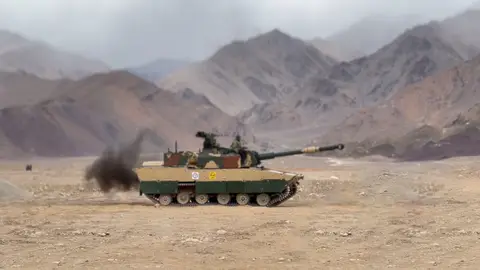
 DEFENCE INDUSTRYTata Zorawar light tank clears Army's L1 hurdle for Rs 20,000 crore contract
 DEFENCE INDUSTRYIndia Belgium Defence Deals Sealed As PM De Wever Visits Delhi
 DEFENCE INDUSTRYAero India 2027 Dates Confirmed for February 8 to 12 in Bengaluru
 DEFENCE INDUSTRYJavelin missile co-production advances as Tata Advanced Systems signs Javelin Joint Venture pact
 DEFENCE INDUSTRYTata Lockheed Martin MTA push gets a lift from US envoy's Hyderabad visit
The Indian Navy's submarine arm combines conventional diesel-electric attack submarines with indigenously built nuclear-powered ballistic missile submarines, giving India both an underwater strike force and the sea-based leg of its nuclear triad. The fleet spans three generations of imported and locally built designs alongside the newer Arihant-class, and traces its origins to the commissioning of India's first submarine, the Foxtrot-class INS Kalvari, in 1968.
Key facts
- Kalvari-class (Project 75): six French-designed Scorpene submarines built by Mazagon Dock, commissioned 2017-2025
- Sindhughosh-class: Russian-origin Kilo-class (Project 877) boats in service since the late 1980s
- Shishumar-class: German Type 209 design submarines, built with technology transfer from HDW
- Arihant-class: indigenous nuclear-powered ballistic missile submarines (SSBNs), led by INS Arihant
- Project 75I: planned next-generation conventional submarines with air-independent propulsion
Kalvari-class (Project 75)
Built under Project 75 with French collaboration, the Kalvari-class is an Indian-built version of the Scorpene design, constructed at Mazagon Dock Limited in Mumbai. The six boats, INS Kalvari, INS Khanderi, INS Karanj, INS Vela, INS Vagir and INS Vagsheer, were commissioned between December 2017 and January 2025. Known for a low acoustic signature, the class is armed with heavyweight torpedoes and anti-ship missiles and can be used for anti-surface and anti-submarine warfare, intelligence gathering and mine-laying, though it does not yet feature air-independent propulsion. Each boat displaces around 1,600 tonnes submerged and can dive to depths beyond 300 metres, and later boats in the class have incorporated incremental upgrades to sonar, combat management and land-attack missile fit compared with the lead vessel.
Sindhughosh and Shishumar classes
The Navy's older conventional boats remain in service alongside the newer Kalvari-class. The Sindhughosh-class comprises Kilo-class (Project 877) diesel-electric submarines acquired from Russia from the late 1980s onward, valued for their heavy torpedo and missile armament, while the four-strong Shishumar-class is an Indian-built variant of the German Type 209 design, commissioned between 1986 and 1994. The Sindhughosh boats displace around 3,000 tonnes and carry a crew of roughly 53, while the smaller Shishumar-class boats, built partly by HDW in Germany and partly by Mazagon Dock under technology transfer, displace around 1,850 tonnes submerged. Both classes have undergone periodic refits and life-extension programmes, including new sonars, combat systems and, in some cases, land-attack missile capability, to keep them operationally relevant as the Navy phases in newer boats.
Arihant-class and the future fleet
The Arihant-class represents India's indigenous nuclear-powered ballistic missile submarine programme, developed to complete the sea leg of the country's nuclear triad. Lead vessel INS Arihant, displacing around 6,000 tonnes submerged and powered by an indigenous pressurised water reactor, was commissioned in 2016, followed by the near-identical INS Arighaat in 2024, with further boats under construction at the Shipbuilding Centre in Visakhapatnam to expand the class. These submarines, armed with nuclear-capable submarine-launched ballistic missiles such as the short-range K-15 and longer-range K-4, are built and operated separately from the conventional attack fleet under close naval and strategic command oversight, and their patrols form the least vulnerable, continuously available leg of India's nuclear deterrent. Looking ahead, the Navy is pursuing Project 75I, a follow-on conventional submarine programme, likely involving an Indian shipyard partnered with a foreign original equipment manufacturer, intended to introduce air-independent propulsion for longer submerged endurance, alongside longer-term plans for a separate class of indigenous nuclear-powered attack submarines optimised for hunting enemy warships and submarines rather than strategic deterrence.
Together, these classes give India a layered underwater capability, from coastal anti-submarine patrols to strategic deterrence patrols far from home waters, and submarine modernisation remains one of the Navy's most closely watched long-term procurement priorities.