

 MINISTRY OF DEFENCEBDL single tender for anti-tank missile sights goes to firm set up by former CMD Siddharth Mishra
 DEFENCE INDUSTRYBrahMos export orders: Vietnam deal worth about $100 million, Indonesia $200 million as Akash reaches Tajikistan, Turkmenistan
 DEFENCE INDUSTRYMahindra Embraer Nagpur facility to assemble C-390 if IAF picks the aircraft
 DEFENCE INDUSTRYSMPP Drone Manufacturing Push: Firm Shifts From Ammunition to Unmanned Warfare, Targets Integrated Defence Capabilities
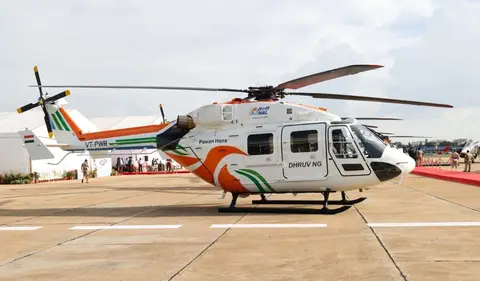 INDIA DEFENCEDhruv NG Helicopter Explained: What HAL Has Actually Put Into Pawan Hans Service
Aatmanirbharta 2.0 in defence should deliver state-of-the-art technology and supply chains that hold up under pressure, Defence Minister Rajnath Singh said on Monday, calling it the next step after the first phase of self-reliance. He was speaking at the plenary session of Swavlamban 2026, the Indian Navy's fifth Naval Innovation and Indigenisation Seminar, at the Manekshaw Centre in New Delhi.
Chief of Defence Staff General NS Raja Subramani, Chief of the Army Staff General Dhiraj Seth and Chief of the Naval Staff Admiral Krishna Swaminathan were on the dais.
Aatmanirbharta 2.0 in defence moves past numbers
According to the Ministry of Defence, Singh said the country had made steady gains in the first phase of self-reliance over the last decade, and that this progress now gives the sector a strong base. Under Aatmanirbharta 2.0 in defence, he said, the focus must move beyond the number of indigenous products to their quality, efficiency and affordability. Output should be top-end and state-of-the-art, and should meet operational requirements in a larger way.
Defence innovators with long-term vision and scientific discipline could act as 'impact players' in chasing harder technology goals, he said.
Indian-made products, the Defence Minister added, must be cost-effective, operationally superior and globally competitive. Self-reliance should strengthen economic resilience as well as national security. He linked the effort to the vision of Viksit Bharat@2047, and asked for stronger research and development, lower import dependence and technological superiority.
A roadmap with timelines for every item
Singh called for a dynamic roadmap. It should set a clear timeline for self-reliance in each item, name the technologies to be developed and the industries expected to lead them, and spell out the resources required.
Buffer stocks and production capacity to be assessed in advance
Supply chain management is not just a technical matter but a strategic one, tied directly to national security, the Defence Minister said. He asked that buffer stocks and domestic production capacity be assessed well ahead of time, so the country is ready for any disruption in supply routes instead of reacting once a crisis arrives.
On shipbuilding, he noted that demand for naval ships is rising steadily with the changing situation in the Indian Ocean Region. Warships are capital-intensive to build, he said, so ways must be found to bring down costs while domestic production expands.
Research and development is at the heart of all this, Singh said.
He said he was confident that India's talent pool could develop cutting-edge technology at home with sustained focus and investment. He called for a deeper research culture through closer industry-academia ties, more encouragement in educational institutions and more career openings in research and development for young people.
Navy leadership calls for faster innovation to integration
Admiral Krishna Swaminathan, addressing the plenary, called for faster conversion of innovation into operational capability and urged all stakeholders to stay ahead of the technology curve. Artificial intelligence and autonomous systems should be used to build naval capability, he said.
At the inaugural ceremony earlier in the day, Vice Chief of the Naval Staff Vice Admiral Ajay Kochhar pushed for a shorter cycle from innovation to integration. He pointed to recent conflicts, short and long, including the one in Ukraine, where drone production has grown many times over in the last few years. Artificial intelligence, autonomous systems and cyber capabilities are changing the character of warfare, he said, adding that "a technological advantage can be short-lived".
Vice Admiral Kochhar said the seminar would strengthen existing partnerships and open new areas of collaboration.
Sanjeev Kumar, Secretary (Defence Production) in the Ministry of Defence, urged industry, the Services and research institutions to work together for greater self-reliance in defence.
Swavlamban 2026 continues on Tuesday
The two-day seminar is organised by the Indian Navy with the Defence Innovation Organisation (DIO) and the Society of Indian Defence Manufacturers (SIDM), under the theme Strength and Power through Innovation and Indigenisation. Sessions cover quantum technologies, artificial intelligence, autonomous systems and hypersonic technologies, with a focus on their use in future naval operations.
The exhibition covers maritime surveillance, counter-UAS, artificial intelligence and quantum, NBCD, and safety and efficiency enhancers.
According to the Navy, the plenary programme included felicitation of industry partners by the Defence Minister and the release of the Swavlamban 5.0 document and the Compendium on Technology Imperatives. NAUSETU interface standards for naval systems were also listed for release during the seminar.
Swavlamban held its maiden edition in July 2022. Participation grew from around 800 in the first edition to nearly 3,000 last year, and more than 100 stalls were expected at this edition. At the previous edition in November 2025, Singh had urged private industry to adopt a profit-plus approach that combines financial returns with national interest.
COMMENTS
JOIN THE DISCUSSION