

 MINISTRY OF DEFENCEBDL single tender for anti-tank missile sights goes to firm set up by former CMD Siddharth Mishra
 DEFENCE INDUSTRYBrahMos export orders: Vietnam deal worth about $100 million, Indonesia $200 million as Akash reaches Tajikistan, Turkmenistan
 DEFENCE INDUSTRYMahindra Embraer Nagpur facility to assemble C-390 if IAF picks the aircraft
 DEFENCE INDUSTRYSMPP Drone Manufacturing Push: Firm Shifts From Ammunition to Unmanned Warfare, Targets Integrated Defence Capabilities
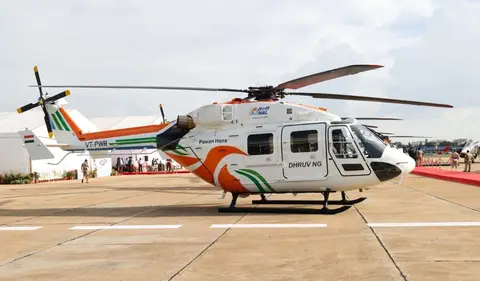 INDIA DEFENCEDhruv NG Helicopter Explained: What HAL Has Actually Put Into Pawan Hans Service
The Swavlamban 2026 seminar, the fifth edition of the Indian Navy's flagship event on innovation and indigenisation, will be held at the Manekshaw Centre in New Delhi on October 26 and 27. Vice Admiral Ajay Kochhar, Vice Chief of the Naval Staff (VCNS), set out the agenda at a curtain raiser press conference on Monday, and also gave a fresh figure on the Navy's escort mission in West Asia.
Under Operation Urja Suraksha, the Navy has escorted merchant ships carrying cargo worth around Rs 16,000 crore through West Asia and the Arabian Sea, the Vice Chief said.
Operation Urja Suraksha escorts Rs 16,000 crore of cargo
The operation was launched in March, after the war in West Asia disrupted shipping around the Strait of Hormuz. Navy warships have provided escort, navigational guidance and layered protection to India-bound vessels, with the focus on energy shipments and other critical supplies. Vice Admiral Kochhar said the crises in the region have kept the force "engaged thinking and deployment wise."
The operation was among the themes of the Naval Commanders Conference at Nausena Bhawan last month. Addressing the commanders, Defence Minister Rajnath Singh called the safe passage of Indian-flagged merchant vessels, particularly LPG tankers, through the Strait of Hormuz an outstanding achievement.
Swavlamban 2026 seminar to showcase indigenous success stories
According to the Ministry of Defence, the Swavlamban 2026 seminar will bring together innovators, industry partners, start-ups, MSMEs, academia, investors and the Defence Forces to work on solutions for emerging maritime security challenges. The exhibition will display indigenous innovations that have already become success stories. These cover maritime surveillance, counter-unmanned aerial systems (counter-UAS), artificial intelligence and quantum, nuclear, biological and chemical defence (NBCD), and safety and efficiency enhancers.
"Swavlamban is the Indian Navy's flagship programme for innovation and indigenisation," Vice Admiral Kochhar said. "As the Navy prepares for its fifth edition, our objective remains to bring India's technological talent and capabilities closer to the Navy's operational needs and translate indigenous innovation into practical capabilities at sea."
The event has grown with each edition. The first drew around 800 participants and nearly 3,000 attended last year, he said. This year's exhibition will have more than 100 stalls.
Sessions with venture capitalists and investors will take up funding, the scaling up of promising enterprises and the commercialisation of indigenous technologies. A panel with SMEs will discuss self-reliance and ways to strengthen the Innovation for Defence Excellence (iDEX) ecosystem, build resilient supply chains and encourage academic entrepreneurship. The deliberations will also look at the hurdles in taking ideas forward, including vulnerabilities in cyber security and supply chains, and at better access to funding for development and production.
Over 4,000 iDEX proposals and Rs 1,900 crore in contracts
More than 4,000 proposals have come in from Indian innovators through the iDEX framework, with around 150 MSMEs and start-ups taking part, the Vice Chief said. Acceptance of Necessity (AoN) has been accorded for projects worth more than Rs 3,500 crore, and contracts worth over Rs 1,900 crore have been concluded.
Both figures have moved up in a year. At last year's curtain raiser, the then Vice Chief, Vice Admiral Sanjay Vatsayan, had put AoNs at over Rs 2,700 crore and contracts at nearly Rs 1,500 crore, according to reports at the time.
The problems on the table are harder too. Current challenges include quantum positioning systems, high-power microwave directed-energy systems, an extra-large autonomous underwater vehicle and indigenous ramjet engines for fixed-wing aerial platforms.
Speed and spiral development set as priorities
Vice Admiral Kochhar named speed and spiral development as the two priorities for the next phase. Speed means quicker routes for a promising idea to move from concept and prototype to testing, production and operational deployment. Spiral development means improving a system in steps, using user feedback, lessons from trials and new technology at each stage. "Technology does not stand still, and neither should the capabilities we develop," he said.
He urged industry and academia to bring forward disruptive solutions grounded in operational understanding, backed by sound engineering and reliable delivery.
42 platforms on order, RFP issued for four LPDs
On the wider modernisation drive, the Vice Chief said 42 platforms are on order. Another 78 platforms and 120 fast interceptor craft, worth around Rs 2.41 lakh crore, have been accorded AoN, and the procurement process for them is at different stages. Among recent additions, the anti-submarine warfare shallow water craft INS Mangrol, was commissioned in Mumbai on 12 October.
The request for proposal (RFP) for four landing platform docks (LPDs) was issued to shortlisted shipyards last week, he said. The RFP for the next generation frigate went out a couple of weeks ago, and responses are awaited.
Propulsion is part of the push. The Navy has started programmes under the Make category of the Defence Acquisition Procedure to develop an indigenous diesel engine, and has received AoN under the same route for a 24 to 28 megawatt marine gas turbine, including gas turbine generators. MoUs have been signed to bring in electric propulsion, with government approvals in place, the Vice Chief added.
The Navy is pursuing development across air, sea, underwater, cyber and space, along with new technologies, under its Maritime Capability Perspective Plan. "All of this also has to be inducted and included on our platforms and in our navy so that we become a multi-dimensional, networked force capable of multi-domain operations," Vice Admiral Kochhar said.
He thanked the government, the Ministry of Defence, the Society of Indian Defence Manufacturers (SIDM) and the Defence Innovation Organisation for backing what he called a whole-of-nation effort towards a truly Aatmanirbhar Navy. Their support, he said, has let each edition build on the last and widen participation.
Three documents will be released at the seminar: the Swavlamban 5.0 Document, the Compendium on Technology Imperatives and the Naval Unified Systems, Ethernet and Tactical Utilisation (NAUSETU) Interface Standards.

COMMENTS
JOIN THE DISCUSSION