

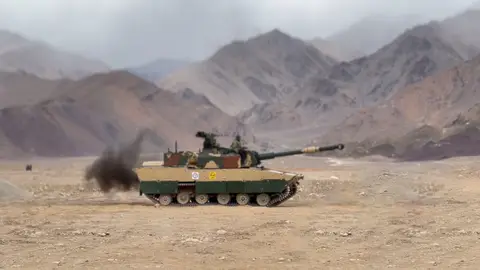
 DEFENCE INDUSTRYTata Zorawar light tank clears Army's L1 hurdle for Rs 20,000 crore contract
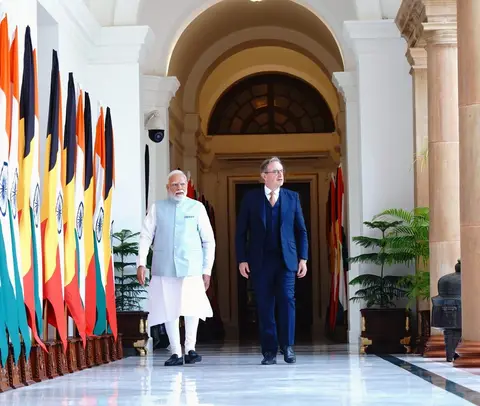 DEFENCE INDUSTRYIndia Belgium Defence Deals Sealed As PM De Wever Visits Delhi
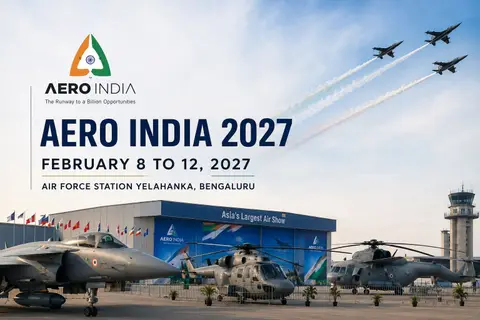 DEFENCE INDUSTRYAero India 2027 Dates Confirmed for February 8 to 12 in Bengaluru
 DEFENCE INDUSTRYJavelin missile co-production advances as Tata Advanced Systems signs Javelin Joint Venture pact
 DEFENCE INDUSTRYTata Lockheed Martin MTA push gets a lift from US envoy's Hyderabad visit
France has indicated that it remains open to India's participation in the Future Combat Air System (FCAS), Europe's flagship sixth-generation fighter programme, in a development that could add a significant new dimension to the growing India-France strategic partnership.
The signal comes just days before Prime Minister Narendra Modi's visit to France for the G7 Summit, where discussions with French President Emmanuel Macron are expected to cover a range of strategic issues, including defence cooperation, advanced technologies and industrial collaboration.
Responding to questions regarding India's potential involvement in FCAS, French diplomatic sources stated that "everything is open," while emphasising that any formal process would require New Delhi to present a concrete proposal. While the comments stop short of an invitation, they indicate that Paris is willing to consider a larger Indian role in one of Europe's most ambitious defence technology programmes.
India Has Already Expressed Interest in FCAS
India's interest in joining the FCAS framework was formally conveyed during the 6th India-France Annual Defence Dialogue held in Bengaluru earlier this year.
During the dialogue, Defence Minister Rajnath Singh discussed the possibility of Indian participation with France's Minister of the Armed Forces and Veterans Affairs. According to official sources, India expressed its willingness to explore opportunities for co-development and co-manufacturing under the FCAS framework, reflecting New Delhi's broader push for technology partnerships rather than traditional buyer-seller defence relationships.
French officials have increasingly described the bilateral defence partnership as entering a new phase focused on industrial collaboration, advanced technologies and joint development projects. The FCAS conversation appears to fit naturally into that evolving framework.
What Is the FCAS Programme?
Launched jointly by France and Germany in 2017, with Spain joining in 2019, the Future Combat Air System is designed to create a next-generation air combat ecosystem centred around a sixth-generation fighter aircraft.
Unlike conventional fighter programmes, FCAS is intended to operate as a fully networked combat architecture. The project includes advanced sensors, artificial intelligence-enabled systems, unmanned collaborative combat aircraft, secure data-sharing networks and a combat cloud capable of connecting multiple platforms in real time.
The programme is led by France's Dassault Aviation, Germany's Airbus Defence and Space, and Spain's Indra. Together, the three countries are investing in technologies expected to define aerial warfare in the decades ahead.
The ambition behind FCAS extends well beyond a new fighter aircraft. The concept envisions manned and unmanned platforms operating together in a highly connected battlespace, supported by AI-assisted decision-making and real-time information sharing. It is regarded as one of the most technologically advanced defence development efforts currently underway anywhere in the world.
Why FCAS Matters for India
For India, participation in FCAS would represent a significant leap beyond traditional defence procurement and licensed production arrangements.
The opportunity aligns closely with the government's Aatmanirbhar Bharat vision and its efforts to strengthen indigenous aerospace capabilities through technology partnerships and collaborative development programmes.
India is already pursuing its own Advanced Medium Combat Aircraft (AMCA) programme in partnership with Hindustan Aeronautics Limited and the Defence Research and Development Organisation. While the AMCA project is expected to significantly enhance India's aerospace capabilities, collaboration with FCAS could provide exposure to emerging technologies in areas such as advanced propulsion, low-observable materials, artificial intelligence, networking and integrated avionics.
Such cooperation could potentially accelerate capability development while also providing Indian industry and research institutions access to cutting-edge aerospace ecosystems.
Rafale Partnership Provides a Strong Foundation
India and France already share one of the deepest defence relationships among India's major strategic partners.
The Indian Air Force operates 36 Rafale fighter aircraft acquired from Dassault Aviation, while the government has approved the procurement of 26 Rafale Marine fighters for the Indian Navy.
These programmes have established extensive cooperation between Indian and French defence industries and have helped build confidence in long-term technology partnerships. That existing relationship could provide a practical foundation for exploring more ambitious projects such as FCAS.
The Dassault Aviation Rafale programme has included industrial cooperation and technology transfer arrangements with Indian partners, creating a track record on which both countries can build.
Strategic and Industrial Considerations
Despite the potential benefits, participation in a programme as complex as FCAS would require careful evaluation.
The technological, financial and industrial commitments associated with sixth-generation fighter development are substantial. India would need to determine the specific technology domains in which it could contribute, the scale of industrial participation it seeks, and the framework governing intellectual property rights, workshare arrangements and technology access.
The geopolitical dimension would also require careful handling. India maintains defence partnerships with the United States, Russia, Israel and several European nations. Any participation in a programme of FCAS' scale would inevitably be assessed in the context of New Delhi's broader strategic relationships.
At the same time, France has consistently demonstrated a willingness to engage India on technology transfer, industrial participation and joint development initiatives. The India-France strategic partnership, established in 1998, has steadily expanded across defence, space, maritime security and civil nuclear cooperation.
Focus Shifts to Modi-Macron Meeting
Prime Minister Modi's upcoming meeting with President Macron at the G7 Summit could provide an opportunity for both sides to take the discussion forward.
Whether the leaders decide to initiate a structured exploratory process or simply maintain diplomatic momentum remains to be seen. However, France's message is clear: the door is open, but India will need to take the next step.
Any formal proposal would likely require detailed consultations involving the Ministry of Defence, DRDO, Hindustan Aeronautics Limited, the armed forces and the Ministry of External Affairs to determine the scope and objectives of potential participation.
The FCAS programme's official framework emphasises industrial and technological contributions from participating nations rather than purely financial involvement. This means India would need to identify specific areas where its aerospace industry and research institutions could add value to the programme.
If discussions eventually progress beyond the exploratory stage, FCAS could become one of the most consequential defence technology collaborations ever considered by India. More than a fighter aircraft programme, FCAS represents the future architecture of air combat, making any Indian role in the project strategically significant for decades to come.


COMMENTS
JOIN THE DISCUSSION