

 DEFENCE INDUSTRYBrahMos export orders: Vietnam deal worth about $100 million, Indonesia $200 million as Akash reaches Tajikistan, Turkmenistan
 DEFENCE INDUSTRYMahindra Embraer Nagpur facility to assemble C-390 if IAF picks the aircraft
 DEFENCE INDUSTRYSMPP Drone Manufacturing Push: Firm Shifts From Ammunition to Unmanned Warfare, Targets Integrated Defence Capabilities
 INDIA DEFENCEDhruv NG Helicopter Explained: What HAL Has Actually Put Into Pawan Hans Service
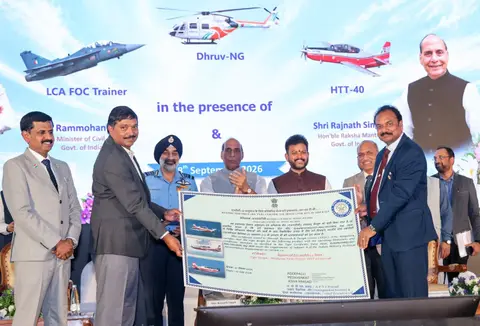 INDIA DEFENCELCA FOC Trainers Delivered With HTT 40 and Dhruv NG as Rajnath Singh Asks Engineers for Technologies That Do Not Exist
Ex Dweep Shakti 2026 has delivered a clear demonstration of India’s integrated warfighting capability, as the Andaman and Nicobar Command (ANC) executed a large-scale joint military exercise spanning land, sea and air domains across the strategically vital island chain. Held at Sri Vijaya Puram on 29 March, the drill brought together the Indian Army, Indian Navy, Indian Air Force and Indian Coast Guard, with troops and formations mobilised from across the country.
The exercise comes at a time when India’s focus on theatre-level jointness has moved from policy commitment to operational reality, and the ANC continues to position itself as the primary guarantor of India’s maritime frontiers in the Indo-Pacific.
What Ex Dweep Shakti 2026 Set Out to Achieve
The stated objectives of the exercise were threefold: sharpening India’s multi-domain warfighting capabilities, refining Standard Operating Procedures (SOPs) across all participating services, and improving interoperability among the Army, Navy, Air Force and Coast Guard in a contested island environment.
These are not abstract goals. The Andaman and Nicobar archipelago sits astride some of the world’s most critical sea lanes. India’s focus on exercising these waterways has been consistent, as seen in the recently concluded IMEX TTX 2026 at Kochi, where the Indian Navy led a critical multilateral maritime security table-top exercise. Over 94,000 merchant vessels transit the adjacent waters annually, carrying an estimated 40 percent of global freight trade. Securing these routes is a core national interest, and exercises of this scale are how that security is operationally validated.
All components of the ANC participated, including Special Forces units drawn from the three services. The scope and reach of the drill underlined the command’s ability to integrate diverse force elements under a single operational framework at short notice.
Tri-Service Integration at the Core of Ex Dweep Shakti 2026
The defining feature of Ex Dweep Shakti 2026 was the coordinated deployment of Army, Navy and Air Force assets across the island chain, backed by synchronised logistics and operational support mechanisms. This is precisely the kind of joint architecture that India’s theatre command model is designed to institutionalise, and the ANC, as India’s only integrated tri-service command, remains its most advanced test bed.
Realistic, multi-domain combat scenarios were simulated across land, sea and air. The exercise validated rapid response capability, assessed command coordination under operational conditions, and stress-tested the logistical pipelines that sustain joint operations in a geographically dispersed island environment.
The inclusion of Special Forces in the drill added a precision-strike and unconventional operations dimension. Their participation confirmed that Ex Dweep Shakti 2026 was designed not merely as a procedural validation but as a genuine warfighting rehearsal across the full spectrum of operational contingencies. India’s Special Forces integration into joint exercises also gains new relevance as platforms like the Ghatak stealth drone come closer to operational induction, opening new strike options for precisely the kind of island-chain scenarios rehearsed in exercises like this one.
Civil-Military Synergy and the Andaman Administration
A notable feature of the exercise was the close coordination extended to the civil administration of the Andaman and Nicobar Islands. This civil-military integration is a practised element of ANC operations and reflects a mature understanding of how complex operations in island territories unfold. Civilian infrastructure, communications and administrative mechanisms all play supporting roles in real-world contingencies, and embedding civil coordination into exercise planning ensures those links are tested and functional.
This approach aligns with broader Indian defence policy that treats civil-military synergy not as a secondary consideration but as an operational enabler. The ANC’s consistent practice of this coordination model strengthens the overall security architecture of the union territory.
CINCAN’s Assessment and the Operational Verdict
Vice Admiral Ajay Kochhar, PVSM, AVSM, NM, Commander-in-Chief, Andaman and Nicobar Command (CINCAN), personally observed the exercise. He commended the participating troops for their professionalism and the seamless execution of complex joint operations across the island chain.
His assessment carries weight. CINCAN’s direct oversight of the drill signals the command-level seriousness attached to Ex Dweep Shakti 2026 and the operational standards demanded of participating formations. It also reflects the ANC’s doctrine of leadership visibility during high-intensity exercises, a practice that reinforces command accountability and operational clarity at every echelon.
India’s Indo-Pacific Posture and the ANC’s Strategic Role
The Andaman and Nicobar Command was established in 2001 as India’s first and only integrated tri-service command, built around the recognition that the archipelago’s geostrategic position required a dedicated, permanently joint force. Over two decades later, that founding logic has only grown stronger.
The islands sit at the entrance to the Strait of Malacca and command the Six Degree Channel, through which all maritime traffic from Southeast Asia and the Pacific must pass before entering Indian Ocean waters. India’s ability to monitor, control and if necessary interdict these approaches is a cornerstone of its Indo-Pacific strategy. This strategy extends well beyond the ANC. The Indian Navy’s IOS SAGAR harbour training phase at Kochi reflects the same push to build partner-nation capacity and deepen India’s reach across the Indian Ocean Region.
Ex Dweep Shakti 2026 reinforces that posture with concrete operational evidence. It signals to regional partners and potential adversaries alike that the ANC maintains a credible, ready and rapidly deployable joint force capable of dominating the maritime and air space around the island chain.
Conclusion: A Command That Delivers
Ex Dweep Shakti 2026 is more than an annual drill. It is a statement of operational intent. As India continues to build out its theatre command architecture and invest in jointness across the armed forces, exercises of this kind provide the empirical foundation that doctrine alone cannot. The ANC has demonstrated, once again, that India’s eastern maritime frontier is defended not just by geography, but by a force that trains to fight and is ready to do so.
The exercise also serves as a timely reminder that India’s commitment to stability, security and freedom of navigation in the Indo-Pacific is backed by a military that prepares rigorously and operates as one.
COMMENTS
JOIN THE DISCUSSION