

 DEFENCE INDUSTRYBrahMos export orders: Vietnam deal worth about $100 million, Indonesia $200 million as Akash reaches Tajikistan, Turkmenistan
 DEFENCE INDUSTRYMahindra Embraer Nagpur facility to assemble C-390 if IAF picks the aircraft
 DEFENCE INDUSTRYSMPP Drone Manufacturing Push: Firm Shifts From Ammunition to Unmanned Warfare, Targets Integrated Defence Capabilities
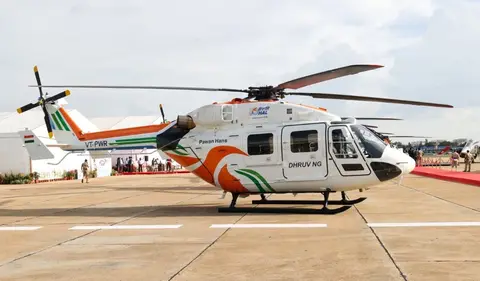 INDIA DEFENCEDhruv NG Helicopter Explained: What HAL Has Actually Put Into Pawan Hans Service
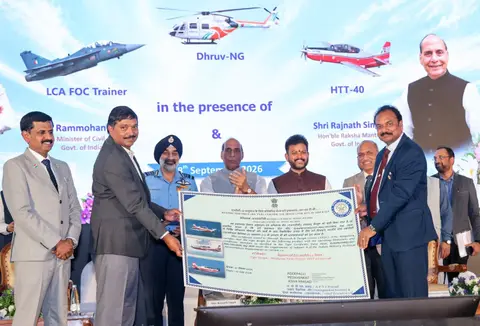 INDIA DEFENCELCA FOC Trainers Delivered With HTT 40 and Dhruv NG as Rajnath Singh Asks Engineers for Technologies That Do Not Exist
Garden Reach Shipbuilders and Engineers Ltd. executed a landmark GRSE warship delivery on March 30, 2026, handing over three commissioned naval platforms — INS Dunagiri, INS Sanshodhak, and INS Agray — to the Indian Navy in a simultaneous ceremony at Kolkata. The concurrent induction of a stealth frigate, a hydrographic survey vessel, and an anti-submarine warfare craft in a single event is unprecedented in the shipyard’s history, and stands as one of the most significant milestones in India’s indigenous defence manufacturing calendar.
The delivery aligns squarely with the Government of India’s Aatmanirbhar Bharat vision, demonstrating that domestic shipbuilding has matured well beyond aspiration into reliable, schedule-driven execution.
A Historic First for GRSE and Indian Shipbuilding
GRSE has now delivered 118 warships since its founding, with 80 of those commissioned into the Indian Navy. Monday’s triple handover pushes that tally further and sets a new benchmark for concurrent production management at a public sector defence shipyard.
The vessels were formally accepted by senior naval officers: Rear Admiral Gautam Marwah, VSM, CSO (Tech), HQ Eastern Naval Command, received INS Dunagiri and INS Agray, while Commodore Shishir Dixit, CSO (Tech), HQ Southern Naval Command, accepted INS Sanshodhak. The presence of flag-rank officers from two separate naval commands at a single shipyard ceremony underlines the operational significance of the handover.
This GRSE warship delivery is not merely a numbers milestone. It reflects the shipyard’s ability to run parallel production pipelines across entirely different vessel classes — frigates, survey ships, and shallow-water combatants — without compromising timelines or quality standards.
INS Dunagiri — Project 17A’s Stealth Frigate Joins the Fleet
INS Dunagiri is the second frigate delivered under Project 17A, the Indian Navy’s most advanced indigenous warship programme. Launched in July 2022 by Defence Minister Rajnath Singh, the 149-metre, 6,670-tonne guided-missile frigate brings formidable multi-domain combat capability to the Eastern Fleet.
The platform features combined diesel and gas turbine propulsion, enabling sustained high-speed operations across extended ranges. Its combat architecture includes an advanced Active Electronically Scanned Array (AESA) radar, an integrated combat management system, and BrahMos supersonic cruise missiles for precision long-range strike. The frigate is configured for simultaneous operations across air, surface, and sub-surface warfare domains, giving fleet commanders genuine blue-water flexibility.
Project 17A frigates incorporate significantly higher indigenous content than their Shivalik-class predecessors, with local industry supplying major weapons, sensors, and propulsion sub-systems. INS Dunagiri’s delivery validates that the programme is on track and that Indian industry can now sustain the supply chains required for frontline surface combatants.
INS Sanshodhak — Hydrographic Reach Expands Maritime Domain Awareness
INS Sanshodhak is the fourth and final vessel in the Survey Vessel Large series, launched in June 2023. At 110 metres, the ship significantly expands the Navy’s hydrographic and oceanographic reach along India’s coastline and into the broader Indo-Pacific.
The vessel is equipped for both shallow-water coastal surveys and deep-water hydrographic mapping, including navigation channel assessment and maritime boundary delineation. Advanced multi-beam sonar and precision thruster systems allow it to hold station accurately during data collection, a technical requirement that demands engineering precision well beyond standard naval construction.
INS Sanshodhak also carries dual-use capability. It can embark helicopters, function as a hospital ship in disaster scenarios, and conduct Humanitarian Assistance and Disaster Relief operations when called upon. This versatility makes it a strategic asset across peacetime, crisis, and contingency roles, extending the Navy’s presence and goodwill across the Indian Ocean Region.
INS Agray — Coastal ASW Capability Gets a Sharp New Edge
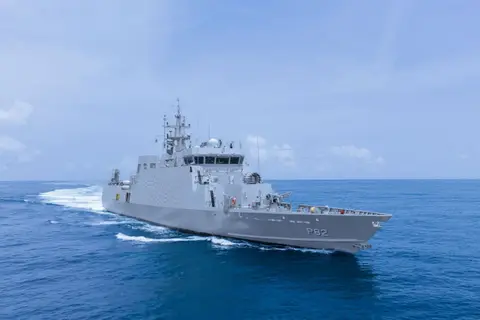
INS Agray, launched in March 2024, is the first vessel delivered under the Anti-Submarine Warfare Shallow Water Craft programme and is purpose-built for the littoral environment. At 77.6 metres with a draught of just 2.7 metres, the craft is optimised for rapid-response operations in coastal waters where larger combatants cannot operate effectively.
The weapons and sensor fit is specifically tailored for sub-surface threat detection and neutralisation. INS Agray carries lightweight torpedoes, ASW rocket systems, and a 30 mm naval gun, integrated through an indigenous combat management system. Waterjet propulsion gives the vessel exceptional agility at speed, critical for prosecuting submarine contacts in confined littoral spaces.
What distinguishes INS Agray in the context of this GRSE warship delivery is its indigenous content figure: 88 percent. That number is not just a procurement statistic. It represents a deep and widening domestic industrial base capable of supplying precision underwater warfare systems, propulsion technology, and integrated combat electronics at acceptable quality thresholds.
GRSE’s Order Book Points to Sustained Naval Expansion
Monday’s GRSE warship delivery does not mark a pause. The shipyard’s current order book includes one additional Project 17A stealth frigate, four more ASW Shallow Water Crafts, four Next Generation Offshore Patrol Vessels, and 30 other vessels including 13 earmarked for export customers. Advanced discussions are also under way for a contract to build five Next Generation Corvettes.
This pipeline confirms that the GRSE warship delivery cycle will remain active and growing through the end of the decade. For the Indian Navy, it means a steady inflow of platforms across mission categories. For Indian industry, it means sustained work share, technology development, and the accumulation of shipbuilding expertise that cannot be imported.tain
Strategic Signal from the Kolkata Waterfront
The simultaneous delivery of a stealth frigate, a survey ship, and an anti-submarine warfare craft in a single ceremony is more than a logistical achievement. It demonstrates that Indian shipbuilding is now capable of managing complex, multi-class programmes concurrently, and delivering them to a navy that operates across the full spectrum of maritime missions.
With sustained government investment, clear indigenisation targets, and a production ecosystem that is steadily closing capability gaps, India’s defence shipbuilding sector is earning its place among credible global contributors. The Kolkata waterfront on March 30, 2026 offered a clear view of where that journey has reached.



COMMENTS
JOIN THE DISCUSSION