

 DEFENCE INDUSTRYBrahMos export orders: Vietnam deal worth about $100 million, Indonesia $200 million as Akash reaches Tajikistan, Turkmenistan
 DEFENCE INDUSTRYMahindra Embraer Nagpur facility to assemble C-390 if IAF picks the aircraft
 DEFENCE INDUSTRYSMPP Drone Manufacturing Push: Firm Shifts From Ammunition to Unmanned Warfare, Targets Integrated Defence Capabilities
 INDIA DEFENCEDhruv NG Helicopter Explained: What HAL Has Actually Put Into Pawan Hans Service
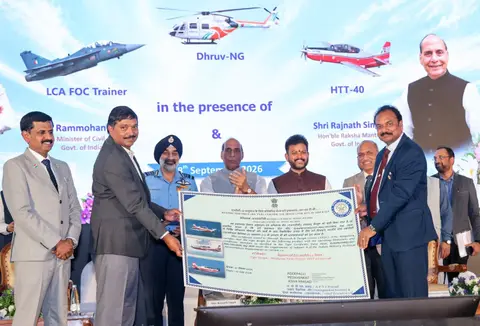 INDIA DEFENCELCA FOC Trainers Delivered With HTT 40 and Dhruv NG as Rajnath Singh Asks Engineers for Technologies That Do Not Exist
The Prahar LMG Indian Army programme moved from contract to field on 28 March 2026, as Adani Defence and Aerospace handed over 2,000 indigenously manufactured 7.62mm light machine guns at its Small Arms Complex in Gwalior.
The handover was formalised at a ceremony attended by A. Anbarasu, Director General (Acquisition) and Additional Secretary, Ministry of Defence, and Ashish Rajvanshi, CEO of Adani Defence and Aerospace. Anbarasu flagged off a convoy of trucks carrying the weapons to operational units. This Prahar LMG Indian Army delivery, completed eleven months before the contracted deadline, is the most visible result yet of India’s push to build a private-sector small arms industry capable of meeting Army timelines at scale.
What the Prahar LMG Brings to the Indian Army’s Infantry
India’s infantry battalions have long relied on a mix of legacy and imported automatic weapons, several procured under conditions that left the service exposed to supply-chain disruptions, a vulnerability the DAC’s landmark defence procurement approvals are now systematically addressing. The Prahar LMG Indian Army induction closes that gap with a platform built for sustained automatic fire across every terrain the Army holds.
The weapon is chambered in 7.62x51mm NATO calibre, carries a 508mm barrel, measures 1,100mm overall, and weighs 8 kg. Effective range extends to 1,000 metres. Its open-bolt, gas-operated piston mechanism supports both belt-fed and assault-drum configurations. A built-in gas regulator maintains reliable cycling in dust, extreme cold, and high-altitude environments where standard gas pressures are insufficient.
The system is a licensed version of the Israeli Negev NG-7, manufactured in India through a technology partnership with Israel Weapon Industries. Adani Defence has achieved over 90 percent domestic sourcing for components, which shifts the programme from a technology-transfer arrangement into a genuinely indigenous production capability.
The adjustable buttstock and cheek rest improve soldier ergonomics during prolonged engagements. The weapon can be field-stripped quickly, reducing maintenance downtime in forward deployments where technical support is limited.
The Gwalior Facility That Made It Possible
The 100-acre Small Arms Complex on the outskirts of Gwalior is India’s first fully integrated private-sector small arms manufacturing hub. It brings barrel manufacturing, bolt carrier and receiver fabrication, CNC machining, robotics, surface treatment, precision metrology, and a 25-metre underground firing range under one roof.
Every weapon undergoes lifecycle testing, ballistic assessment, and environmental trials before dispatch. The facility has a designed annual capacity of up to 100,000 weapons, with over 90 percent of components sourced domestically, supporting MSMEs across the supply chain.
The ammunition side of the ecosystem sits at Adani Defence’s Kanpur complex, commissioned in 2024, which produces approximately 300 million rounds of small-calibre ammunition annually. Expansion into medium and large-calibre production is underway, with Rajvanshi indicating the Kanpur facility will be among the largest ammunition complexes in South Asia once complete.
Prahar LMG Indian Army Deployment: Where These Guns Are Going
The Prahar LMG is cleared for deployment across all theatres where the Indian Army maintains operational presence, but two frontiers define its immediate relevance.
Along the Line of Actual Control with China, infantry units operating above 4,000 metres require weapons that function reliably in sub-zero temperatures with reduced atmospheric pressure. The gas regulator and environmental certification address those conditions directly. Along the Line of Control with Pakistan, counterinfiltration operations demand high volumes of accurate suppressive fire sustained over extended periods. The belt-fed configuration and sustained-fire design are built for exactly that requirement.
The quick field-dismantling capability and minimal downtime for maintenance matter particularly in both these environments, where resupply and technical support involve long lead times and difficult logistics chains.
How the Delivery Schedule Was Beaten by Nearly a Year
The pace of delivery is as significant as the delivery itself. Rajvanshi put the timeline plainly at the Gwalior ceremony: “The journey that has begun today took us six years, starting from bid submission, and we have delivered it 11 months ahead of schedule. The original timeline, which was given to us by the customer, was over seven years, but I can assure you that in the next three years, the full order will be delivered.”
The first batch was completed in seven months from the start of bulk production. The First-of-Production Model was realised in six months against a stipulated 18-month development timeline, followed by Bulk Production Clearance that enabled the rapid transition to manufacturing scale.
From April 2026, Adani Defence plans to sustain output of 1,000 Prahar LMGs per month. The total contract covers approximately 40,000 to 41,000 weapons, with the company targeting completion well within three years against an original seven-year window.
Anbarasu characterised the performance accurately: the delivery demonstrates the ability to “race against time and deliver” when converting contracts into production. For an Indian private-sector firm operating in small arms manufacturing, that is not yet a given. This programme establishes it as a replicable model.
The Prahar induction, alongside programmes like the Vayu Baan helicopter drone cleared for the IAF, reflects a consistent pattern: India’s private and public defence sectors are now delivering across platform categories simultaneously.
Private Sector and Make in India: What This Contract Proves
The Prahar LMG Indian Army programme is not the first Make in India defence contract, but it is among the clearest examples of private-sector execution matching the intent behind the policy. The combination of schedule performance, domestic sourcing above 90 percent, and integrated manufacturing from barrel to ballistic testing represents the full model, not a partial one.
This trajectory mirrors the broader Atmanirbhar Bharat push that has seen 60 Ghatak stealth UCAVs cleared in a single MoD decision, signalling that India is now moving indigenous platforms from drawing board to procurement order at pace.. The Kanpur ammunition complex, meanwhile, adds depth to what would otherwise be a weapons-only capability, allowing the company to offer an integrated supply rather than a platform alone.
For the Prahar LMG specifically, the operational rollout over the next three years will test whether the 1,000-units-per-month target is maintained under conditions of full production rather than initial burst. That is where the programme’s real significance will be confirmed.



COMMENTS
JOIN THE DISCUSSION