

 INDIA DEFENCEDhruv NG Helicopter Explained: What HAL Has Actually Put Into Pawan Hans Service
 INDIA DEFENCELCA FOC Trainers Delivered With HTT 40 and Dhruv NG as Rajnath Singh Asks Engineers for Technologies That Do Not Exist
 DEFENCE INDUSTRYTata Zorawar light tank clears Army's L1 hurdle for Rs 20,000 crore contract
 DEFENCE INDUSTRYIndia Belgium Defence Deals Sealed As PM De Wever Visits Delhi
 DEFENCE INDUSTRYAero India 2027 Dates Confirmed for February 8 to 12 in Bengaluru
India China LAC stable but sensitive as Gen Dwivedi signs off on his tenure
The India China LAC remains stable but sensitive, outgoing Army Chief Gen Upendra Dwivedi said on Monday, describing the calm along the Line of Actual Control as something the two armies work at daily rather than anything they have settled. Speaking to ANI, Gen Dwivedi credited sustained military engagement and the border management mechanisms built up over years with holding the peace and heading off the misreadings that can turn a local incident into a crisis.
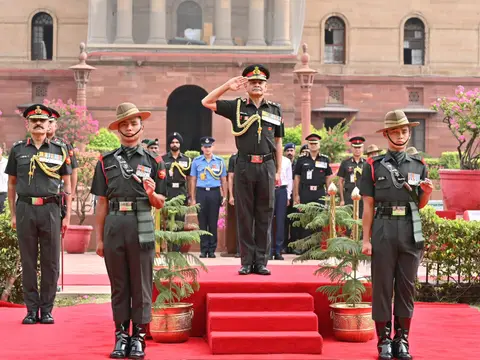
The timing carries its own weight. Gen Dwivedi made the remarks in the closing days of his tenure as the 30th Chief of the Army Staff, before handing charge on June 30 to Lt Gen Dhiraj Seth.
India China LAC held by disengagement and daily contact
On the ground the picture has shifted since the worst of the eastern Ladakh standoff. Gen Dwivedi said the disengagement agreements reached between the two sides have improved stability, with each army now more responsive to the other's concerns. He made no claim that the boundary question itself is anywhere near resolved.
The figure that anchors his assessment is 1,100. The Indian and Chinese militaries hold more than 1,100 ground-level interactions every year, the Army Chief said, the routine business of managing a contested frontier where the two sides read the alignment of the LAC differently across several sectors. Most of these contacts never reach the news. They settle questions of patrolling, grazing rights, local friction and the small disputes that, left to fester, are the ones that escalate.
That is what stable but sensitive means in practice. Quiet held by constant management, not by a treaty.
Mechanisms doing the work along the India China LAC
Gen Dwivedi laid out the toolkit. Military-to-military talks, hotlines, flag meetings and commander-level dialogue together manage the local issues thrown up by differing perceptions of where the line runs, and keep routine activity such as patrolling moving without incident.
From there he set three priorities for the Indian Army on the northern front. Preserve peace and tranquillity along the LAC. Resolve local issues through dialogue and the established mechanisms. And hold a robust, credible deployment posture strong enough to deter any potential threat. The order is deliberate. Dialogue first, deterrence underwriting it.
These are not new inventions. The hotlines and the flag meeting points have been in place for years, but the volume of contact has climbed as both sides try to keep small frictions from drifting upward. A face-off at a patrolling point, on this approach, is meant to be closed by a local commander long before it reaches a capital.
A diplomatic thaw running alongside
The military read tracks a wider warming through 2024 and 2025. Gen Dwivedi pointed to a run of developments that, taken together, mark the most active phase of India China engagement since the 2020 clash: an Experts Group set up on boundary delimitation, a Working Group on border management, the resumption of the Kailash Mansarovar Yatra, the return of direct flights, agreement to reopen border trade through designated passes, and visa facilitation. Diplomatic and military channels, in his telling, have moved in the same direction at the same time.
None of that has thinned out the deployment.
Build-up on the northern borders
The standoff that began in the summer of 2020 reset how the Army holds the eastern Ladakh sector, and the disengagement that followed at the main friction points took years of talks to negotiate. What Gen Dwivedi described is the system that grew out of that period, a frontier kept quiet by routine contact while forces on both sides stay forward. The responsiveness he pointed to is the practical test of it, each side reading the other early enough to keep a patrol face-off from hardening.
The Army keeps building infrastructure, logistics, surveillance and operational readiness across the northern borders even as it keeps talking, Gen Dwivedi said, the two tracks running in parallel by design. The build-up shows in recent inductions, from the Prahar light machine guns now reaching infantry units cleared for sub-zero high-altitude use, to the long-range rocket systems brought in under emergency procurement, to the loitering munitions handed to the Army for deep strike. The forward posture is being thickened, not drawn down, and the surveillance layer behind it expanded.
Peace through strength
His framing for the whole approach was blunt. India's stance, Gen Dwivedi said, rests on peace through strength, and the Army will stay firm, vigilant and credible to safeguard the country's territorial integrity and national interests. Engagement and dialogue continue, but the posture behind them does not soften.
The change of command was confirmed by the Ministry of Defence, with Lt Gen Seth taking over the same day.
COMMENTS
JOIN THE DISCUSSION