

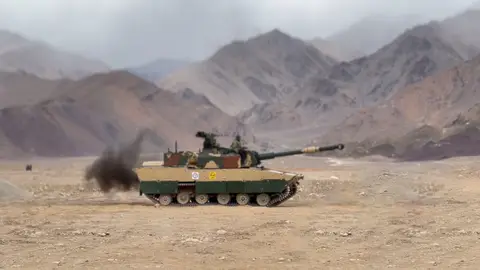
 DEFENCE INDUSTRYTata Zorawar light tank clears Army's L1 hurdle for Rs 20,000 crore contract
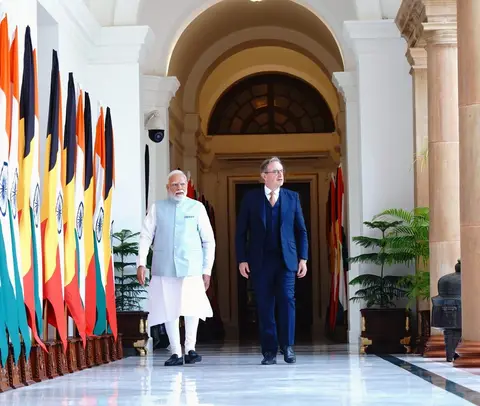 DEFENCE INDUSTRYIndia Belgium Defence Deals Sealed As PM De Wever Visits Delhi
 DEFENCE INDUSTRYAero India 2027 Dates Confirmed for February 8 to 12 in Bengaluru
 DEFENCE INDUSTRYJavelin missile co-production advances as Tata Advanced Systems signs Javelin Joint Venture pact
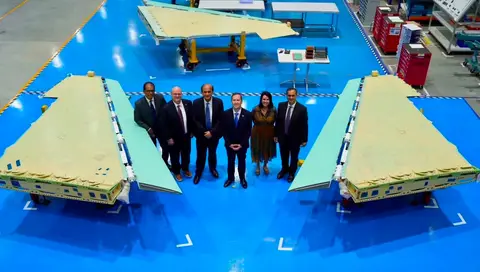 DEFENCE INDUSTRYTata Lockheed Martin MTA push gets a lift from US envoy's Hyderabad visit
SMPP kamikaze drone delivery to Indian Army draws indigeneity challenge as Belarus papers surface
The SMPP kamikaze drone that the Indian Army received in a batch of 106 units on 11 June carries a name more revealing than its manufacturer may have intended. Peacekeeper, the English designation for the Agniveg loitering munition, is a direct translation of Mirotvorets, the name given by Belarusian designers to a turbojet-powered kamikaze system developed by the firm KB Indela under the Berkut-BM programme. The coincidence of naming, the coincidence of specifications and the documentary trail published by a Belarusian investigative group have together reopened the question that Aatmanirbhar Bharat procurement policy asks of every induction: how much of this system was actually made in India?
The delivery SMPP announced on 11 June
SMPP, the Delhi-based defence manufacturer registered in Sangrur, Punjab, said it had completed the delivery of 100 operational Peacekeeper (Agniveg) drones and six training systems to the Indian Army. The company said trials conducted in a heavily jammed and spoofed environment had demonstrated a circular error probable of under five metres at ranges of approximately 180 kilometres, and that the system can operate autonomously against high-value targets including command centres, radar installations and logistics nodes at speeds of up to 450 kmph. Ashish Kansal, CEO and Director of SMPP, described the completion of deliveries within six months as a landmark for the company and for India's indigenous defence manufacturing ecosystem.
The Army's interest in a jet-powered loitering munition with this performance envelope is straightforward to explain. Operation Sindoor in May 2025 accelerated several capability requirements that had been moving through procurement pipelines for years, and the gap between tube artillery systems and long-range missiles capable of deep strike became a recognised operational priority in that conflict's aftermath. A one-way attack system that can prosecute targets at 180 kilometres in a GPS-denied environment fills that gap at a cost conventional strike platforms cannot match. The Peacekeeper was selected following trials at Pokhran after Operation Sindoor and was brought in under emergency procurement as part of a broader modernisation push. The induction is operationally sound, and the Army's decision to compress the acquisition timeline is consistent with the urgency the post-Sindoor period has imposed on capability development.
The SMPP kamikaze drone and its Belarusian blueprint
The indigeneity claim around the Agniveg is a separate matter from its operational utility. ThePrint, citing sources in the defence and security establishment, reported on the day of the delivery announcement that the Peacekeeper is originally a Belarusian design manufactured by KB Indela, which has partnered with SMPP. The report said SMPP has localised the munition portion of the drone under a transfer-of-technology arrangement, and that phased transfer of remaining elements, including the turbojet engine, is tied to the volume of future orders. That framing places the delivered batch in a transitional category, closer to import-with-integration than to indigenous manufacture.
The documentary record is more specific. In January 2026, BELPOL, an investigative initiative of exiled former Belarusian security officials, published what it described as contract documentation establishing that SMPP Ammunition Private Limited had purchased approximately 100 Belarusian-made Mirotvorets kamikaze drones. BELPOL said negotiations opened in August 2025, the contract was signed in October 2025, and acceptance procedures were conducted at the Belarusian end between 22 and 25 October 2025. The seller named in the documentation was Belspetsvneshtechnika, the state foreign trade enterprise of the State Authority for Military Industry of the Republic of Belarus. The Indian defence portal IDRW had independently reported, before the BELPOL documents were published, that the Indian Army had procured the Belarusian Berkut-BM platform in its Mirotvorets configuration.
BELPOL's character as an exile-run investigative group means its publications carry a qualification that should be stated plainly. The group consists of former Belarusian security and intelligence officials who oppose the Lukashenka government and operate from outside Belarus. Their releases carry a political dimension, and the SMPP contract documentation has not been independently verified by this publication. What sets this account apart from a claim resting on a single disputed source is the convergence of independent reporting. The BELPOL document, the IDRW reporting on the Berkut-BM procurement and the ThePrint sourcing from within India's own defence establishment all arrive at the same factual core. The specifications match. The timeline fits. The name translates.
Specifications that are difficult to explain away
The Berkut-BM, developed by KB Indela, is a robotic aerial target fitted with a turbojet engine, a wingspan of 2.8 metres and a top speed of 450 kmph. Its Mirotvorets variant is a kamikaze configuration with a range of 180 kilometres and a 10 kilogram warhead. The Agniveg, as described in SMPP's announcement, has a range of 180 kilometres, speeds of up to 450 kmph and a CEP of under five metres in electronically contested conditions. The numbers are not approximately similar. They are identical. Mirotvorets translates directly from Russian as Peacekeeper. The Agniveg's English name is Peacekeeper. The design brief for both drones is the same document.
A delivery timeline that does not accommodate indigenous manufacture
The six-month delivery window that SMPP cited as evidence of its execution capability contains an internal problem. Counted back from the June 2026 completion, the order opens around the end of 2025. BELPOL's documentation places the acceptance of the Belarusian units at the Belspetsvneshtechnika end in October 2025, weeks before that window even begins. A six-month programme ending with the delivery of more than a hundred turbojet-powered loitering munitions is achievable if the airframes arrive complete and the work is limited to integration, warhead fitting and operator training. It is not achievable as a domestic development and manufacturing programme for a new jet-powered strike system. No Indian company has taken a turbojet-powered loitering munition from contract to hundred-unit delivery in six months, because the engineering and production requirements of the task do not permit it.
The Indian Army's procurement decision remains sound on its own terms. Emergency procurement exists to compress acquisition timelines when operational necessity demands it, and the system delivered has cleared trials and is capable of meeting the requirement it was acquired to fill. There is no suggestion that the Army received a deficient product. The question falls on the vendor's representation, not on the procurement route or the end-user's judgement. Calling a system indigenous when the airframes were accepted from a Belarusian state enterprise weeks before their delivery to the Indian Army is a characterisation the available record does not support.
What Aatmanirbhar Bharat demands of its vendors
The Aatmanirbhar Bharat framework that successive Defence Ministers have advanced is not a rhetorical position. It is an acquisition architecture built around indigenisation categories, positive lists and the expectation that Indian companies winning capital procurement contracts will manufacture what they win. The framework has delivered results. It has driven genuine domestic depth across ammunition, protection systems and aerospace components, and those gains are real. The credibility of that architecture depends on vendors being held to what they represent rather than what their press communications suggest. A technology transfer programme with milestones tied to future order volumes is a legitimate path to indigenisation. It is not a description that applies to the batch already delivered.
SMPP is not a new entrant in the Indian defence industrial base. The company has supplied the armed forces for decades across ammunition components and protection systems, a track record that constitutes a long and substantially creditable relationship with the establishment. Its 2018 contract for 1,86,138 bulletproof jackets at Rs 639 crore was the largest personal protection procurement of its kind at the time. The drone programme represents the company's most prominent expansion into precision strike systems. If the phased technology transfer from KB Indela advances as described, including eventual Indian manufacture of the propulsion system, this programme may in time deliver the domestic capability the Aatmanirbhar Bharat framework is designed to build. That outcome remains possible. It does not describe the first batch.
India Defence Wire has sought a response from SMPP on the SMPP kamikaze drone programme's indigenous content, the proportion of the delivered system manufactured in India and the timetable for domestic absorption of the propulsion technology. The company has not responded as of publication. The Ministry of Defence has also been approached for comment on whether the emergency procurement terms carry indigenisation milestones and what mechanisms exist to verify vendor claims of domestic origin in loitering munition contracts.



COMMENTS
JOIN THE DISCUSSION