

 DEFENCE INDUSTRYBrahMos export orders: Vietnam deal worth about $100 million, Indonesia $200 million as Akash reaches Tajikistan, Turkmenistan
 DEFENCE INDUSTRYMahindra Embraer Nagpur facility to assemble C-390 if IAF picks the aircraft
 DEFENCE INDUSTRYSMPP Drone Manufacturing Push: Firm Shifts From Ammunition to Unmanned Warfare, Targets Integrated Defence Capabilities
 INDIA DEFENCEDhruv NG Helicopter Explained: What HAL Has Actually Put Into Pawan Hans Service
 INDIA DEFENCELCA FOC Trainers Delivered With HTT 40 and Dhruv NG as Rajnath Singh Asks Engineers for Technologies That Do Not Exist
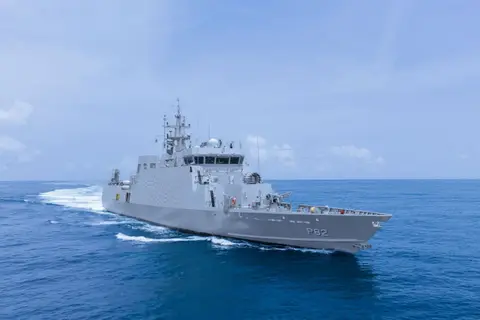
The Malwan ASW Shallow Water Craft was delivered to the Indian Navy on March 31, 2026, marking another concrete step forward in India’s campaign to build a self-reliant maritime defence ecosystem. Constructed by Cochin Shipyard Limited (CSL) in Kochi, the vessel is the second of eight such warships that CSL is contracted to build for the Navy under a landmark Make in India agreement.
Designed and built entirely in India to meet Navy specifications, the ship has been certified in accordance with the classification standards of DNV, the globally respected maritime quality authority. The delivery reaffirms that Indian shipyards are fully capable of producing frontline naval platforms without dependence on foreign yards.
A Name With Deep Maritime Roots
Malwan draws its name from the historic coastal town of Malwan in Maharashtra, a region inseparably linked to the maritime legacy of Chhatrapati Shivaji Maharaj. The Maratha navy, which operated from these very shores, remains one of the most celebrated chapters in India’s seafaring history.
The naming also carries forward the legacy of the earlier INS Malwan, an Indian Naval minesweeper that served the fleet with distinction until 2003. By choosing this name, the Navy continues a long-standing tradition of honouring its warship heritage and keeping distinguished vessel names alive across generations.
The Malwan ASW Shallow Water Craft: Built for Littoral Dominance
The Malwan ASW Shallow Water Craft is equipped for underwater surveillance, Anti-Submarine Warfare operations in coastal waters, Low Intensity Maritime Operations, and mine warfare. These are precisely the operational demands that India’s evolving maritime threat environment places on its coastal defence forces.
The vessel measures 78 metres in overall length with a breadth of 11.3 metres and a maximum draught of 2.7 metres at full load. It can operate in coastal waters within 200 nautical miles of its base port, reach a maximum speed of 25 knots, and sustain an endurance of over 1,800 nautical miles at 14 knots. The ship can accommodate nearly 57 personnel, including seven officers.
Waterjet propulsion driven by three diesel engines provides the ship with exceptional manoeuvrability in shallow water while keeping its acoustic signature low, a critical advantage in ASW operations where detectability is a tactical liability.
Weapons and Sensor Suite
The vessel is equipped with torpedoes, multifunctional anti-submarine rockets, and state-of-the-art sensors, including advanced radars and sonar systems. This integrated weapons package is purpose-built to detect, track, and neutralise submarine threats operating in coastal and littoral zones where conventional surface combatants face serious limitations.
The weapons suite includes a forward-mounted RBU-6000, triple 324 mm lightweight torpedo tubes on both port and starboard fitted with Advanced Light-Weight Torpedoes, and anti-submarine mine-laying rails. The ship also carries torpedo decoy launching systems as part of an Integrated Anti-Submarine Warfare Defence Suite.
For surface self-defence, the ship is fitted with a 30 mm Naval Surface Gun and stabilised remote-controlled 12.7 mm weapons. A comprehensive electronics suite covers radar electronic support measures, communication intelligence systems, satellite communications, and an integrated bridge system — all networked through a Combat Management System.
Aatmanirbhar Bharat in Measurable Terms
With over 80 per cent indigenous content, the Malwan ASW Shallow Water Craft marks a milestone in indigenous warship construction and reaffirms the Government of India’s vision of Aatmanirbhar Bharat. The ship carries equipment and systems developed and integrated by the domestic defence manufacturing ecosystem, including MSMEs.
The ASW SWC series is expected to significantly enhance the Navy’s shallow water anti-submarine capabilities, strengthening India’s coastal security and operational readiness. The involvement of smaller domestic suppliers at every level of construction demonstrates that the Aatmanirbhar Bharat initiative is producing tangible industrial results, not just policy intent.
The ship’s design was developed by Smart Engineering and Design Solutions (SEDS), a Kakkanad-based private firm. SEDS has become India’s first private company to design warships for the Indian Navy , a landmark development for India’s private defence sector.
The involvement of smaller domestic suppliers at every level of construction demonstrates that the Aatmanirbhar Bharat initiative is producing tangible industrial results across all three services — from domestic defence manufacturing deliveries of infantry weapons to frontline naval platforms built by Indian shipyards.
Part of a 16-Vessel Programme
A total of 16 ASW Shallow Water Craft are being built for the Indian Navy jointly by CSL and GRSE under the Make in India initiative, with the Navy planning to have all 16 vessels in active service by 2026. The lead ship of the CSL batch, Mahe, was delivered in October 2025 and commissioned in November 2025 at Naval Dockyard, Mumbai. The Malwan delivery keeps the programme on schedule.
The vessels are replacing the ageing Abhay-class corvettes, which had been in service since the late 1980s. ASW Shallow Water Craft are specially designed for operations in coastal areas where the water is too shallow for conventional warships to operate effectively, making them indispensable for keeping Indian waters secure from undersea threats.
The lead ship of the CSL batch, Mahe, was delivered in October 2025 and commissioned in November 2025 at Naval Dockyard, Mumbai. Just one day before the Malwan delivery, GRSE handed over three vessels simultaneously at Kolkata, including INS Agray, the first ASW SWC delivered under the GRSE lot of the same programme.
Strategic Timing in a Contested Maritime Region
Submarine activity in the Indian Ocean Region has risen sharply in recent years, with multiple extra-regional navies now maintaining a persistent presence in waters close to India’s coastline. India’s maritime security posture in the Indian Ocean Region has been reinforced through a steady programme of capacity building and partner engagement — and platforms like Malwan form the hard end of that architecture.
With six more CSL-built vessels still to follow, the Indian Navy is systematically building the force structure it needs to dominate littoral environments and protect both strategic assets and vital sea lines of communication. Each delivery in this programme is a measure of how far India’s shipbuilding capability has come since the days when nearly every warship had to be sourced from abroad. The Malwan ASW Shallow Water Craft stands as the clearest evidence of that progress to date.


COMMENTS
JOIN THE DISCUSSION