

 DEFENCE INDUSTRYBrahMos export orders: Vietnam deal worth about $100 million, Indonesia $200 million as Akash reaches Tajikistan, Turkmenistan
 DEFENCE INDUSTRYMahindra Embraer Nagpur facility to assemble C-390 if IAF picks the aircraft
 DEFENCE INDUSTRYSMPP Drone Manufacturing Push: Firm Shifts From Ammunition to Unmanned Warfare, Targets Integrated Defence Capabilities
 INDIA DEFENCEDhruv NG Helicopter Explained: What HAL Has Actually Put Into Pawan Hans Service
 INDIA DEFENCELCA FOC Trainers Delivered With HTT 40 and Dhruv NG as Rajnath Singh Asks Engineers for Technologies That Do Not Exist
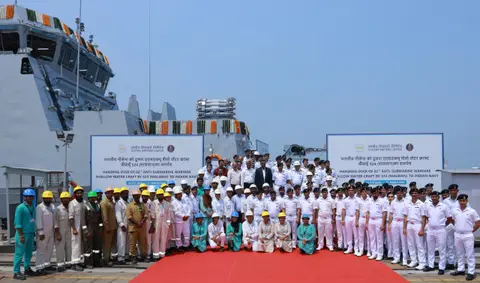
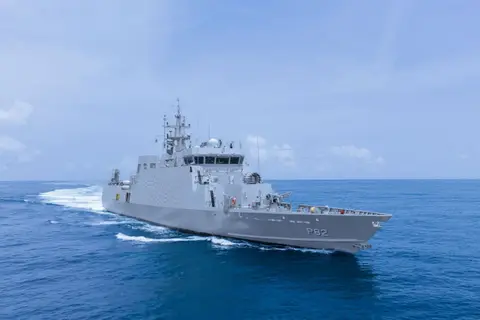
The Indian Navy NGOPV Shachi marked a defining moment for India’s indigenous shipbuilding programme on Tuesday, March 31, 2026, as the vessel was formally launched at Goa Shipyard Limited (GSL) in a ceremony steeped in naval tradition. The occasion reinforces India’s accelerating push toward maritime self-reliance and signals the next chapter in the Indian Navy’s expansion plans across the Indian Ocean Region.
A Landmark Launch Under Aatmanirbhar Bharat
The first of eleven Next Generation Offshore Patrol Vessels (NGOPVs), Shachi carries the yard designation 1280 and was launched by Mrs Shagun Sobti in the presence of Vice Admiral Tarun Sobti, Deputy Chief of the Naval Staff. Senior officials from the Ministry of Defence and GSL were also present for the event.
The NGOPV programme is being executed concurrently at two of India’s premier public sector shipyards: Goa Shipyard Limited and Garden Reach Shipbuilders and Engineers (GRSE), Kolkata. This dual-yard approach reflects a deliberate, coordinated national strategy to scale up shipbuilding capacity and meet the Indian Navy’s growing operational requirements without dependence on foreign platforms.
The programme sits squarely within the framework of the Government of India’s Aatmanirbhar Bharat and Make in India initiatives. By commissioning vessels of this class through domestic yards, India is not only reducing import dependency in a critical security domain but also building long-term industrial capacity in high-precision naval construction.
Indian Navy NGOPV Shachi: Multi-Mission Capabilities
The Indian Navy NGOPV Shachi and the vessels that follow her are designed for versatile, multi-domain deployment across the full spectrum of maritime security operations. These are not single-purpose platforms. Their operational mandate covers maritime surveillance, coastal defence, protection of offshore energy assets, search and rescue, anti-piracy operations, and Humanitarian Assistance and Disaster Relief (HADR) missions.
This breadth of capability is a deliberate design choice. The Indian Ocean Region presents a complex maritime environment where threats range from state-level grey-zone operations to non-state piracy, natural disasters, and the ever-present need to secure India’s vast exclusive economic zone. A multi-mission vessel that can shift roles rapidly is exactly the kind of platform that doctrine demands.
Once inducted, the eleven NGOPVs will augment the Indian Navy’s existing fleet of ten OPVs and NOPVs, providing significantly enhanced endurance, operational flexibility, and mission readiness across extended patrol zones.
The Symbolism of ‘Shachi’
The name Shachi is drawn from Indian mythology, representing “one who renders assistance.” For a ship whose primary roles include search and rescue, disaster relief, and protection of civilian maritime assets, the name is not merely ceremonial. It captures the operational identity of the class.
The vessel’s crest reinforces this ethos further. It features the Ursa Major constellation alongside a red and white lighthouse, together evoking the values of guidance, vigilance, and resilience at sea. These are the qualities that the Indian Navy has consistently demonstrated from the Malabar coast to the Strait of Malacca, and which the NGOPV fleet will be expected to project across the broader Indo-Pacific.
Strategic Significance for India’s Maritime Posture
The launch of the Indian Navy NGOPV Shachi is not an isolated event. It is part of a broader strategic recalibration in which the Indian Navy is simultaneously expanding its blue-water capabilities and deepening its capacity for sustained grey-zone and constabulary operations closer to home.
India’s maritime neighbourhood has grown more complex over the past decade. The presence of foreign naval vessels in the IOR, heightened competition for Indian Ocean sea lanes, and the security of India’s island territories and offshore infrastructure all demand a more capable, more numerous patrol fleet. The NGOPV programme directly addresses that gap.
The choice to build eleven vessels of this class, across two shipyards, under an indigenous programme is also a statement of intent. It demonstrates that the Indian government and the Indian Navy have both the strategic clarity and the industrial confidence to commit to long-cycle, domestically delivered capability.
GSL and GRSE: Shipyards at the Centre of Naval Growth
Goa Shipyard Limited has an established track record of delivering patrol and offshore vessels for the Indian Navy and Coast Guard. The assignment of the lead vessel in this programme to GSL acknowledges that history and places the shipyard at the forefront of India’s next generation of naval construction.
GRSE‘s concurrent involvement in the NGOPV programme broadens the industrial base, reducing bottlenecks and ensuring that delivery timelines are distributed across two capable facilities. This approach also seeds expertise and institutional knowledge across the defence shipbuilding sector, with long-term benefits that extend well beyond this single programme.
Conclusion
The launch of the Indian Navy NGOPV Shachi at GSL is a milestone with implications that go beyond one vessel or one ceremony. It represents the maturation of India’s indigenous naval construction ecosystem, the visible output of the Aatmanirbhar Bharat framework, and the Indian Navy’s expanding capacity to police, protect, and project across the waters that matter most to India’s security and prosperity. As the remaining ten NGOPVs take shape at GSL and GRSE, the programme will stand as one of the more consequential domestic defence investments of this decade.


COMMENTS
JOIN THE DISCUSSION