

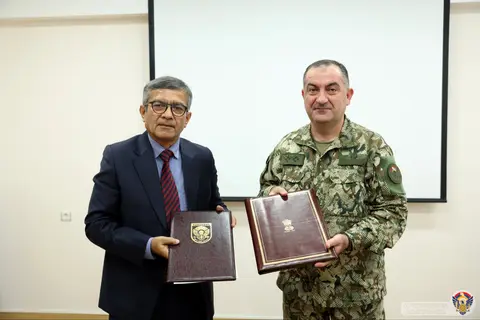
 DEFENCE INDUSTRYBrahMos export orders: Vietnam deal worth about $100 million, Indonesia $200 million as Akash reaches Tajikistan, Turkmenistan
 DEFENCE INDUSTRYMahindra Embraer Nagpur facility to assemble C-390 if IAF picks the aircraft
 DEFENCE INDUSTRYSMPP Drone Manufacturing Push: Firm Shifts From Ammunition to Unmanned Warfare, Targets Integrated Defence Capabilities
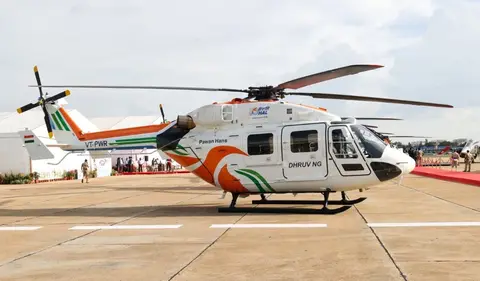 INDIA DEFENCEDhruv NG Helicopter Explained: What HAL Has Actually Put Into Pawan Hans Service
 INDIA DEFENCELCA FOC Trainers Delivered With HTT 40 and Dhruv NG as Rajnath Singh Asks Engineers for Technologies That Do Not Exist
Bengaluru, 11 March 2026. The Indian Air Force and Hindustan Aeronautics Limited stepped onto the same stage here to present the most detailed public picture yet of how India’s Next Generation IAF Aircraft will fight and survive in contested airspace.
The venue was the VM Ghatge Convention Centre. The occasion was Bharat Aero 2026, organised by the Society of Indian Defence Manufacturers and the Centre for Aerospace Power and Strategic Studies. What emerged was less a conference proceeding and more a statement of operational intent.
The ‘Concept of Next Gen Aircraft Mission’ Explained
What the Framework Actually Is
The centrepiece of the event was the formal presentation of the Concept of Next Gen Aircraft Mission, a structured eight stage operational architecture that maps a complete combat sortie from initial ingress to safe extraction.
Unlike broad vision documents, this framework is designed to feed directly into hardware specifications, avionics integration requirements, and tactical doctrine. Officials were clear that it reflects where the IAF intends to fight, not just what it intends to fly.
Why It Matters Now
India’s regional security calculus has tightened considerably. Developing a sovereign mission framework, rather than adopting doctrine from foreign platform suppliers, is itself a strategic signal. The framework’s presentation at a domestic industry event reinforces the government’s Atmanirbhar Bharat push, placing self-reliant aerospace development at the centre of air power planning.
Breaking Down the Eight-Stage Combat Cycle
Ingress Through Strike
The cycle opens with Ingress and Navigation, where aircraft penetrate hostile airspace using terrain-masking and anti-jamming systems built to hold position accuracy even under GPS denial. It is a direct acknowledgement that future adversaries will contest the electromagnetic environment from the moment a mission begins.
Aerial Engagement follows — sensor fusion algorithms and automated targeting work together so pilots can process threats and match weapons to targets faster than legacy systems allow. Precision Strike then executes the mission objective, after which Real-Time Damage Assessment kicks in: onboard sensors relay battle damage feedback before the aircraft leaves the target area, collapsing what was once a post-mission analysis function into the mission itself.
Survivability and Extraction
Threat Evasion and Combat Survivability govern the return leg. Electronic warfare suites counter surface to air missiles and hostile radar networks; the airframe is engineered to keep flying through damage or electronic interference rather than abort. Safe Extraction closes the kinetic loop recovering pilot and aircraft in condition for rapid turnaround.
AI-Assisted Operations runs across the final stage and, implicitly, throughout. Artificial intelligence supports flight management in high stress, low visibility conditions, trimming pilot cognitive load at the moments it is most likely to become a limiting factor.
Network-Centric Warfare: The Doctrine Behind the Hardware
From Platform to System of Systems
The eight stage structure is more than a mission checklist. It encodes a doctrinal shift one that treats dominance in the electronic and information domains as a prerequisite for physical combat effectiveness, not an add on capability.
IAF officials at the conference emphasised that future air operations will depend on interconnected platforms exchanging data in real time, with AI driven decision support reducing the gap between sensor input and weapons release. Winning the network battle, in this framing, precedes winning the air battle.
What This Demands from Industry
For domestic manufacturers, the framework sets a demanding bar. Indigenous firms will need to develop and integrate sensor fusion architectures, hardened datalinks, and AI flight management systems, capabilities that have historically been sourced from abroad. The conference message was direct: that dependency needs to end.
Programmes Set to Adopt the Framework
AMCA: The Flagship Application
The Next Generation IAF Aircraft mission architecture is expected to guide the Advanced Medium Combat Aircraft (AMCA), currently in development by the Aeronautical Development Agency in partnership with HAL. Conceived as a 5.5-generation stealth fighter with an internally carried weapons load and radar-evading airframe geometry, the AMCA is the programme where this framework will face its most demanding test.
Development timelines for the AMCA have been ambitious; translating a combat doctrine framework into certified flight hardware remains a complex undertaking. But the presentation of a formal mission architecture is itself a maturation milestone, it gives the development team a doctrinal target, not just an engineering specification. The Next Generation IAF Aircraft framework represents India’s clearest doctrinal statement yet on future air combat.
Tejas Mk2, Su-30MKI, and Loyal Wingman
Beyond the AMCA, the framework is expected to shape the Tejas Mk2 medium-weight fighter and inform the ongoing modernisation of the Su-30MKI fleet, India’s current heavy-fighter backbone. Perhaps most significantly for future force structure, it will govern the integration of unmanned loyal wingman platforms autonomous or semi-autonomous aircraft designed to operate alongside manned fighters in high-threat environments.
The loyal wingman dimension, though briefly mentioned at the conference, may prove to be the most consequential. It signals that the IAF is actively planning for a mixed manned-unmanned combat formation, not treating unmanned systems as a separate domain.
Conclusion: Blueprint Before the Aircraft
India has, for decades, invested in acquiring advanced aircraft. What Bharat Aero 2026 demonstrated is a shift toward defining, on India’s own terms, what those aircraft must do and how they must do it.
The Next Generation IAF Aircraft framework is not a finished product. It is a doctrine document with engineering consequences, and its influence on the AMCA, Tejas Mk2, and loyal wingman programmes will be observable in the years ahead. Whether domestic industry can deliver on the specifications it implies is the harder question — one that Bengaluru answered with ambition, if not yet with hardware.
Frequently Asked Questions
What is the Next Generation IAF Aircraft mission framework?
It is an eight-stage operational architecture presented jointly by HAL and the Indian Air Force at Bharat Aero 2026, designed to define how future Indian combat aircraft will execute and survive air combat missions.
Which Indian aircraft programmes will it influence?
The framework is expected to guide the AMCA stealth fighter, Tejas Mk2, Su-30MKI upgrades, and the integration of loyal wingman unmanned platforms.
What role does AI play in the framework?
Artificial intelligence is designated to support flight management, targeting assistance, and decision-making in high-stress or low-visibility conditions, reducing pilot workload during critical mission phases.
What is Bharat Aero 2026?
A defence aerospace conference held in Bengaluru on 11 March 2026, organised by SIDM and CAPSS with HAL support, focused on advancing India’s indigenous military aviation capabilities.
DefenceChronicles.com will continue tracking AMCA development milestones and IAF modernisation updates.



COMMENTS
JOIN THE DISCUSSION