

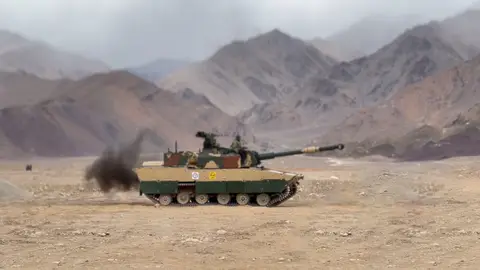
 DEFENCE INDUSTRYTata Zorawar light tank clears Army's L1 hurdle for Rs 20,000 crore contract
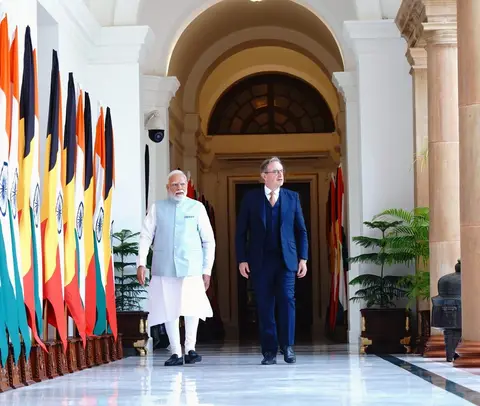 DEFENCE INDUSTRYIndia Belgium Defence Deals Sealed As PM De Wever Visits Delhi
 DEFENCE INDUSTRYAero India 2027 Dates Confirmed for February 8 to 12 in Bengaluru
 DEFENCE INDUSTRYJavelin missile co-production advances as Tata Advanced Systems signs Javelin Joint Venture pact
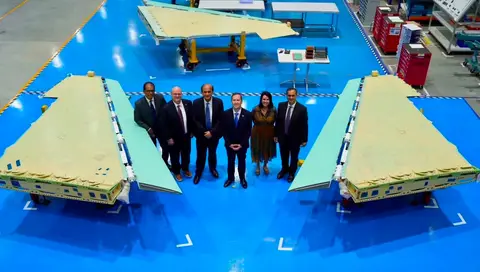 DEFENCE INDUSTRYTata Lockheed Martin MTA push gets a lift from US envoy's Hyderabad visit
The Nibe Naval Group MoU signed on Friday brings Nibe Limited and its group companies together with Naval Group of France under a formal framework spanning underwater drones, mine countermeasure vessels, submarine systems and naval weapon launching platforms. The two sides described it as a step toward strengthening India's naval shipbuilding capabilities and its wider maritime technology ecosystem, and positioned it explicitly within the government's Aatmanirbhar Bharat push.
The signing was conducted over video link.
Marie-Laure Bourgeois, Executive Vice President for Sales and Marketing at Naval Group, signed at the company's France office. Nibe's leadership, led by Chairman and Managing Director Ganesh Nibe, convened at the company's own premises for the ceremony, with senior executives from both sides present on screen. Neither company disclosed a contract value or delivery timeline attached to Friday's signing.
What the Nibe Naval Group MoU covers
The memorandum sets a formal framework for cooperation across a range of technological areas tied to modern naval systems. The named areas include shipbuilding, defence platforms and autonomous systems such as underwater drones, mine countermeasure vessels, underwater submarine systems and technologies, and naval weapon launching systems along with their maintenance.
The two companies said they would cooperate specifically on underwater drones and their integration onboard submarines, on future weapon ready modular launching systems, and on mine countermeasure systems and engineering.
An MoU of this kind typically sets the terms under which detailed technical and commercial discussions can follow. It does not, on its own, commit either party to a specific order, a platform or a delivery schedule. What Friday's release does establish is the scope those future talks are meant to sit within.
The Kalvari class legacy behind the tie up
Naval Group's history in India runs through Project 75. The six Kalvari class submarines built at Mazagon Dock Shipbuilders Limited under that programme carry a design lineage back to Naval Group's Scorpene, delivered through years of technology transfer between the French company and MDL.
Naval Group India was established in 2008, originally as DCNS India, and has since built out offices in Mumbai, New Delhi and Karwar to support that programme and its aftermarket work.
Naval Group's decade of Indian partnerships
Over that period, Naval Group has built what it describes as an extensive network of industrial partnerships across India, working with local firms on components and subsystems tied to the Kalvari programme. Friday's release cited more than a decade of presence in the country as the foundation the Nibe partnership now builds on. It framed the new tie up as a way to widen an existing ecosystem into newer technology areas, rather than as the start of a relationship from scratch.
Naval Group describes its own work as covering the full life cycle of naval vessels, from design, production and integration through in service support and upgrades, to deconstruction and dismantling at the end of a platform's service life. Autonomous systems, underwater weapons and drones sit among the areas the company names as core strengths, and it says these place it well to grow further in that segment of the European market.
Nibe's own naval push
Nibe Limited, the flagship company of the Nibe Group led by Ganesh Nibe, is listed on both the National Stock Exchange and the Bombay Stock Exchange. Its defence portfolio already spans land, air, naval and electronic warfare systems, including missile launchers, weapon platforms, ammunition components, counter unmanned aerial system technology, military electronics and specialised defence structures, alongside work on artillery, armoured vehicles and missile systems.
Nibe has been building a naval and rocket artillery track record of its own well before Friday's agreement. It emerged as the L2 vendor in the Indian Army's loitering munition tender for the Vayuastra system, and it has separately defended the indigenous content of its Suryastra rocket launcher after questions were raised over its Israeli design lineage.
Both those systems sit closer to land based artillery than to the undersea domain this agreement addresses. Group companies beyond Nibe Limited extend into satellite manufacturing, earth observation and bio energy. Naval cooperation is the newest addition.
What both sides said
Bourgeois framed the agreement in terms of the broader India France relationship. "This agreement illustrates our shared commitment to develop sovereign, resilient, and future ready naval capabilities in India and exemplifies our commitment to the Special Global Strategic Partnership shared between India and France," she said.
Ganesh Nibe put the emphasis on capability rather than diplomacy. "Nibe's strong expertise in delivering integrated defence solutions that power India's strategic autonomy, backed by continued investment in the sector will be an asset to the cooperation with Naval Group in order to provide latest generation of naval technologies for the country," he said.
Where the cooperation sits in India's undersea push
India's Navy has been widening its base of private sector suppliers in submarine adjacent technologies, a shift already visible in programmes such as the indigenously designed Project 76 submarine now being taken forward by the Naval Design Bureau. Friday's MoU adds a private manufacturer to that widening base.
Mine countermeasure vessels and underwater drones fall into a category India has historically sourced from a narrow set of foreign suppliers, with limited domestic manufacturing history to draw on. An MoU that brings a private Indian defence manufacturer into that space, alongside a foreign partner already embedded in the country's submarine programme, adds one more name to a supplier base the Navy has been trying to widen.


COMMENTS
JOIN THE DISCUSSION