

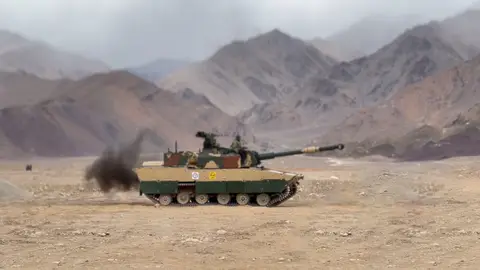
 DEFENCE INDUSTRYTata Zorawar light tank clears Army's L1 hurdle for Rs 20,000 crore contract
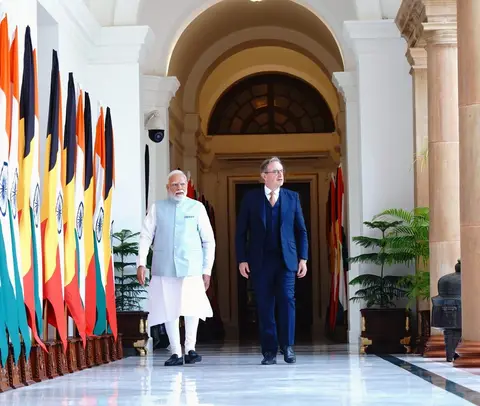 DEFENCE INDUSTRYIndia Belgium Defence Deals Sealed As PM De Wever Visits Delhi
 DEFENCE INDUSTRYAero India 2027 Dates Confirmed for February 8 to 12 in Bengaluru
 DEFENCE INDUSTRYJavelin missile co-production advances as Tata Advanced Systems signs Javelin Joint Venture pact
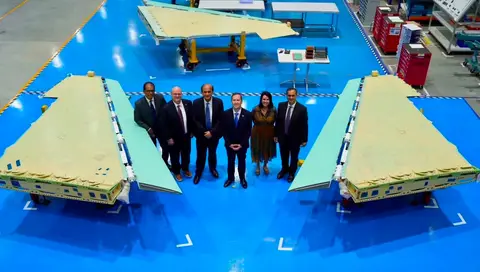 DEFENCE INDUSTRYTata Lockheed Martin MTA push gets a lift from US envoy's Hyderabad visit
Project 76 Submarine: India's Indigenous Undersea Ambition Steps Into the Open
The Project 76 submarine programme moved from the realm of planning documents into public view on June 5, when Prime Minister Narendra Modi toured Larsen and Toubro's defence manufacturing complex at Hazira in Gujarat. Among the systems on display was a scale model believed to represent India's future conventional submarine under Project-76, an entirely indigenously designed boat that would mark a clean break from the foreign-collaboration model that has defined Indian submarine procurement for decades.
The moment generated immediate attention among naval analysts and defence watchers because it offered, for the first time, a visible and officially acknowledged public reference to a programme that has largely developed away from public scrutiny. The Prime Minister's engagement with the model, at a facility that has become one of India's most consequential private-sector defence manufacturing addresses, carried weight beyond the choreography of a factory tour.
The Long Road From Imported Designs to the Naval Design Bureau
India's experience with conventional submarines has always involved a foreign partner at the design stage. The six Kalvari-class boats built under Project-75 were constructed at Mazagon Dock Shipbuilders Limited using the French Scorpene design. The forthcoming Project-75I programme, which will bring six additional next-generation submarines into service, is being taken forward through a partnership with Germany's ThyssenKrupp Marine Systems. Both programmes have delivered or promise real capability, but neither was designed in India.
Project-76 is structurally different. The programme is being led by the Indian Navy's Naval Design Bureau, which will take primary ownership of the submarine's design rather than adapting a foreign blueprint. That shift, from integrator and licence-builder to originator, is what makes Project-76 qualitatively distinct from everything that preceded it in the conventional submarine space.
The Naval Design Bureau has accumulated institutional experience through its work on surface warships, most visibly in the Vikrant-class aircraft carrier programme. Applying that capacity to submarines, which are considerably more technically demanding, represents the next stage in the bureau's evolution as a design authority. Project-76 is expected to absorb the lessons from both the Kalvari-class programme and whatever emerges from Project-75I, building on the accumulated knowledge rather than starting from nothing.
What Project 76 Submarine Is Expected to Bring
Defence sources have indicated that the new class will be equipped with Air Independent Propulsion technology. AIP systems allow a conventional submarine to remain submerged for substantially longer periods without needing to snorkel and recharge its batteries, which significantly improves both survivability and tactical flexibility. The ability to remain undetected beneath the surface for extended durations is particularly important in the Indian Ocean Region, where adversary maritime surveillance capabilities have grown.
Beyond propulsion, the programme is intended to push indigenous content to levels not previously achieved in an Indian submarine. Sonars, communication suites, weapon-control systems, sensors and the specialised submarine-grade steel needed for pressure hull construction are all planned to be sourced domestically. The goal is a submarine whose core systems do not depend on continuing foreign supply relationships, which in turn protects the programme from the kind of disruptions that have periodically complicated India's defence acquisition history.
The reduction in foreign dependency is as much a strategic calculation as an industrial one. Submarines are among the most sensitive and long-lived items in a navy's inventory. A boat designed to serve for three to four decades needs a support ecosystem that will remain accessible across that entire period. Indigenous systems make that calculation far more predictable than supply chains routed through foreign capitals.
The Broader Submarine Modernisation Sequence
Project-76 sits within a layered modernisation plan that the Indian Navy has been working through for years. Project-75 established the foundation by delivering six capable Kalvari-class boats through the Mazagon Dock Shipbuilders production line. Project-75I will raise the bar further, introducing next-generation stealth features and AIP capability through the Indo-German partnership with ThyssenKrupp Marine Systems. There are indications that the Project-75I line may ultimately be extended beyond the initial six boats, potentially to nine submarines, which would give the programme an even larger footprint in the fleet's composition.
Project-76 then represents the logical succession, the point at which India stops adapting foreign designs and builds the capability to originate its own. The target is a domestically conceived submarine class that can serve as the long-term backbone of India's conventional underwater fleet without the perpetual reliance on overseas technical authorities that has characterised previous programmes.
Alongside the conventional track, India is also pursuing nuclear-powered attack submarines under the separate Project-77 programme. The combination of Project-76 and Project-77 reflects a broader ambition to build a balanced undersea force that can operate credibly across the Indo-Pacific, sustaining presence in contested maritime zones where surface forces face growing vulnerabilities.
Why the Fleet Numbers Are Pressing
The urgency behind Project-76 is not difficult to locate. India's conventional submarine fleet is ageing, with multiple older boats approaching the end of their operational service lives. The six Kalvari-class submarines have brought modern capability online, but the total number of serviceable conventional submarines has caused concern given the pace of naval modernisation elsewhere in the region.
China's submarine fleet is among the largest in the world, and Beijing has made a sustained effort to build a presence in the Indian Ocean that was not part of its posture a generation ago. Pakistan has also been pursuing submarine acquisitions and upgrades that directly affect the threat calculus India's naval planners must manage. The requirement for a credible undersea deterrent and sea-denial capability in India's maritime approaches is not theoretical.
Government planners are therefore working to ensure that India's submarine industrial base develops the capacity to deliver future platforms on a sustained basis, without the gaps and delays that have periodically reduced operational fleet strength. Project-76 is central to that effort because it is the programme most likely to create a genuine domestic design and production capability, one that could in principle be replicated and scaled in a way that licence-built foreign designs cannot easily accommodate.
L&T, Hazira, and the Private Sector's Growing Role
The choice of Hazira as the venue where Project-76 effectively entered public awareness is worth noting. Larsen and Toubro has grown into one of India's most capable private-sector defence manufacturers, contributing to naval programmes, strategic missile systems and armoured vehicle production. The Hazira complex is where some of the most sophisticated hardware in India's defence inventory has been produced or will be produced.
Prime Minister Modi's visit, and his engagement with the Project-76 model in particular, was a visible expression of the government's intent to develop the private sector's role in the most technically demanding segments of Indian defence manufacturing. Conventional submarines are not peripheral items. They are among the most complex products in any defence industrial portfolio. Having a facility like Hazira associated with India's indigenous submarine programme carries a message about where the country's private defence sector is heading.
The Aatmanirbhar Bharat framework has been the government's stated organising principle for defence industrial development for several years. In the submarine domain, the true test of that framework is not whether India can assemble foreign designs efficiently, but whether the country can produce the underlying intellectual property. Project-76 is the point at which that test will be applied most directly.
Project 76 Submarine and the Question of What Comes Next
No formal contract for Project-76 has been announced, and the programme remains in its developmental phase. The scale model at Hazira is an indication of direction rather than a procurement milestone. The detailed design work, platform configuration decisions, and eventual production arrangements are still ahead. Given India's historical experience with defence programme timelines, the path from a design bureau concept to boats in commission is measured in years and sometimes in decades.
But the Hazira visit established something that had not previously been established in the same way: public acknowledgement, at the level of the Prime Minister, that Project-76 is a live national programme rather than a distant aspiration. For those tracking India's submarine modernisation, that distinction carries real weight. The programme now has a public face, and the government has associated itself visibly with its ambitions.
If the Naval Design Bureau delivers on the programme's promise, the Project 76 submarine could eventually represent the point at which India's underwater combat capability became genuinely self-sustaining. That is a long way from where the country started with its first foreign-built submarines, and it is a distance worth measuring.
For more on India's submarine modernisation roadmap, the Indian Navy's official website carries background on the service's capability development priorities. Details on the Naval Design Bureau's role in indigenous warship programmes are also available through the Ministry of Defence. L&T's defence manufacturing activities at Hazira are documented on the Larsen and Toubro defence portal.




COMMENTS
JOIN THE DISCUSSION