

 DEFENCE INDUSTRYBrahMos export orders: Vietnam deal worth about $100 million, Indonesia $200 million as Akash reaches Tajikistan, Turkmenistan
 DEFENCE INDUSTRYMahindra Embraer Nagpur facility to assemble C-390 if IAF picks the aircraft
 DEFENCE INDUSTRYSMPP Drone Manufacturing Push: Firm Shifts From Ammunition to Unmanned Warfare, Targets Integrated Defence Capabilities
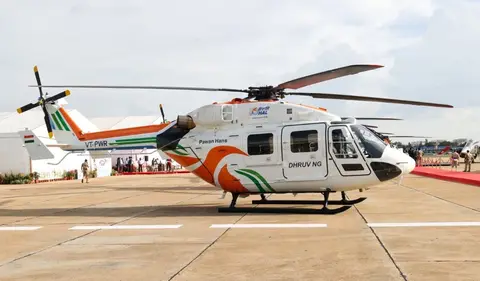 INDIA DEFENCEDhruv NG Helicopter Explained: What HAL Has Actually Put Into Pawan Hans Service
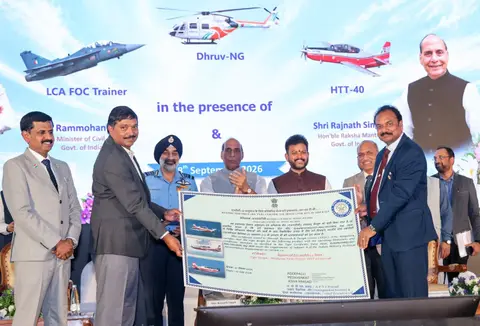 INDIA DEFENCELCA FOC Trainers Delivered With HTT 40 and Dhruv NG as Rajnath Singh Asks Engineers for Technologies That Do Not Exist
Defence Minister Rajnath Singh at Tarang Shakti 2026 told aircrew and commanders from seven partner air forces at Air Force Station Jodhpur on Saturday that the air power of the future will be judged by speed, not size.
The Indian Air Force (IAF) is hosting the second edition of the multinational air exercise from 26 September to 12 October. Australia, Bangladesh, France, Germany, Sri Lanka, the United Arab Emirates and the United States have sent air forces to fly alongside the IAF, while 32 more nations are taking part as observers.
"Future military power will be defined less by the number of platforms we possess. It will be determined by the speed of sensing, understanding, deciding, and acting," the Defence Minister said.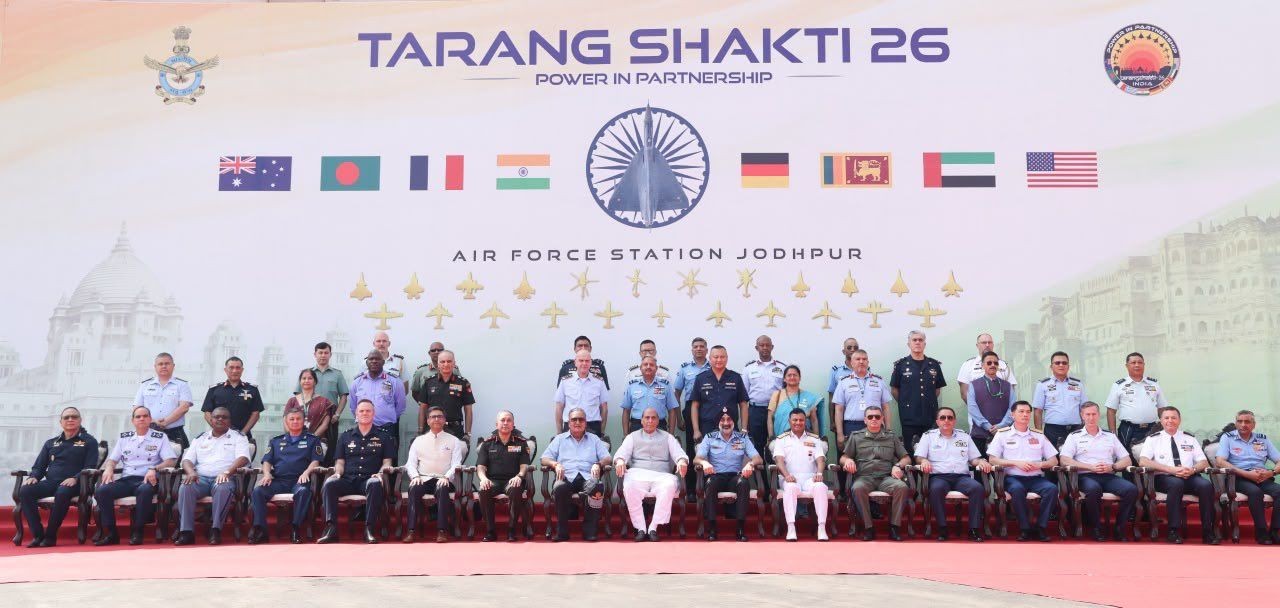
Rajnath Singh at Tarang Shakti puts speed ahead of numbers
Warfare, he said, is no longer confined to land, sea and air. Space, cyber, the electromagnetic spectrum and the information domain are now part of the fight, he added, while drones, unmanned systems, artificial intelligence, electronic warfare and long-range precision weapons are changing how military operations are carried out.
Speed, precision, information and integration now decide military capability, in his assessment.
He also called for constant vigilance. The geopolitical environment is changing fast, the Defence Minister said, and new defence technologies bring uncertainties of their own.
Self-reliance adopted as national policy in defence
India, under Prime Minister Narendra Modi, has adopted self-reliance in defence as national policy, he said. A country must be able to make its own weapons and critical technologies if it is to hold out through a long conflict or a stretch of uncertainty, he argued.
He was clear on what that does not mean. Aatmanirbhar Bharat is not isolation from the world.
It is, the Defence Minister said, the ability to design, develop, manufacture, maintain and upgrade critical defence technologies at home. The IAF itself began at Independence as a force with limited resources. Today it is a modern aerospace power, flying advanced aircraft with precision weapons, sophisticated sensors and integrated networks, and a growing share of indigenous technology.
Tejas, Prachand and AMCA named in the indigenous roll call
He listed the Tejas fighter, the Dhruv, Rudra and Prachand helicopters, the Light Utility Helicopter (LUH), the Akash air defence system, AESA radars, electronic systems and emerging unmanned technologies as products of India's aerospace and defence manufacturing base.
The Advanced Medium Combat Aircraft (AMCA) programme, he said, is an important step towards mastering fifth-generation stealth fighter technology. He stressed the need for advanced aero-engine development and co-production, a subject the IAF leadership has also raised at its annual press conference this month.
India wants to work with like-minded countries on research, co-development, co-production, maintenance, training and innovation, according to the Defence Minister. "The defence relationships of the future will be about technology and trust, not just about platforms," he said.
"We are aware that no nation can afford to operate in isolation," he said. Critical technologies, resilient supply chains, interoperability and trusted partnerships are becoming increasingly important elements of national power, in his view, and India must be capable of acting independently when required while working effectively with others when interests and responsibilities converge.
India is ready to explore these possibilities with countries that share its commitment to a stable, secure and peaceful international environment, he added.
One sky message for seven partner air forces
The Defence Minister congratulated the IAF and every organisation involved in running the exercise, and welcomed the visiting contingents. According to the Ministry of Defence, he said their presence had added real value to Tarang Shakti, and voiced hope that the crews would return home with useful professional lessons and a clearer understanding of India's capabilities and outlook.
"Different nations. Different aircraft. Different experiences. But one sky. That is the message of Tarang Shakti," he said.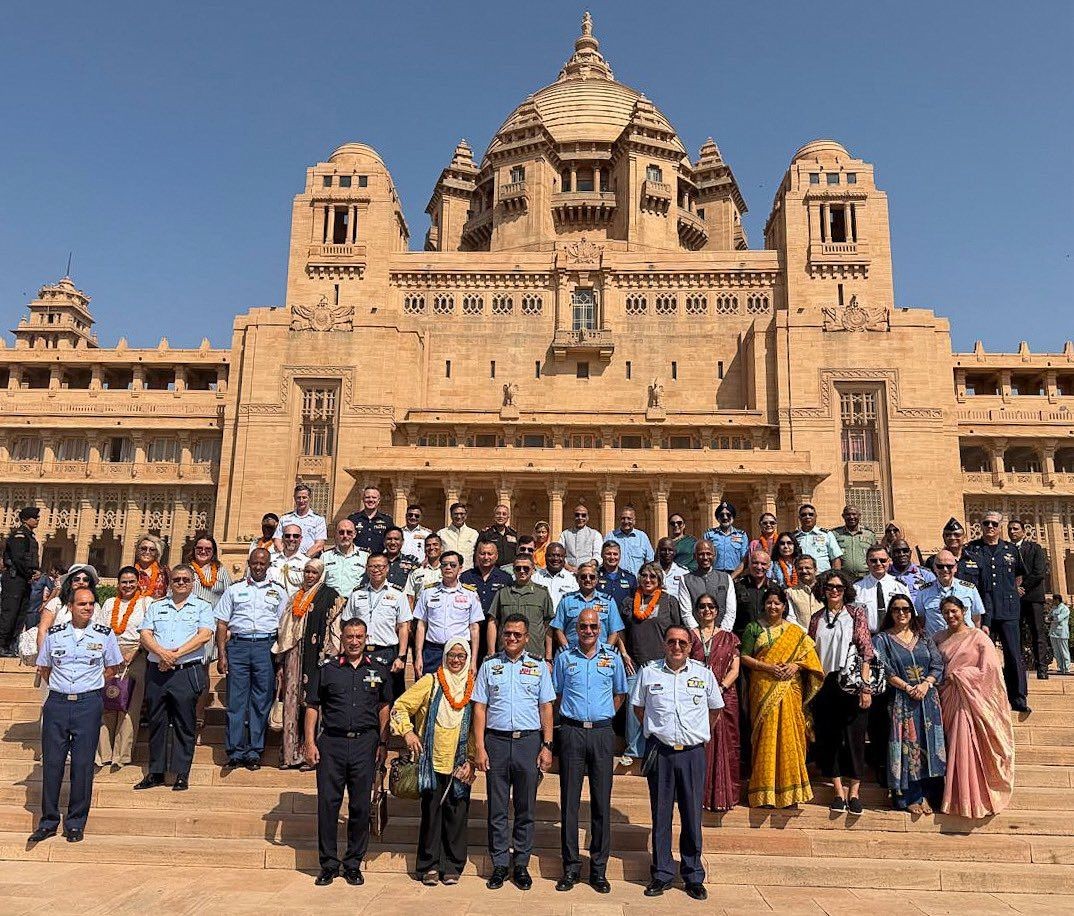
The value of the exercise, he said, goes beyond the sorties flown and the scenarios rehearsed. It lies in learning to communicate, coordinate and operate with partner forces. Multinational exercises let aircrew and commanders learn from one another, test existing assumptions and find ways to improve their own systems and processes, he noted.
He asked the IAF to fold the lessons of Tarang Shakti into its training, tactics, technology, doctrine and future capability development.
Bringing together air forces with diverse platforms and philosophies, he said, lets aircrews and commanders "sense, decide, and act together across different languages of command". He expects the ties formed at Jodhpur to open new avenues of defence cooperation.
Tejas and Prachand fly alongside foreign fighters
The second edition builds on the inaugural Tarang Shakti held in 2024, the ministry said. This year the exercise has brought together combat, transport, surveillance and air-to-air refuelling aircraft for joint mission planning and interoperability training, as reported when the operational phase began at Jodhpur.
The LCA Tejas and the LCH Prachand are among the aircraft flying, a sign, the ministry said, of India's progress in indigenous aerospace design, engineering and manufacturing.
Defence sources had earlier said the foreign line-up includes US Air Force F-35A stealth fighters and KC-135 tankers, French Rafales with A400M transports and MRTT tankers under Mission Pegase 26, and Emirati F-16s. Tarang Shakti 2026 marks the first time the F-35 has trained with the IAF.
The address by Rajnath Singh at Tarang Shakti came two days before the exercise is due to close on 12 October. The full text of the ministry's account is on the Press Information Bureau website.
Operation Sindoor experience behind the exercise
The ministry linked the exercise to Operation Sindoor, in which air power played a decisive role. The operation showed the IAF's ability to carry out precise, calibrated and effective operations in pursuit of national security objectives, it said, and brought out the value of operational preparedness, integrated planning and credible deterrence.
Details of the IAF's fleet are on the Indian Air Force website, while the Department of Defence Production tracks the indigenisation drive.
Away from the flight line, industrial tours gave visiting contingents a look at India's aerospace and defence manufacturing base. There were also yoga sessions, heritage visits and an International Night.
Chief of Defence Staff General NS Raja Subramani, Chief of the Air Staff Air Chief Marshal AP Singh, Chief of the Naval Staff Admiral Krishna Swaminathan, officials of the Ministry of Defence and representatives of the participating countries attended the address.
COMMENTS
JOIN THE DISCUSSION