

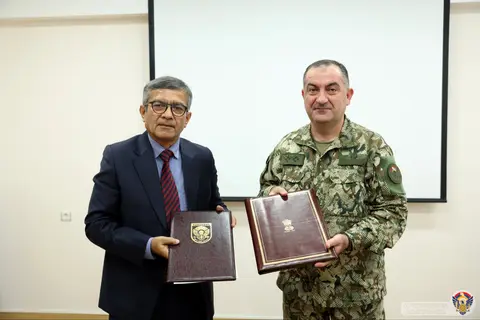
 DEFENCE INDUSTRYBrahMos export orders: Vietnam deal worth about $100 million, Indonesia $200 million as Akash reaches Tajikistan, Turkmenistan
 DEFENCE INDUSTRYMahindra Embraer Nagpur facility to assemble C-390 if IAF picks the aircraft
 DEFENCE INDUSTRYSMPP Drone Manufacturing Push: Firm Shifts From Ammunition to Unmanned Warfare, Targets Integrated Defence Capabilities
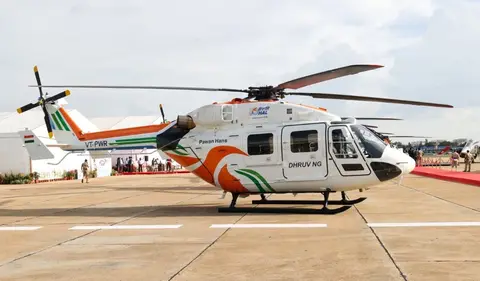 INDIA DEFENCEDhruv NG Helicopter Explained: What HAL Has Actually Put Into Pawan Hans Service
 INDIA DEFENCELCA FOC Trainers Delivered With HTT 40 and Dhruv NG as Rajnath Singh Asks Engineers for Technologies That Do Not Exist
The DRDO High Altitude Platform HAPS, which climbed to 21 km in a flight trial announced on Tuesday, belongs to a class of machine most Indians have never seen. It is not a plane, not a satellite and not a weather balloon, though it borrows from each.
What the DRDO High Altitude Platform HAPS did on its trial flight
The platform reached 21 km above mean sea level. It then held at about 20 km for more than 30 minutes, until controllers on the ground commanded it to come down, and it was recovered. Real-time video and other vehicle data reached the ground throughout the flight, according to the Ministry of Defence.
That is roughly twice the height at which passenger jets cruise.
The platform is being designed and developed by the Aerial Delivery Research and Development Establishment (ADRDE), the DRDO laboratory in Agra better known for parachutes, including the one that made its maiden live jump at Nyoma this week. The Indian Air Force, the Centre for Military Airworthiness and Certification (CEMILAC), the Directorate General of Civil Aviation (DGCA), the Airports Authority of India (AAI) and other civil authorities coordinated the 21 km flight trial.
What is a HAPS?
HAPS stands for High Altitude Platform System, and the simplest way to picture one is as a satellite that never goes to space. It is an unmanned aircraft or airship built to fly in the stratosphere, typically around 18 to 25 km up, and to stay over one area for a long time. Many designs run on solar power.
The DRDO High Altitude Platform HAPS is the lighter-than-air kind, an airship. The ministry describes it as a long endurance platform.
A satellite moves along a fixed orbit and passes over a given spot only at set times. A HAPS can park. It can also, in principle, be brought down, repaired, fitted with new equipment and sent back up, something no satellite in orbit allows.
Why 20 km
At that height a platform sits well above commercial air traffic and most weather, with a clear line of sight to areas hundreds of kilometres away.
What the armed forces could use it for
Watching, first of all. Fitted with day and night cameras, infrared sensors, radar or electronic listening equipment, a HAPS could keep a steady eye on troop movements, roads, supply activity and new construction. A surveillance aircraft has to return to base to refuel. A mature HAPS might stay up for days or weeks, depending on how well it generates and stores power, and it would not need to keep flying into the area it is watching.
The obvious place for this is the northern frontier, where the terrain is hard and changes on the other side have to be spotted early.
Talking is the second job. Mountains block radio signals. A platform above the peaks could relay messages between Army units in high-altitude areas and link troops, drones, aircraft and command centres, including during joint operations with the Air Force and other agencies.
The third is the sea. Over the Indian Ocean, a HAPS could keep watch on shipping lanes and suspicious activity, adding to what maritime patrol aircraft, satellites, coastal radars and drones already cover.
It would not replace the Netra airborne early warning and control aircraft, ground radars or satellites. It would add a layer between them.
What has to be solved first
The trial was a technology demonstration. The step to an operational system runs through three engineering problems.
Endurance comes first. Holding at 20 km for weeks needs very efficient solar power, good energy storage and a light structure that can take strong winds, sharp temperature swings and the harsh conditions of the stratosphere.
Then the payload. Radars, high-resolution cameras and radio sets are heavy and hungry for power.
And station keeping, which means holding position over a chosen area for long periods even as high-altitude winds push the platform around. That ability is what finally decides a HAPS's military value.
From 17 km in 2025 to 21 km now
ADRDE's first stratospheric airship flew from the Sheopur trial site in Madhya Pradesh on 3 May 2025. It carried an instrument payload to around 17 km on a flight of about 62 minutes, the ministry said in its release at the time, and the team recovered it for study.
This year's platform went about 4 km higher, added a sustained hold at 20 km and sent live video down through the flight. Like the first, it was recovered.





COMMENTS
JOIN THE DISCUSSION