
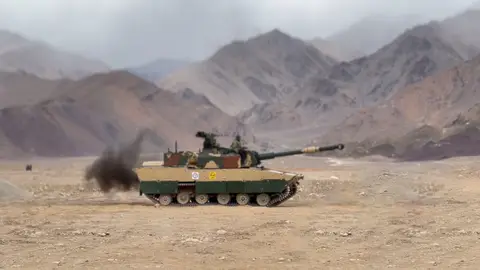
 DEFENCE INDUSTRYTata Zorawar light tank clears Army's L1 hurdle for Rs 20,000 crore contract
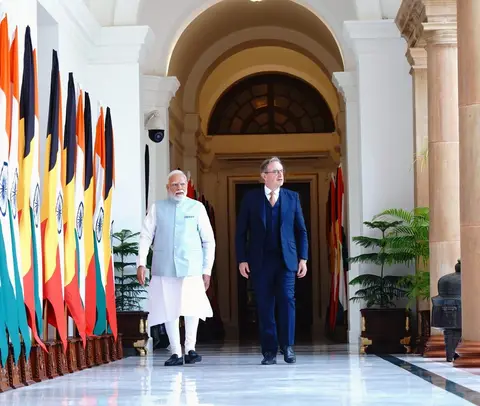 DEFENCE INDUSTRYIndia Belgium Defence Deals Sealed As PM De Wever Visits Delhi
 DEFENCE INDUSTRYAero India 2027 Dates Confirmed for February 8 to 12 in Bengaluru
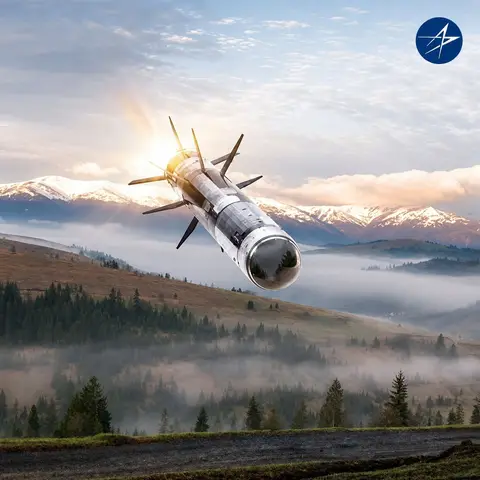 DEFENCE INDUSTRYJavelin missile co-production advances as Tata Advanced Systems signs Javelin Joint Venture pact
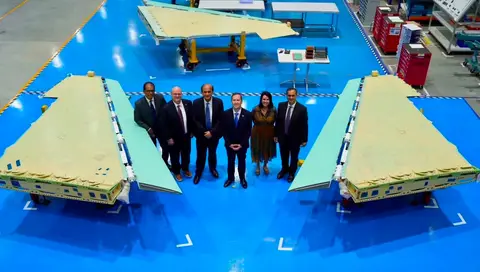 DEFENCE INDUSTRYTata Lockheed Martin MTA push gets a lift from US envoy's Hyderabad visit
India's defence exports have grown from a negligible base a decade ago into a rapidly expanding stream of missiles, aircraft, artillery, ammunition and electronics sold to partner countries across Asia, Africa, Europe and Latin America. Successive annual records have turned exports into one of the most visible markers of the Make in India and Atmanirbhar Bharat defence push, with the government now pursuing an ambitious medium-term export target.
Key facts
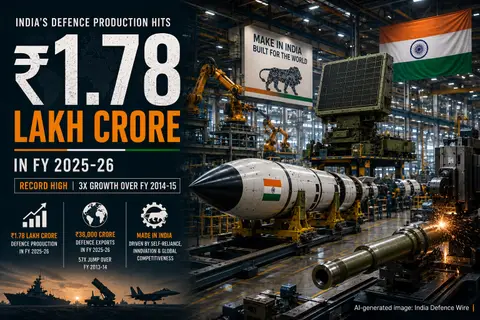
- Defence exports touched a record ₹38,424 crore in FY 2025-26, up 62.66 percent over the previous year's ₹23,622 crore.
- FY 2024-25 exports of ₹23,622 crore were themselves a record, up 12.04 percent over FY 2023-24's ₹21,083 crore.
- Private industry contributed ₹17,353 crore (45.16 percent) of FY 2025-26 exports, with DPSUs contributing ₹21,071 crore (54.84 percent).
- The number of active defence exporters rose to 145 in FY 2025-26, from 128 a year earlier.
- India now exports defence equipment to more than 80 countries, with a government target of ₹50,000 crore in annual exports by 2029.
Record growth
Exports have risen roughly three-fold over the past five years, driven by a combination of policy support — simplified export licensing, defence attaches promoting Indian equipment abroad, and lines of credit for partner countries — and the maturing of platforms that are now competitive on the international market. Both DPSUs and private companies have contributed to the surge, with private industry's ammunition, electronics and platform exports complementing DPSU sales of missiles, aircraft and naval equipment. The number of companies holding export authorisations has also widened well beyond the large primes, with 145 firms recorded as active exporters in FY 2025-26 compared with 128 a year earlier, reflecting a broader base of MSMEs and mid-sized private manufacturers now shipping components and sub-systems abroad alongside the larger platform sales.
What India exports
The export basket has diversified well beyond the ammunition and small components that once dominated it. Current offerings include the BrahMos supersonic cruise missile, the Akash surface-to-air missile system, Pinaka multi-barrel rocket launchers, Advanced Towed Artillery Gun System (ATAGS) howitzers, Dornier-228 transport aircraft, Advanced Light Helicopters, Swathi weapon-locating radars, electronic-warfare systems, naval patrol vessels, ammunition and protective equipment such as bulletproof jackets and night-vision devices. Armenia has emerged as a major buyer, acquiring Akash-1S missile systems, Pinaka rocket launchers and ATAGS howitzers, while Advanced Light Helicopters have gone to Mauritius, Nepal and the Maldives and Dornier-228 aircraft to Sri Lanka and Seychelles.
BrahMos and the Philippines
The most prominent recent export success is the sale of the shore-based, anti-ship version of the BrahMos supersonic cruise missile to the Philippines, under a $375-million contract signed in 2022 for three missile batteries. The first battery was delivered in April 2024 and later inducted by the Philippine Marine Corps into a coastal defence regiment in western Luzon; a second battery followed in April 2025, with the third expected by early 2026. Manila has since opened discussions with New Delhi for a further expansion of up to nine additional batteries, which would make BrahMos the backbone of the Philippines' coastal missile force and mark India's most significant single defence-export contract to date.
Target for 2029
The government has set a target of ₹50,000 crore in annual defence exports by 2029, roughly one-and-a-quarter times the FY 2025-26 figure. Officials attribute the trajectory to deepening private-sector participation, DPSU export drives, and defence diplomacy that pairs equipment sales with training, maintenance support and technology-transfer offers, positioning India as a credible alternative supplier in a global arms market long dominated by a small number of established exporters. Reaching that goal would require exports to keep compounding at close to the pace seen in FY 2025-26, but officials point to a healthy pipeline of BrahMos, Akash and artillery orders under discussion with several countries as grounds for confidence that the target remains within reach.