
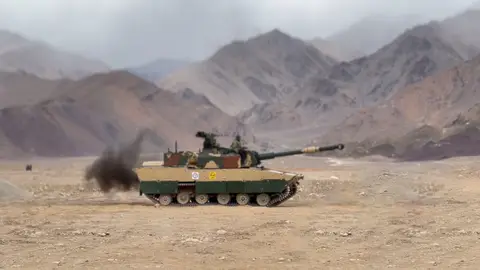
 DEFENCE INDUSTRYTata Zorawar light tank clears Army's L1 hurdle for Rs 20,000 crore contract
 DEFENCE INDUSTRYIndia Belgium Defence Deals Sealed As PM De Wever Visits Delhi
 DEFENCE INDUSTRYAero India 2027 Dates Confirmed for February 8 to 12 in Bengaluru
 DEFENCE INDUSTRYJavelin missile co-production advances as Tata Advanced Systems signs Javelin Joint Venture pact
 DEFENCE INDUSTRYTata Lockheed Martin MTA push gets a lift from US envoy's Hyderabad visit
The Indian Army's operational and training responsibilities are divided among seven commands, each covering a defined geographic zone or functional role and led by a General Officer Commanding-in-Chief (GOC-in-C) of Lieutenant General rank. Six commands hold direct operational responsibility for a stretch of India's borders or coastline, while the seventh, the Army Training Command, oversees training and doctrine across the force. The command structure has evolved gradually since independence, with the newest command raised as recently as 2005 to meet a changing threat picture along the western border.
Key facts
- Northern Command, headquartered at Udhampur, covers Jammu and Kashmir and Ladakh, including the Line of Control and Line of Actual Control
- Western Command, headquartered at Chandimandir, covers Punjab, Haryana and parts of Jammu opposite Pakistan
- South Western Command, headquartered at Jaipur, was raised in 2005 to cover the Rajasthan desert sector
- Southern Command, headquartered at Pune, is the Army's oldest command and covers the peninsular states
- Central Command, headquartered at Lucknow, provides training, logistics and second-line defence in north-central India
- Eastern Command, headquartered at Kolkata, covers the north-eastern states bordering China, Myanmar, Bangladesh and Bhutan
- Army Training Command (ARTRAC), headquartered at Shimla, runs the Army's training establishments and doctrine
Operational commands
Northern Command is regarded as the Army's most strategically demanding formation, holding responsibility for the high-altitude Siachen Glacier, the Line of Control with Pakistan and the Line of Actual Control with China in Ladakh. Western Command and South Western Command together secure the plains and desert sectors facing Pakistan, with South Western Command carved out of the older Western and Southern Commands to give the Rajasthan front a dedicated operational headquarters. In the east, Eastern Command manages both conventional defence against China along the Line of Actual Control and long-running counter-insurgency operations across the north-eastern states.
Southern and Central Commands
Southern Command, the oldest of the Army's commands, oversees the western and southern peninsular states and coordinates with the Navy on coastal defence in that region. Central Command, based in Lucknow, does not face an external border directly but plays a vital role in training, logistics, rear-area security and disaster response across the Gangetic plains.
Training Command
ARTRAC, based in Shimla, is unique among the seven in having no assigned geographic sector; instead it oversees the Army's training army-wide, from basic recruit training to specialised arms schools, and is responsible for evolving doctrine, concepts and force structures as warfare changes.
Corps within each command
Each operational command is further divided into corps — usually three or four — followed by divisions, brigades and battalions down to unit level. Strike corps capable of offensive operations are concentrated in the commands facing Pakistan, while mountain-oriented corps and divisions are based in Northern and Eastern Commands to operate along the high-altitude Line of Actual Control with China. This layered command-corps-division structure allows the Army to plan and fight at a scale appropriate to each front, from localised border skirmishes to full-scale conventional war.
Together, the seven commands allow the Army to combine dedicated, terrain-specific operational planning along each of its live borders with a centralised system for training, doctrine and force modernisation that keeps the wider force ready for deployment wherever it is needed.