

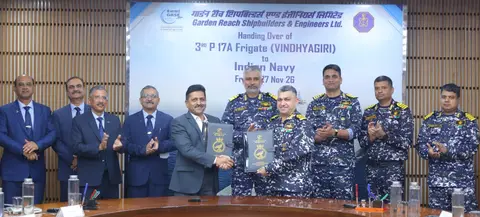
 INDIA DEFENCEProject 17A deliveries complete as GRSE hands over seventh frigate Vindhyagiri to Navy
 MINISTRY OF DEFENCEDelhi Defence Dialogue 2026: Self-reliance means no hostage to outside suppliers, says Rajnath Singh
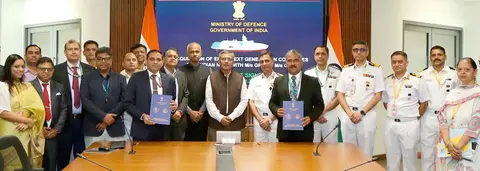 MINISTRY OF DEFENCENext Generation Corvettes contracts worth Rs 53,866.50 crore signed with GRSE and GSL
 MINISTRY OF DEFENCEBDL single tender for anti-tank missile sights goes to firm set up by former CMD Siddharth Mishra
 DEFENCE INDUSTRYBrahMos export orders: Vietnam deal worth about $100 million, Indonesia $200 million as Akash reaches Tajikistan, Turkmenistan
The CISF IIT Delhi MoU, signed on Thursday at the IIT Delhi campus in New Delhi, brings the Central Industrial Security Force and the Indian Institute of Technology Delhi together on drone and anti-drone technology.
Senthil Avoodai Krishna Raj S, IPS, signed on behalf of the CISF. Prof Rangan Banerjee, Director, IIT Delhi, signed for the institute, with Prof Ashwini K Agarwal, Dean (R&D), present. The same CISF officer had signed the force's cyber security training agreement with IIT Ropar in August.
Four areas of cooperation under the CISF IIT Delhi MoU
The agreement sets up a structured framework between the two sides. It has four parts.
Under training and capacity building, IIT Delhi will run specialised technical programmes for CISF personnel. Joint research and development is meant to produce practical, indigenous solutions matched to field requirements. A third strand takes security problems the force meets on the ground and turns them into academic research. The fourth covers the exchange of research papers, technical ideas and expert consultancy, so that the force keeps pace with changing unmanned aerial threats.
Each CISF sector needs a different counter-drone answer
The Ministry of Home Affairs has designated the CISF as the nodal agency for the aerial security of vital installations. According to the force, it is now studying operational use cases and threat perceptions at sites across the country.
The CISF recently reorganised itself along functional lines, with separate verticals for airports, ports, coal and power among others.
Its position is that one solution will not fit all of them. Airports need high-precision detection and counter-drone measures that do not disrupt flying, to protect flight paths and crowded terminals. Ports face maritime and coastal aerial threats and need perimeter defence built for that setting. Coal and power installations are spread over large industrial areas. They need wide-area surveillance, night-vision capability and round-the-clock monitoring.
Working with research institutions lets the force co-develop solutions for each of these settings, the CISF said.
IIT Delhi joins Ropar, Kanpur, Madras and Hyderabad
The CISF IIT Delhi MoU is the force's fifth with an IIT. IIT Ropar's agreement focuses on cyber security and technology capability for aviation infrastructure. IIT Kanpur holds two MoUs with the force, one for cyber security training through C3iHub and a five-year agreement to develop the Centre of Excellence in Drone and Anti-Drone Technology at MPRTC Behror, Rajasthan. IIT Madras, through Pravartak, works with the CISF on technology and security training. At IIT Hyderabad, the TiHAN hub covers autonomous navigation, drone training for NISA trainees and technical support for countering aerial threats.
More institutes, more training seats
Course seats at any single institute are limited. Spreading the training across several IITs allows the CISF to train a larger number of personnel at the same time, the force said, which speeds up readiness across its units.
Behror already anchors CISF drone training
The IIT Delhi work adds to a counter-drone base the force has been building in Rajasthan. In August, the CISF signed an MoU with the Drone Federation of India to develop Behror into a national counter-drone hub, covering deployment procedures, forensic analysis and red-teaming with Indian drone firms.
More than 7,000 CISF personnel have so far been trained in drone and counter-drone operations.



COMMENTS
JOIN THE DISCUSSION