

 DEFENCE INDUSTRYBrahMos export orders: Vietnam deal worth about $100 million, Indonesia $200 million as Akash reaches Tajikistan, Turkmenistan
 DEFENCE INDUSTRYMahindra Embraer Nagpur facility to assemble C-390 if IAF picks the aircraft
 DEFENCE INDUSTRYSMPP Drone Manufacturing Push: Firm Shifts From Ammunition to Unmanned Warfare, Targets Integrated Defence Capabilities
 INDIA DEFENCEDhruv NG Helicopter Explained: What HAL Has Actually Put Into Pawan Hans Service
 INDIA DEFENCELCA FOC Trainers Delivered With HTT 40 and Dhruv NG as Rajnath Singh Asks Engineers for Technologies That Do Not Exist
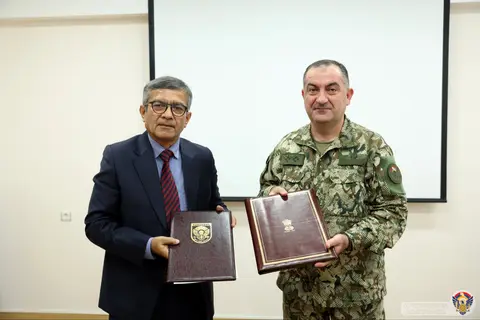
The CISF Drone Federation MoU was signed on Friday at Central Industrial Security Force Headquarters in New Delhi, bringing the force into a formal partnership with the Drone Federation of India (DFI) to widen its drone and counter-drone capabilities at the critical installations it guards. The agreement was signed by Dr C D Naik, DIG (Principal) of the Modernisation, Planning, Research, Training and Communication (MPRTC) unit at Behror, on behalf of CISF, and Shri Smit Shah, President of DFI.
The signing was witnessed by Shri Praveer Ranjan, Director General, CISF, along with Shri Sudhir Kumar, ADG (North), and Shri Vijay Prakash, ADG (HQ). DFI's delegation included Shirin Joshi, Director, Shivangi Prakash, Associate Director, and Sama Sehgal, Chief of Staff.
CISF's expanding footprint in drone operations
CISF is the nodal agency for handling aerial threats at vital installations, and it currently secures more than 370 units across the country, spanning aviation, nuclear facilities, space centres and oil refineries. That spread has pushed the force to treat rogue drones as an operational priority rather than a peripheral risk, a shift the force says draws on operational lessons from sensitive border units and other critical sites where a fast, dependable response has mattered.
Drone technology already sits inside CISF's daily operations. Over 3,000 personnel have been formally trained in drone and anti-drone protocols, building on the 7,120-personnel drone training milestone the force crossed earlier this year. Roughly 80 CISF units now use drones for monitoring, threat detection and training, and a dedicated team of domain experts is pioneering how the technology gets absorbed into the force's operational fold.
RTC Behror positioned as a counter-drone centre of excellence
A central aim of the MoU is to grow CISF's Recruit Training Centre (RTC) at Behror into a full Centre of Excellence for Drone and Counter-Drone Systems, developed strictly within Ministry of Home Affairs guidelines. CISF has assembled a dedicated team of domain experts to lead that effort inside the force's operational framework.
Under the partnership, DFI will organise structured engagements between CISF and Indian drone startups and technology firms, aimed at capacity building, applied research and operational preparedness at Behror. It follows a similar academic-partnership template to the one CISF struck this month with IIT Ropar, where a six-week residential cyber security programme is being run to build a specialised cadre for aviation infrastructure.
What the CISF Drone Federation MoU covers on the ground
The collaboration spans four broad areas. On deployment, DFI will support CISF in developing standard operating procedures, deployment frameworks and pilot projects for structured counter-drone operations across CISF-protected sites, from airports to nuclear installations and refineries. On the forensic side, the two organisations will work to establish best practices and indigenous forensic tools for analysing, investigating and assessing rogue drone incidents after the fact, feeding lessons back into how CISF trains its personnel.
Red-teaming drills and a training pipeline
Joint drills form the operational core of the arrangement. Controlled red-teaming exercises will test how CISF detects, tracks, responds to and escalates against a rogue drone intrusion, along with how it manages readiness once an incident has passed. Training and capacity building round out the MoU, with dynamic modules, student hackathons and challenge programmes designed to cover operational practice, regulation and threat scenarios for personnel working the counter-drone beat, a track that sits alongside the counter-drone drills the Army's Spear Corps has already run with CISF personnel guarding Agartala's MBB Airport.
The Drone Federation of India represents manufacturers, service providers and technology developers across the country's drone and counter-drone ecosystem, and has previously worked with state governments and industry bodies on skilling programmes in the sector.
What CISF and DFI said about the partnership
DG Ranjan called the MoU important for CISF's Behror ambitions. "This MoU is particularly important for CISF as we are working towards developing RTC Behror as a Centre of Excellence in the field of Drones and Counter-Drone Systems," he said, adding that he was confident the partnership would help the force meet objectives set by the Ministry of Home Affairs and build Behror into a leading national centre for drone and counter-drone capabilities. He said DFI's involvement would let CISF test its preparedness against realistic and evolving drone threats and identify gaps in its existing systems, procedures and response mechanisms.
CISF announced the MoU on X shortly after the ceremony, tagging the Ministry of Civil Aviation, DFI and the Ministry of Electronics and Information Technology.
https://x.com/CISFHQrs/status/2093324276317425884?ref_src=twsrc%5Etfw%7Ctwcamp%5Etweetembed%7Ctwterm%5E2093324276317425884%7Ctwgr%5E505321c42de7e01d8349ddae2555112bd7140802%7Ctwcon%5Es1_c10&ref_url=https%3A%2F%2Fpublish.x.com%2F%3Furl%3Dhttps%3A%2F%2Ftwitter.com%2FCISFHQrs%2Fstatus%2F2093324276317425884
Shah framed the agreement around the domestic drone industry's own stake in the outcome. "The Indian drone industry is fully committed to supporting the CISF in safeguarding the nation's critical infrastructure," he said, adding that DFI aims to bridge operational requirements with indigenous technological innovation. Testing startup capabilities in realistic scenarios, building robust forensic tools and creating specialised training platforms, he said, are steps toward a technologically resilient and Aatmanirbhar security architecture.
Neither side named a timeline for when the Behror centre would become operational, and CISF has not said which drone or counter-drone systems, indigenous or otherwise, it plans to test first once the CISF Drone Federation MoU moves from paper to practice.

COMMENTS
JOIN THE DISCUSSION