

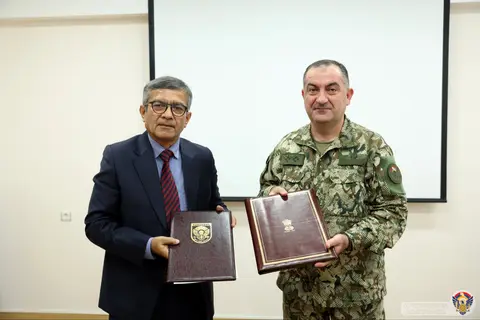
 DEFENCE INDUSTRYBrahMos export orders: Vietnam deal worth about $100 million, Indonesia $200 million as Akash reaches Tajikistan, Turkmenistan
 DEFENCE INDUSTRYMahindra Embraer Nagpur facility to assemble C-390 if IAF picks the aircraft
 DEFENCE INDUSTRYSMPP Drone Manufacturing Push: Firm Shifts From Ammunition to Unmanned Warfare, Targets Integrated Defence Capabilities
 INDIA DEFENCEDhruv NG Helicopter Explained: What HAL Has Actually Put Into Pawan Hans Service
 INDIA DEFENCELCA FOC Trainers Delivered With HTT 40 and Dhruv NG as Rajnath Singh Asks Engineers for Technologies That Do Not Exist
The IAF MiG-29 ASRAAM upgrade marks one of the most consequential air armament decisions in recent years, signalling a clear pivot from Soviet-era weapons towards advanced Western missile systems on one of the Air Force’s most battle-tested platforms. The Ministry of Defence has formally proposed the integration and testing of the Advanced Short Range Air-to-Air Missile on the upgraded MiG-29 UPG variant, replacing the legacy Russian-origin R-73 that has served the fleet for decades.
The decision reflects a broader strategic recalibration within the Indian Air Force — one that prioritises lethality, engagement range, and doctrinal flexibility in an increasingly contested aerial environment along both the western and northern frontiers.
What the ASRAAM Brings to the MiG-29
Developed by European missile major MBDA, ASRAAM is a high-speed, short-range air-to-air missile built specifically for the demanding conditions of modern close-combat aerial engagements. Its imaging infrared seeker and fire-and-forget capability allow a pilot to acquire a target, launch, and immediately disengage — a critical advantage in dynamic dogfight scenarios where seconds determine the outcome.
The missile reaches speeds exceeding Mach 3, carries a high-explosive warhead, and measures approximately 2.9 metres in length with a weight of around 88 kg. Most significantly for IAF pilots, ASRAAM delivers an engagement range of over 25 km — more than double the 10 to 15 km effective range of the R-73 it replaces.
That extended envelope means Indian pilots can engage threats from significantly safer stand-off distances, reducing their own exposure to enemy weapons while retaining the initiative in fast-moving aerial engagements.
Why the R-73 Needed to Go
The R-73 has been a reliable short-range missile since its induction into Soviet and then Russian service in the 1980s. For the IAF, however, the combination of its limited range and older guidance architecture no longer meets the demands of the threat environment India faces today.
Modern adversarial aircraft — including those operated across India’s western and northern borders — are equipped with advanced avionics, high-off-boresight missile systems, and electronic countermeasures. Against such platforms, the R-73’s engagement envelope is a liability. The IAF MiG-29 ASRAAM upgrade directly addresses this gap by delivering a missile system that can outrange, outpace, and out-manoeuvre the threats the fleet is most likely to encounter.
The upgrade also reduces the MiG-29’s dependence on Russian supply chains for critical ordnance, a strategic consideration that has grown sharper in the context of ongoing geopolitical shifts.
ASRAAM’s Track Record on Indian Platforms
The ASRAAM is not entering Indian service as an untested foreign import. The missile is already integrated on two IAF platforms — the LCA Tejas and the Jaguar — giving Indian pilots and maintenance crews operational familiarity with the system.
This existing integration footprint strengthens the case for the IAF MiG-29 ASRAAM upgrade from both a technical and logistical standpoint. Engineers and armourers working on the MiG-29 UPG variant will be building on institutional knowledge already accumulated across the Tejas and Jaguar programmes, reducing integration risk and accelerating the transition timeline.
Make in India: BDL and the Hyderabad Production Line
The upgrade carries strong Atmanirbhar Bharat credentials. Under a 2021 agreement, Bharat Dynamics Limited is collaborating with MBDA for local assembly and testing of the ASRAAM. A dedicated production facility is under development in Hyderabad, positioning India to progressively reduce import dependency on this critical short-range weapon system.
BDL’s involvement ensures that as the IAF scales up ASRAAM procurement — across Tejas, Jaguar, and now the MiG-29 fleet — the supply chain has a domestic anchor. This is precisely the model the government has consistently advocated: acquire proven foreign technology, localise production, and build indigenous capacity for sustained operations. The ASRAAM programme is a textbook execution of that approach.
The MiG-29’s Continued Relevance
With over 55 aircraft in active service, the MiG-29 remains a significant component of India’s tactical air power. Inducted in 1987, the aircraft has been progressively upgraded to the UPG standard, extending its operational life and expanding its mission profile to include both air superiority and ground attack roles.
The fleet is deployed along India’s most sensitive frontiers and saw operational use during Operation Sindoor in 2025, confirming that the MiG-29 is not a legacy asset being managed into retirement but an active combat platform with real-world tasking. Arming it with ASRAAM is a logical extension of the investment India has already made in keeping the aircraft combat-relevant.
Strategic Weight of the Decision
The IAF MiG-29 ASRAAM upgrade is more than a weapon swap. It represents a deliberate strengthening of India’s deterrence posture in short-range aerial combat — the domain most likely to be decisive in any high-intensity conflict along India’s borders. By pairing a proven airframe with a next-generation missile, the IAF is ensuring that even its older platforms carry a credible and modern offensive punch.
The IAF MiG-29 ASRAAM upgrade, taken alongside the Tejas production ramp-up, the induction of Rafale jets, and the ongoing S-400 deployment, reinforces a consistent pattern: India is modernising its air power systematically, purposefully, and with increasing self-reliance at the core of every programme.




COMMENTS
JOIN THE DISCUSSION