

 DEFENCE INDUSTRYTata Zorawar light tank clears Army's L1 hurdle for Rs 20,000 crore contract
 DEFENCE INDUSTRYIndia Belgium Defence Deals Sealed As PM De Wever Visits Delhi
 DEFENCE INDUSTRYAero India 2027 Dates Confirmed for February 8 to 12 in Bengaluru
 DEFENCE INDUSTRYJavelin missile co-production advances as Tata Advanced Systems signs Javelin Joint Venture pact
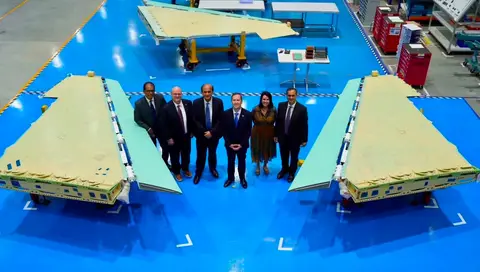 DEFENCE INDUSTRYTata Lockheed Martin MTA push gets a lift from US envoy's Hyderabad visit
GSAT-32 Satellite Terminals: DRDO Awards Rs 9.94 Crore Contract to Avantel
GSAT-32 satellite terminals are at the centre of a new Rs 9.94 crore contract that the Defence Research and Development Organisation has awarded to Hyderabad-based Avantel Limited, advancing India's push to build indigenous secure communication infrastructure for the armed forces. The contract, placed under the Ministry of Defence, requires Avantel to develop and validate the terminals under the GSAT-32/N3 programme, with the work scheduled for completion by December 2028.
Avantel Limited, headquartered in Hyderabad, is a specialist in satellite communication systems and has an established track record of delivering communication solutions for defence and strategic users. The company's selection for this programme reflects DRDO's preference for working with experienced domestic vendors capable of meeting the technical demands of military-grade satellite communication development.
What the GSAT-32/N3 Programme Entails
The GSAT-32/N3 programme focuses on building satellite terminals that will support secure and reliable satellite-based communications across defence and strategic applications. Satellite terminals serve as the ground-based or platform-mounted interface between users and communication satellites, enabling data transmission, voice links and real-time information exchange across operational environments. In a military context, these systems are central to maintaining connectivity between forward-deployed units, naval vessels, aerial platforms and command headquarters.
Under the contract, Avantel will carry out both development and testing of the terminals, ensuring that the systems meet the specifications required for operational use in demanding conditions. The December 2028 completion timeline gives the programme approximately two and a half years for full development and validation cycles, pointing to the technical complexity involved in producing defence-grade satellite communication hardware to Indian military standards.
GSAT-32 is part of India's growing constellation of communication satellites operated by the Indian Space Research Organisation, and the N3 designation refers to the specific payload or service band configuration under which these terminals will operate. Integrating indigenous ground terminals with the satellite infrastructure is an important step in reducing India's dependence on foreign communication systems for defence purposes.
GSAT-32 Satellite Terminals and the Indigenisation Agenda
This contract sits squarely within DRDO's sustained effort to grow the domestic defence technology base across every critical domain, communication infrastructure included. Satellite communication has become a foundational enabler of modern military operations, supporting everything from intelligence, surveillance and reconnaissance networks to logistics coordination and battlefield management systems. Building these capabilities at home, rather than procuring finished systems from abroad, is now a stated priority of the defence establishment.
The government's Aatmanirbhar Bharat policy has given fresh impetus to exactly this kind of programme. Contracts that route development work through Indian private sector companies such as Avantel help build technical depth within the domestic industry, creating a pool of engineers and test infrastructure that can support more advanced programmes in the years ahead. The Rs 9.94 crore value of this contract, while modest in absolute terms, represents an investment in capability-building rather than a simple procurement transaction.
India's armed forces have for years relied on a mix of indigenous and foreign-sourced satellite communication terminals. Each successive programme that successfully develops and fields a homegrown solution reduces that dependence incrementally, and the cumulative effect of these incremental gains is a communication architecture that is less vulnerable to supply disruptions or foreign technology restrictions. The GSAT-32/N3 programme is one step in that longer trajectory.
Avantel's Role and Strategic Significance
Siddhartha Abburi, Director of Avantel Limited, said the company was honoured to have been selected by DRDO for the programme and reaffirmed its commitment to delivering advanced communication solutions tailored to India's strategic requirements. The statement captures the direction in which Avantel has been developing its business, with an increasing focus on defence and government clients where the technical bar is high and the strategic value of reliable performance is clear.
Avantel has previously worked on satellite communication programmes for Indian defence and government users, giving it institutional familiarity with the procurement processes, testing protocols and operational requirements that characterise this segment. That background is relevant here because developing military satellite terminals is not simply an engineering task. It requires understanding how these systems will be used in the field, what environmental and operational stresses they must withstand, and how they integrate with broader communication networks that the armed forces depend on for mission execution.
Hyderabad has over the past decade become a significant node in India's defence electronics ecosystem, with a concentration of companies working on communication systems, radar technology and electronic warfare. Avantel is among the established players in that cluster, and contracts of this nature reinforce the city's position as a hub for defence technology development.
Network-Centric Warfare and the Demand for Satellite Communication
The broader context for programmes like GSAT-32/N3 is the shift across all three Indian services toward network-centric approaches to warfare. The concept, broadly speaking, involves linking sensors, decision-makers and shooters through robust communication networks so that battlefield information flows rapidly and operations can be coordinated with greater precision and speed. Satellite communication is a critical layer in that architecture, particularly for operations in remote or contested terrain where terrestrial communication links are unavailable or unreliable.
The Indian Army has been working to expand its satellite communication capabilities to support operations along the northern borders, where the terrain makes conventional communication infrastructure difficult to maintain. The Indian Navy operates across vast ocean areas where satellite links are the primary means of maintaining contact with shore-based command structures. The Indian Air Force depends on satellite communication for both operational coordination and for the data links that support its intelligence and surveillance missions. All three services have a direct interest in seeing domestic satellite terminal programmes succeed.
DRDO's role in programmes like GSAT-32/N3 is to drive the development side while the services provide the operational requirements. When a programme reaches the field, the terminals that come out of it will need to meet demanding standards for reliability, security and interoperability with existing and future satellite payloads. The testing phase of the Avantel contract, running through to December 2028, will be where those standards are put to the proof.
DRDO's Broader Communication Technology Push
GSAT-32 satellite terminals represent one piece of a larger portfolio of communication technology programmes that DRDO is advancing in parallel. The organisation has been working on software-defined radios, tactical communication systems, electronic warfare platforms and cyber-secure communication networks across multiple concurrent programmes. The satellite terminal work with Avantel adds another dimension to this effort, extending DRDO's reach into the space-based layer of military communication.
India's defence communication infrastructure has historically included equipment sourced from multiple foreign vendors, which creates both logistical complexity and strategic risk. A communication system that depends on foreign components or software is a potential vulnerability in a conflict scenario, whether through supply chain disruption or through the risk of embedded features that a foreign supplier could exploit. Building indigenous alternatives, even when they take time to develop and require sustained investment, addresses that vulnerability at its root.
The Rs 9.94 crore contract with Avantel is the kind of development investment that does not generate the headlines that missile programmes or aircraft acquisitions do, but that quietly builds the foundation on which those higher-profile capabilities depend. Satellite communication terminals that work reliably under operational conditions are what allow a commander to talk to a forward unit, a naval vessel to receive tasking from fleet headquarters, or a strike aircraft to transmit post-mission data to an intelligence cell. The systems are invisible when they work and critical when they do not.
With the contract now in place and work set to run through December 2028, DRDO and Avantel have a defined timeline to produce validated terminals that advance India's indigenous satellite communication capabilities under the GSAT-32/N3 framework. The outcome of that programme will be one of many data points in the larger story of whether India's Aatmanirbhar Bharat defence industrial base can consistently deliver on the technical ambitions that policy has set for it.
For more on DRDO's satellite and communication technology programmes, visit the official DRDO website. Details on the GSAT-32 satellite family are available through the Indian Space Research Organisation. Avantel Limited's defence communication portfolio is documented on the Avantel corporate website.




COMMENTS
JOIN THE DISCUSSION