

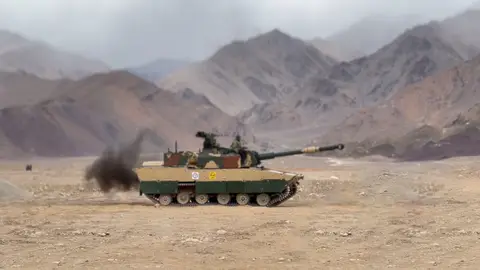
 DEFENCE INDUSTRYTata Zorawar light tank clears Army's L1 hurdle for Rs 20,000 crore contract
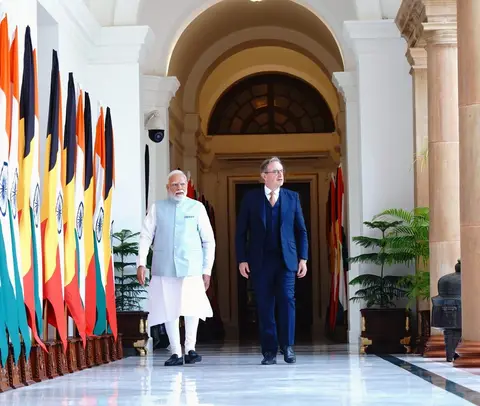 DEFENCE INDUSTRYIndia Belgium Defence Deals Sealed As PM De Wever Visits Delhi
 DEFENCE INDUSTRYAero India 2027 Dates Confirmed for February 8 to 12 in Bengaluru
 DEFENCE INDUSTRYJavelin missile co-production advances as Tata Advanced Systems signs Javelin Joint Venture pact
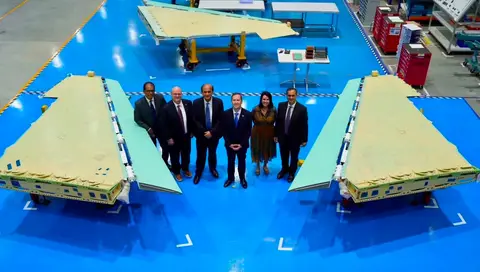 DEFENCE INDUSTRYTata Lockheed Martin MTA push gets a lift from US envoy's Hyderabad visit
India Nuclear Warheads Rise to 190, Maintaining Lead Over Pakistan: SIPRI 2026
India nuclear warheads number approximately 190 at the start of 2026, according to the Stockholm International Peace Research Institute's annual yearbook, placing New Delhi ahead of Pakistan's estimated stockpile of around 170 warheads. The assessment, released as part of SIPRI's authoritative global review of armaments, disarmament and international security, captures the continuing arc of India's nuclear modernisation and its growing emphasis on longer-range delivery systems.
SIPRI, the Sweden-based research institute whose annual yearbook is among the most closely watched assessments in global strategic affairs, noted that India's modernisation programme is increasingly shaped by the need to hold targets across China at risk, while the enduring security challenges posed by Pakistan continue to anchor the baseline requirements of New Delhi's deterrent posture.
India Nuclear Warheads in Context of South Asian Balance
The gap between India and Pakistan in estimated warhead numbers has remained relatively stable, but SIPRI flagged that Islamabad continued to accumulate fissile material and develop new delivery systems through 2025. The institute assessed that Pakistan's arsenal could grow further in the coming years, meaning the current numerical lead New Delhi holds does not translate into a static strategic balance.
Both countries were examined in the context of Operation Sindoor, which SIPRI described as an unusually severe military crisis in May 2025. The institute documented that India carried out strikes against Pakistani air and missile bases, with some of that infrastructure likely linked to nuclear-supporting military facilities. Despite the severity of the confrontation, SIPRI observed that both sides took deliberate steps to prevent further escalation, pointing to the functioning of deterrence and active crisis management between two nuclear-armed states sharing a land border.
The crisis also produced a development that SIPRI highlighted as significant in the evolution of modern conflict between the two neighbours. Cyber operations were integrated into active military operations by both India and Pakistan during the crisis, representing a meaningful shift in the character of confrontation in South Asia. The institute's documentation of this cyber dimension reflects a wider global trend: states are no longer treating cyber warfare as a tool separate from conventional or nuclear-tinged conflict, but as a component woven into the full spectrum of operations.
Strategic Triad and Sea-Based Deterrence
Beyond warhead numbers, SIPRI's assessment of India's nuclear posture focused on the growing sophistication of delivery systems and the increasing weight being placed on the sea-based leg of the strategic triad. India continues to invest in its submarine-launched ballistic missile capability, seeking to develop a survivable second-strike force that can operate from the depths of the Indian Ocean.
The report identified India as one of several Indo-Pacific states expanding underwater nuclear delivery capabilities, alongside China, Pakistan and North Korea. For New Delhi, the submarine deterrent carries a particular logic rooted in its declared no-first-use posture. A credible assured second-strike capability, survivable against a first strike, is the operational foundation on which India's deterrence doctrine rests, and the sea-based leg is central to that assurance.
Longer-Range Missiles and the China Calculus
SIPRI's observation that India's modernisation is increasingly oriented toward delivery systems capable of reaching targets across China reflects a strategic reorientation that has gathered pace over the past decade. The development of longer-range missile systems has moved from aspiration to operational programme as the security competition with Beijing has intensified. India's border standoffs with China, the accelerating pace of the People's Liberation Army's own modernisation, and Beijing's continued expansion of its nuclear arsenal have all contributed to a recalibration of India's deterrence requirements beyond the South Asian theatre.
India's Defence Spending Reaches USD 92.1 Billion
The SIPRI Yearbook 2026 placed India among the world's top five defence spenders for the year 2025. India's military expenditure reached USD 92.1 billion, an increase of 8.9 per cent over the previous year. This positioned India fifth globally, behind the United States, China, Russia and Germany.
The scale of that spending reflects both the ambition of India's ongoing force modernisation across all three services and the operational demands that the security environment continues to impose. From the accelerated procurement of air defence systems to the expansion of naval capacity and the push toward greater domestic production under Aatmanirbhar Bharat, the defence budget has become one of the more direct expressions of Indian strategic intent.
SIPRI also identified India as the second-largest importer of major arms globally during the 2021 to 2025 period, accounting for 8.2 per cent of total global arms imports. Only Ukraine imported more major weapons systems during the same period. The volume of India's arms imports during a period when the country has simultaneously been working to expand its domestic defence industrial base underscores the scale of the modernisation backlog that New Delhi has been attempting to address, and the pace at which it has sought to close capability gaps.
Global Nuclear Stockpiles and a Deteriorating Security Environment
The broader picture painted by SIPRI is one of renewed reliance on nuclear weapons as instruments of national power across all nine nuclear-armed states. The institute assessed the global warhead inventory at approximately 12,187 at the start of 2026, of which around 9,745 were held in military stockpiles and potentially available for use. Approximately 4,012 warheads were deployed with operational forces, and more than 2,000 remained on high operational alert.
SIPRI noted that while the overall global inventory continues to decline, the trend is primarily driven by the dismantlement of retired warheads by the United States and Russia. The institute cautioned that the pace of dismantlement is slowing and may soon be overtaken by the production and deployment of new warheads, particularly as China's expansion programme accelerates and other states modernise existing stockpiles.
China's nuclear arsenal grew from approximately 600 to 620 warheads over the past year, supported by what SIPRI described as an extensive modernisation programme. Beijing's expansion is not simply numerical. It encompasses new delivery platforms, improved command-and-control infrastructure and a strategic posture that appears to be moving toward a larger and more diverse force. For India, watching a nuclear-armed neighbour with which it shares a contested border expand its arsenal at this pace is a direct input into New Delhi's own modernisation calculus.
SIPRI recorded six interstate armed conflicts during 2025, double the number reported in 2024. These included the India-Pakistan crisis over Operation Sindoor, the ongoing Russia-Ukraine war with documented North Korean military involvement, the Iran-Israel-US confrontation, and several other regional disputes. The institute's director noted in the yearbook's introduction that the global strategic landscape has been fundamentally transformed over the past decade by the return of large-scale interstate warfare and intensifying major-power competition.
For New Delhi, the convergence of these trends, China's nuclear growth, Pakistan's continued weapons development, the lessons of Operation Sindoor, and a global environment of rising interstate conflict, all point in the same direction. India's nuclear warheads programme and its broader strategic modernisation are not responses to any single threat but to a security environment that has become measurably more complex and less forgiving over a relatively short span of years.
Full details of the SIPRI assessment are available through the institute's official publication at SIPRI Yearbook 2026. India's Ministry of Defence outlines the broader framework of national defence priorities at mod.gov.in. Background on India's nuclear posture and no-first-use doctrine is maintained by the Ministry of External Affairs.



COMMENTS
JOIN THE DISCUSSION