

 DEFENCE INDUSTRYBrahMos export orders: Vietnam deal worth about $100 million, Indonesia $200 million as Akash reaches Tajikistan, Turkmenistan
 DEFENCE INDUSTRYMahindra Embraer Nagpur facility to assemble C-390 if IAF picks the aircraft
 DEFENCE INDUSTRYSMPP Drone Manufacturing Push: Firm Shifts From Ammunition to Unmanned Warfare, Targets Integrated Defence Capabilities
 INDIA DEFENCEDhruv NG Helicopter Explained: What HAL Has Actually Put Into Pawan Hans Service
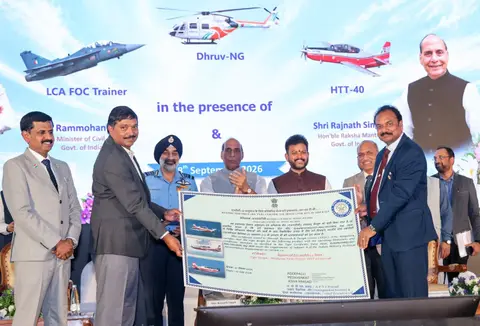 INDIA DEFENCELCA FOC Trainers Delivered With HTT 40 and Dhruv NG as Rajnath Singh Asks Engineers for Technologies That Do Not Exist
The Indian Army Bharat Rice initiative was launched for the defence forces in New Delhi on Monday, together with a Memorandum of Understanding (MoU) that gives the Army access to Food Corporation of India (FCI) warehousing, manpower and material-handling equipment during operational contingencies.
Defence Minister Rajnath Singh and Union Minister of Consumer Affairs, Food and Public Distribution Pralhad Joshi attended the ceremony, where the MoU was signed and exchanged. According to the Ministry of Defence, the rice will be delivered directly to Army Supply Depots, including those in far-flung parts of Ladakh and the North East. Until now, Army depots have collected rice from local FCI facilities.
The Defence Minister described Bharat Rice as a bond of trust running from the farmer's field to the soldier's plate, and said it gave tangible form to the spirit of Jai Jawan, Jai Kisan.
"This superior-quality rice will be provided in accordance with standard specifications. Furthermore, we are ensuring ergonomic packaging. While this initiative might appear small, it offers immense operational relief to the soldiers responsible for transporting rations to remote and difficult terrains," he said.
Indian Army Bharat Rice to be milled to defence specifications
The initiative has been spearheaded by the Directorate General of Supplies and Transport and grew out of sustained feedback from troops on ration quality, the ministry said. The rice will be milled to prescribed defence specifications and supplied through the National Agricultural Cooperative Marketing Federation of India Limited (NAFED) during financial year 2026-27. Each lot will go through quality-control checks. It is to be free from foreign matter and admixtures, with minimal broken, damaged and discoloured grains.
Packing follows the needs of forward posts. Procurement will be in 10 kg and 30 kg bags, which are easier to handle and carry where loads move by porter or on foot.
Officials said the scheme follows nearly 18 months of coordination among the Army, FCI, NAFED and the Department of Food and Public Distribution.
Pralhad Joshi said it was a matter of pride for his department to supply superior quality rice to those who protect the nation. "To provide quality food to the nation's protectors and cater to their needs is our duty," the Food Minister said.
FCI godowns brought into the Army supply chain
The second half of Monday's event concerned storage rather than food. The MoU provides the Army a formal framework to use identified FCI warehousing infrastructure, labour resources and material-handling equipment when an operational contingency arises. Coordination will run at formation level, between the Army's Supply and Transport elements and FCI's Regional and Divisional Offices, and will be written into operational logistics plans.
According to the ministry, the arrangement allows additional storage, rapid mobilisation, dispersion and forward positioning of rations, stores and equipment closer to operational areas, using national infrastructure that already exists. It has been aligned with the vision of PM Gati Shakti under a whole-of-government approach.
MoU valid for five years, extendable by mutual consent
The agreement runs for five years and can be extended if both sides agree.
Operation Sindoor lessons behind the logistics pact
Rajnath Singh said logistics itself is combat power, and that weapons, platforms and technology are not the only critical elements in modern warfare. Supply chains, storage capacity, transport networks, warehousing and timely replenishment count as much as the front line, he said.
He said the strategic analysis of Operation Sindoor indicated that future conflicts could begin at extremely short notice and draw heavily on technology. "Such conflicts could also put the endurance of our logistics chains and supply networks to the test. Therefore, we must build logistics resilience to sustain our operations," the Defence Minister said.
The ministry said the MoU draws on those operational lessons, which pointed to the need for logistics arrangements able to cope with contingencies that arise at short notice and stretch over long periods.
FCI holds warehouses, storage infrastructure, modern silos, material-handling equipment and trained manpower across the country, including in areas of operational importance. The Defence Minister called the pact a dual-use approach, in which national capacity serves civil and military needs alike. Just as fighter aircraft now land on expressways and roads and bridges built by the Border Roads Organisation are used by local residents, he said, FCI godowns will no longer be limited to food storage and will become an integral part of the Indian Army's supply chain.
"This MoU is far more than a mere administrative arrangement. It acts as a force multiplier for operational preparedness and reflects our 'Whole-of-Government' and 'Whole-of-Nation' approach," he said.
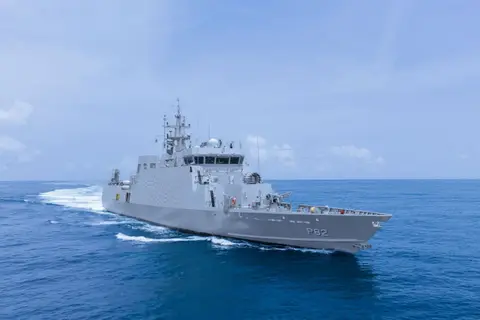
The sustainment push extends beyond the Army. Last week the Defence Minister launched the Navy's first indigenous Fleet Support Ship at Hindustan Shipyard Limited in Visakhapatnam, where he also laid the keel of the fifth ship in the class.
Soldiers' welfare integral to national security, says Defence Minister
Operational readiness is not defined by weaponry alone, Rajnath Singh said. It also rests on the physical health, mental balance, morale and stamina of soldiers serving in the harshest conditions. He described their welfare as an integral component of national security rather than a peripheral issue, adding that healthy food, robust equipment and complete training keep troops ready for every challenge.
The Defence Minister said the government's emphasis on self-reliance and modernisation now covers weaponry and technology as well as clothing, equipment and training, and that India produces a large share of its defence requirements at home, a theme he set out at length in his recent Defence Conclave address on strategic autonomy. Soldiers at the border must know the entire country stands with them, he said. That resolve, he added, is shared by farmers, the cooperative sector, the civil administration and the nation at large.
Chief of the Army Staff General Dhiraj Seth, Secretary (Food and Public Distribution) Sanjeev Chopra and senior officials from the Ministry of Defence, the Ministry of Consumer Affairs, Food and Public Distribution, FCI, NAFED and the cooperative sector were present.
The Indian Army Bharat Rice scheme is the latest in a series of steps the Army has taken in recent years to improve ration quality and scales. These include additional rations for Agniveer recruits and greater commonality in ration scales across the three Services. Organic rations are also proposed to be introduced.
COMMENTS
JOIN THE DISCUSSION