

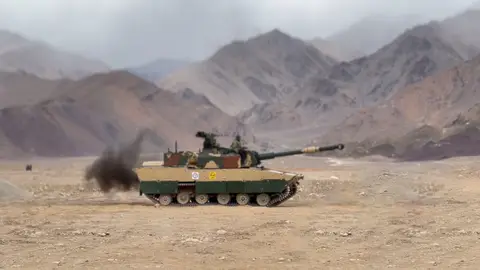
 DEFENCE INDUSTRYTata Zorawar light tank clears Army's L1 hurdle for Rs 20,000 crore contract
 DEFENCE INDUSTRYIndia Belgium Defence Deals Sealed As PM De Wever Visits Delhi
 DEFENCE INDUSTRYAero India 2027 Dates Confirmed for February 8 to 12 in Bengaluru
 DEFENCE INDUSTRYJavelin missile co-production advances as Tata Advanced Systems signs Javelin Joint Venture pact
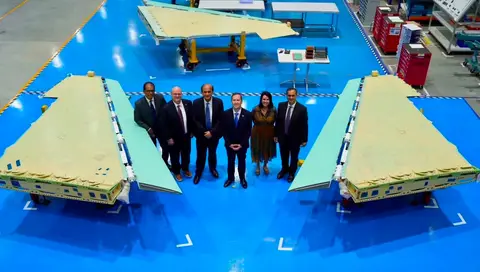 DEFENCE INDUSTRYTata Lockheed Martin MTA push gets a lift from US envoy's Hyderabad visit
MiG-29K Aero Rockets: Navy Seeks Domestic Industry To Build Indigenous 80-mm Munition
MiG-29K aero rockets are in line for full indigenisation after the Indian Navy issued an Expression of Intent inviting domestic defence manufacturers to design, develop and produce an indigenous 80-mm unguided air-to-ground rocket for its carrier-borne fighter fleet. The move replaces what has until now been an entirely import-dependent supply chain for a frontline aviation munition.
The EoI calls upon Indian industry to participate across the full development cycle, from design and engineering through qualification testing and series production. The rockets in question are used by MiG-29K and MiG-29KUB aircraft operating from India's two aircraft carriers, INS Vikramaditya and INS Vikrant. For the Navy, getting a domestic source for this munition is not merely an administrative preference. It directly addresses a vulnerability that any conflict or supply disruption would immediately expose.
India currently operates around 42 MiG-29K fighters, which constitute the entire fixed-wing strike component of its carrier aviation arm. These aircraft form the primary offensive layer aboard both carriers, and their operational readiness is directly tied to the availability of the weapons they carry. The 80-mm rocket, fired from B8M-1 launcher pods, is one of the key air-to-ground munitions in that inventory and has until now been sourced entirely from overseas suppliers. The EoI explicitly acknowledges that no indigenous alternative exists at present.
What the Navy Wants From Indian Industry
The technical requirements set out in the EoI are detailed and demanding. The rocket must weigh approximately 11.3 kilograms and measure around 1.54 metres in length. It must reach a velocity of approximately 600 metres per second and be capable of engaging targets at ranges between 1.3 km and 4 km. The weapon must remain serviceable for a minimum of 15 years and operate across a temperature envelope stretching from minus 60 degrees Celsius to plus 60 degrees Celsius, covering conditions from Arctic-equivalent high-altitude deployments to equatorial maritime operations.
The warhead specification is among the more exacting requirements in the EoI. The Navy has called for a 0.9-kg explosive payload that can penetrate 400 mm of armour on direct impact while simultaneously producing a minimum of 400 lethal metal fragments, each weighing approximately three grams, upon detonation. This dual-effect requirement means the weapon must be effective against hardened armoured targets as well as softer assets including radar installations, parked aircraft and infantry concentrations.
Altitude performance is another area where the specification pushes at the upper end of operational requirements. The rocket must be fully sealed and functional for storage and operations at altitudes up to 20,000 metres, and certified for launch from aircraft operating at heights of up to 17,500 metres. These figures reflect the full operational envelope of the MiG-29K and ensure the munition remains reliable across every mission profile the aircraft is likely to fly.
A Practice Round With Identical Flight Characteristics
Alongside the combat variant, the Navy has sought a practice version of the 80-mm rocket with flight characteristics identical to the live round but without an explosive warhead. This requirement is standard practice for high-performance aviation munitions and allows pilots to train with a realistic representation of the weapon's ballistics without the cost or safety implications of expending live ordnance. The Navy has specified a procurement of 2,400 practice rounds once the system successfully completes qualification, alongside 273 live rockets for operational inventory.
The induction timeline has been set at 2026-27, which means the programme carries an urgency that development teams will need to factor into their planning. Achieving full qualification of a military-grade aero rocket within that window will require companies to come to the programme with existing propulsion, warhead and fuze expertise rather than building from scratch.
MiG-29K Aero Rockets and the Indigenisation Imperative
The broader context for this EoI sits within the Navy's stated goal of achieving near-complete indigenous capability across its platforms and weapons systems by 2047. That ambition has gathered pace in recent years as the Aatmanirbhar Bharat framework has pushed all three services to identify import dependencies and systematically work to eliminate them. Aviation munitions have historically been one of the harder categories to indigenise because they require specialist propellant, warhead and fuze manufacturing capabilities that India's private sector has not traditionally held at scale.
That is changing. The Ministry of Defence has progressively opened the production licensing and development grant framework to draw a growing number of private companies into the munitions segment. The 80-mm rocket programme represents an entry point for companies that may already hold adjacent capabilities in rocket propulsion, pyrotechnics or precision metalwork but have not yet produced a complete, qualified air-delivered munition. The EoI makes clear that only those firms with demonstrable research and development expertise, dedicated testing infrastructure, proof range access and the financial capacity to sustain a multi-year development programme need apply.
The Navy's insistence that all sub-systems and assemblies be developed indigenously, with zero dependence on foreign original equipment manufacturers, sets a higher bar than some earlier indigenisation programmes that permitted a blend of domestic and imported components. It signals that the service wants a genuinely sovereign capability, not simply a domestic assembly operation built around imported parts.
Supply Chain Resilience as an Operational Requirement
The supply-chain dimension of this programme is worth understanding in the context of how Indian defence planners have been thinking since the events of May 2025. Operation Sindoor sharpened awareness across the armed forces of what import-dependent ammunition lines mean when a conflict ignites without the luxury of extended lead times for overseas procurement. A munition that can only be restocked through a foreign supplier is a munition whose availability in a sustained operation is contingent on factors outside Indian control. Building a domestic source for the 80-mm rocket addresses that problem at the level of one specific weapons line, but it also adds to a growing body of indigenous munitions capability that collectively strengthens the Navy's operational autonomy.
The carrier aviation dimension adds a particular edge to this point. India's two operational carriers represent the apex of its naval power-projection capability, and the MiG-29K fleet is the instrument through which that capability is exercised offensively. Maintaining those aircraft at full combat readiness requires uninterrupted access to their weapons, and the EoI is an acknowledgment that uninterrupted access cannot be assured when the supply line runs through a foreign manufacturer.
Industry Opportunity in a Specialist Segment
For India's private defence sector, the programme opens a window into one of the more technically demanding corners of the aviation munitions market. The 80-mm unguided rocket sits at the intersection of propulsion engineering, warhead design and precision mechanical manufacturing. Companies that successfully develop and qualify the system will build a capability base that is directly transferable to adjacent programmes, including guided rocket variants and other air-delivered munitions that the armed forces are expected to indigenise over the coming decade.
The procurement quantities specified in the EoI, 273 live rockets and 2,400 practice rounds, represent the initial buy on induction. As the MiG-29K fleet continues to fly and as training cycles consume practice rounds at a consistent rate, follow-on orders would be expected to sustain a viable production run for the successful developer. Interested companies can review the programme requirements and submission process through the Defence Acquisition Portal, where the EoI documentation is accessible.
MiG-29K aero rockets joining the list of systems earmarked for domestic development reflects a Navy that is thinking ahead about the operational consequences of supply dependence, and a defence industrial policy that is now mature enough to absorb specialist programmes of this kind into the Aatmanirbhar Bharat ecosystem.




COMMENTS
JOIN THE DISCUSSION