

 DEFENCE INDUSTRYBrahMos export orders: Vietnam deal worth about $100 million, Indonesia $200 million as Akash reaches Tajikistan, Turkmenistan
 DEFENCE INDUSTRYMahindra Embraer Nagpur facility to assemble C-390 if IAF picks the aircraft
 DEFENCE INDUSTRYSMPP Drone Manufacturing Push: Firm Shifts From Ammunition to Unmanned Warfare, Targets Integrated Defence Capabilities
 INDIA DEFENCEDhruv NG Helicopter Explained: What HAL Has Actually Put Into Pawan Hans Service
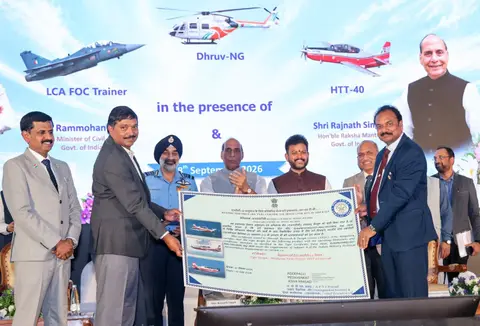 INDIA DEFENCELCA FOC Trainers Delivered With HTT 40 and Dhruv NG as Rajnath Singh Asks Engineers for Technologies That Do Not Exist
The Rajnath Singh Ambedkar University convocation in Lucknow, the university's 11th, turned into a civics lesson on Saturday, with the Defence Minister telling graduating students that acquiring knowledge counts for little unless they are willing to question injustice, and that any such fight has to run through the Constitution, never around it.
Speaking at Babasaheb Bhimrao Ambedkar University, Rajnath Singh traced the point back to Dr BR Ambedkar's final address to the Constituent Assembly, where he had argued that India's social and economic goals must be pursued by constitutional means alone, according to the Ministry of Defence. Where democratic and constitutional avenues exist, he said, resorting to violence or anarchy cannot be justified, a method Ambedkar had once termed a "grammar of anarchy" that India needed to abandon.
Rajnath Singh Ambedkar University message: educate, then agitate, then organise
Dr Ambedkar's mantra, the Defence Minister said, was to educate first, then question injustice, then organise for change, doing all three through democratic methods rather than the street. He urged students at a university named for the architect of the Constitution to hold onto that sequence as they entered public life.
He did not stop at civics.
Holding universities to a higher standard
Universities, Rajnath Singh said, should shape minds around justice, equality, liberty and fraternity, so graduates can contribute meaningfully to nation building. True education, in his framing, develops the capacity to think and understand while sharpening practical, problem solving skills, but its most important task is teaching people to use what they know for society's benefit.
He returned to Dr Ambedkar's own emphasis on character and humility, telling students that achievement without ethical grounding counts for little. Drawing on Swami Vivekananda, the minister asked the audience to look beyond personal success toward becoming job creators, problem solvers and catalysts of change, part of what he called a united Team India working toward the Viksit Bharat goal by 2047.
That framing carried through the rest of the Rajnath Singh Ambedkar University convocation, especially once the minister turned from the Constitution to the economy.
Team India and the Viksit Bharat push
Rajnath Singh argued that success tends to arrive not in favourable conditions but in the face of adversity, and that determination and hard work turn challenges into openings. Over the last decade, he said, the government led by Prime Minister Narendra Modi had applied the same logic at scale, building an Aatmanirbhar Bharat around semiconductor manufacturing, digital public infrastructure, start ups and manufacturing.
He asked students not to fear uncertainty, and to focus on solutions instead.
Learning as a moving target
The world is changing fast, Rajnath Singh told the gathering, with new technologies opening opportunities almost as quickly as they close old ones. Those willing to keep learning and picking up new skills, he said, would be the ones best placed to progress in it. A related push for youth already runs through openings for young people in the defence sector, part of the same effort to fold India's youth into nation building work.
From modest missions to a space station of India's own
On India's space record, the Defence Minister said the country had moved from missions run on limited resources to advanced programmes, including human spaceflight and plans for a space station, an ambition ISRO has been building toward through its Gaganyaan effort. He credited the private sector with a growing share of that progress, pointing to Indian space start ups making advances in launch vehicles and satellite technology.
Research spending has doubled over the past twelve years, he said, and the National Education Policy arrived after a 34 year gap. Indian students, meanwhile, are picking up medals at international Olympiads, launching start ups and building unicorns, a run that Rajnath Singh linked to India's climb in the Global Innovation Index and its position as the world's third largest start up ecosystem. The government, he assured the audience, would keep building an ecosystem where young people can explore, innovate and build solutions.
Economic strength, and something the balance sheet does not capture
Rajnath Singh closed on a distinction between prosperity and greatness. Economic strength makes a nation prosperous, he said, but cultural self confidence is what makes it great, and the push toward a developed nation by 2047 cannot be measured in growth figures alone. He pointed to government efforts around Indian languages and the country's knowledge tradition as part of that same project, one that also runs through the contribution young Indians are asked to make to a developed nation. India today, he argued, is heard on the world stage not only for the size of its economy but for its confidence in its own civilisation and its own institutions, a shift he framed as the quieter story behind the country's manufacturing and technology gains.
Deputy Chief Minister of Uttar Pradesh Brajesh Pathak attended the ceremony, along with university Vice Chancellor Prof Raj Kumar Mittal and members of the faculty and staff, the ministry said.


COMMENTS
JOIN THE DISCUSSION