

 DEFENCE INDUSTRYBrahMos export orders: Vietnam deal worth about $100 million, Indonesia $200 million as Akash reaches Tajikistan, Turkmenistan
 DEFENCE INDUSTRYMahindra Embraer Nagpur facility to assemble C-390 if IAF picks the aircraft
 DEFENCE INDUSTRYSMPP Drone Manufacturing Push: Firm Shifts From Ammunition to Unmanned Warfare, Targets Integrated Defence Capabilities
 INDIA DEFENCEDhruv NG Helicopter Explained: What HAL Has Actually Put Into Pawan Hans Service
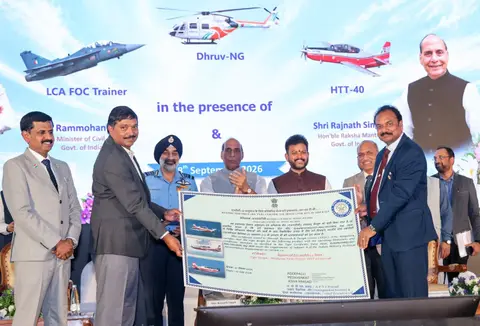 INDIA DEFENCELCA FOC Trainers Delivered With HTT 40 and Dhruv NG as Rajnath Singh Asks Engineers for Technologies That Do Not Exist
Rajnath Singh Nepal condolences were delivered in person on Monday, as the Defence Minister visited the Embassy of Nepal in New Delhi and signed the condolence book opened for victims of the flash flood that struck the Himalayan nation on 26 August 2026.
The visit placed a senior member of the Union Cabinet at the embassy on Barakhamba Road five days after the disaster, at a point when Nepal's own tally of the dead was still climbing by the day.
Message conveyed on behalf of the government and people of India
Singh's entry in the condolence book set out the government's position plainly, without the hedging that sometimes accompanies official messages of grief. He framed the gesture as coming from the country rather than from him alone, extending sympathy to both the Nepali people and their government.
"On behalf of the Government and people of India, I extend my deepest condolences to the people of Nepal and their Government, on the loss of precious lives and large-scale devastation caused by the flash flood on 26 August 2026," Singh wrote in the book, a copy of which was later shared through the Embassy of Nepal's own channels.
Hon’ble Minister of Defence of India Shri @rajnathsingh ji visited the Embassy today and signed the Book of Condolence on behalf of the Government and people of India.
— Nepal Embassy, India (@EONIndia) August 31, 2026
He conveyed his deepest condolences over the loss of precious lives and widespread devastation caused by the… pic.twitter.com/YYn15RDxvk
He went on to note that the calamity had struck Nepali citizens alongside a number of foreign nationals, Indians included, and that families of the dead were in the government's thoughts. Singh also wished a swift recovery for the injured. "As a close friend and partner, and Sukh Dukh Ke Saathi, India has always stood by Nepal," he added, describing the two countries' relationship in terms that go beyond diplomatic courtesy.
Rajnath Singh Nepal condolences follow a widening Indian relief effort
The embassy visit did not stand alone. Defence sources said it came against the backdrop of an Indian relief operation that has grown steadily since the flood first hit, with successive aircraft carrying humanitarian material into Kathmandu and further offers of specialised help still on the table.
India's Ministry of External Affairs has said the country stood ready to send National Disaster Response Force teams with dedicated equipment, an offer Kathmandu had yet to formally take up as of the weekend. A tunnel rescue reconnaissance team was despatched separately at Nepal's own request, to assess conditions near a hydroelectric project where workers were feared trapped, and Bailey bridge sections were offered for river crossings damaged in the flood. The Indian Air Force's first relief sortie had flown out of India within a day of the flood, carrying supplies and setting the pattern that later flights, medical teams and forensic experts have followed since.
https://x.com/SpokespersonMoD/status/2094350909665063120?ref_src=twsrc%5Etfw%7Ctwcamp%5Etweetembed%7Ctwterm%5E2094350909665063120%7Ctwgr%5E8846fc4667c755e4c09a95a274c27dce50aa559d%7Ctwcon%5Es1_c10&ref_url=https%3A%2F%2Fpublish.x.com%2F%3Furl%3Dhttps%3A%2F%2Ftwitter.com%2FSpokespersonMoD%2Fstatus%2F2094350909665063120
Toll from the flash flood keeps rising
Nepal's National Disaster Risk Reduction and Management Authority put the confirmed death count at 903 as of Monday, with Chitwan district alone accounting for 272 of the bodies recovered, the highest of any single district. Thousands more remain listed as missing across the flood affected river systems, and authorities across the border in Tibet have separately reported their own dead and missing from the same event.
The figures have moved in one direction only since the flood struck, rising from an initial count in the low hundreds to well over 900 within days. Search operations were still under way in several districts at the time of Singh's visit, and officials have not indicated when a final count might be reached.
A neighbourhood-first pattern with deeper Army roots
Singh's condolence call sits inside a longer running habit of treating Nepal's crises as close to home rather than as events at a distance. That instinct runs through the two countries' military relationship as well, most visibly in an Army-to-Army tradition that predates the current government by decades.
Chief of the Army Staff Gen Dhiraj Seth had travelled to Kathmandu earlier in August, in what was described at the time as his first foreign visit of consequence as chief. The trip culminated in Gen Seth receiving the honorary rank of General of the Nepali Army, an exchange the two forces have observed since 1950 and one that both sides have kept alive through successive changes of government on either side of the border.
Condolence visits have become something of a personal practice for Singh
This was not the Defence Minister's first stop at a foreign mission to record grief in person. He went to the High Commission of Bangladesh in New Delhi in January to sign a condolence book after the death of former prime minister Khaleda Zia, and to the Vietnamese Embassy in 2024 to pay tribute after the death of the Communist Party's then General Secretary. Ministry engagements of this kind are logged in the Ministry of Defence's own record of the minister's activities, alongside his core defence brief.
The Rajnath Singh Nepal condolences visit closes out a week in which India has sent more than 68.5 tonnes of emergency relief material to Nepal, alongside the tunnel rescue and forensic teams already on the ground, part of an effort now formally attached on record to Monday's stop at the embassy.
COMMENTS
JOIN THE DISCUSSION