

 DEFENCE INDUSTRYBrahMos export orders: Vietnam deal worth about $100 million, Indonesia $200 million as Akash reaches Tajikistan, Turkmenistan
 DEFENCE INDUSTRYMahindra Embraer Nagpur facility to assemble C-390 if IAF picks the aircraft
 DEFENCE INDUSTRYSMPP Drone Manufacturing Push: Firm Shifts From Ammunition to Unmanned Warfare, Targets Integrated Defence Capabilities
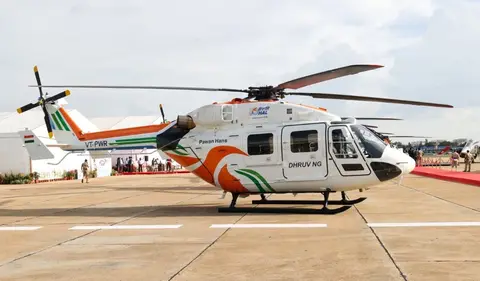 INDIA DEFENCEDhruv NG Helicopter Explained: What HAL Has Actually Put Into Pawan Hans Service
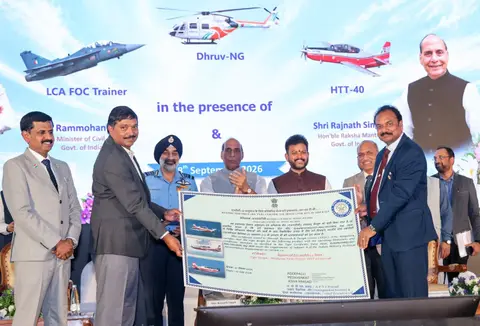 INDIA DEFENCELCA FOC Trainers Delivered With HTT 40 and Dhruv NG as Rajnath Singh Asks Engineers for Technologies That Do Not Exist
The SAREX-2026 sea drill off Paradip on Thursday put the Indian Coast Guard and nine partner agencies through a mock disaster at sea: a passenger aircraft carrying 228 people ditching near Paradip Port and crashing into a container ship.
The 12th National Maritime Search and Rescue Exercise was held under the National Maritime Search and Rescue Board (NMSARB). Director General Paramesh Sivamani, Director General of the Indian Coast Guard, reviewed it.
This year's theme was "Leveraging Technology to Strengthen SAR Preparedness and Maritime Safety".
SAREX-2026 sea drill stages a plane crash at sea
In the scenario, the aircraft struck the container vessel MV Zumba as it came down, damaging the ship's structure and setting it on fire. That created two emergencies at once, one aeronautical and one maritime. Rescuers had to fight a burning ship while more than 200 survivors waited in the water.
An Incident Command Post was activated to run the response. Coast Guard ships fought the fire, helicopters lifted survivors to safety, and life rafts were launched from ships and dropped from aircraft.
Survivors were pulled out using a Jason's Cradle, a rigid net that scoops a person from the water, and inflatable Gemini boats. Teams also carried out rescue basket lifts and scramble net drills, in which survivors climb up nets hung over a ship's side. A Remotely Operated Vehicle (ROV) was demonstrated as well.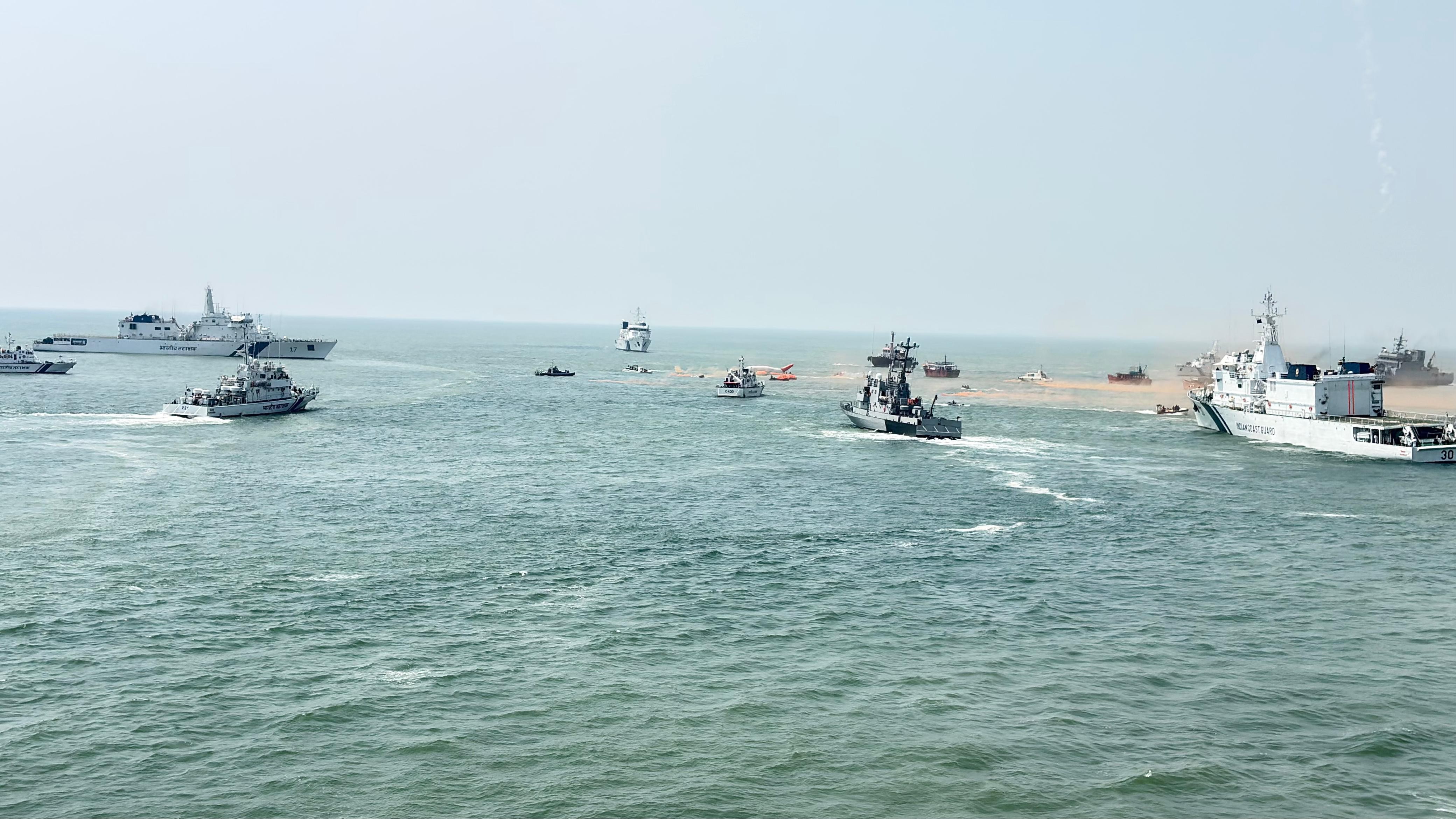
15 Coast Guard ships and IAF aircraft deployed
The Coast Guard put 15 ships, three Dornier aircraft, three Advanced Light Helicopters (ALH) and a Chetak helicopter into the exercise. The Indian Air Force flew a C-130J and an Mi-17, and the Indian Navy sent two ships, backed by civil, state and shore-based units.
Taking part alongside the three services were the Shipping Corporation of India, the Directorate General of Shipping, Fisheries, Customs, the Marine Police, the Paradip Port Authority and the Odisha State Administration.
32 observers from 30 countries watch the drill
Thirty-two observers from 30 countries watched the exercise. The Coast Guard said their presence strengthened interoperability and the exchange of best practices, and reaffirmed India's role as a dependable maritime search and rescue partner in the region. The Coast Guard has been building that kind of partnership at sea, most recently by carrying observers from Quad partners on its Quad-at-Sea Ship Observer Mission to Perth.
The drill focused on technology-enabled search and rescue, real-time information sharing, better maritime domain awareness and faster movement of resources. It was also used to validate Standard Operating Procedures and fold the lessons into future preparedness.
Sea drill follows the NMSAR Board meeting in Bhubaneswar
The sea phase came a day after the NMSAR Board met in Bhubaneswar, as set out in the SAREX-2026 schedule announced earlier this week.
Coast Guard has saved 11,897 lives at sea
India acceded to the International Convention on Maritime Search and Rescue, 1979, in 2001 and constituted the NMSAR Board in 2002. The Coast Guard linked this year's exercise to the vision of SAGAR and the spirit of MAHASAGAR. The Coast Guard serves as the national maritime search and rescue coordinating authority, with its search and rescue role backed by ships and an aviation fleet of Dorniers and helicopters.
The same waters saw a real rescue last month, when a Coast Guard damage control team stabilised the flooding chemical tanker MT Seagull 9 off Paradip with 23 crew on board.
Over the past five decades, the Coast Guard has undertaken 4,390 search and rescue missions, saved 11,897 lives and carried out 530 medical evacuations.

COMMENTS
JOIN THE DISCUSSION