
 DEFENCE INDUSTRYTata Zorawar light tank clears Army's L1 hurdle for Rs 20,000 crore contract
 DEFENCE INDUSTRYIndia Belgium Defence Deals Sealed As PM De Wever Visits Delhi
 DEFENCE INDUSTRYAero India 2027 Dates Confirmed for February 8 to 12 in Bengaluru
 DEFENCE INDUSTRYJavelin missile co-production advances as Tata Advanced Systems signs Javelin Joint Venture pact
 DEFENCE INDUSTRYTata Lockheed Martin MTA push gets a lift from US envoy's Hyderabad visit
Missile development is the most prominent strand of DRDO's work, spanning ballistic missiles, cruise missiles, air defence systems and precision-guided munitions. What began in the 1980s as a single coordinated programme has grown into several parallel missile families, many of them now in serial production for the Indian armed forces.
Key facts
- Foundational programme: the Integrated Guided Missile Development Programme (IGMDP), launched in 1983 under Dr APJ Abdul Kalam, covering Prithvi, Agni, Trishul, Akash and Nag
- Strategic missiles: the Agni series of ballistic missiles, ranging from the short-range Agni-I to the intercontinental-range, MIRV-capable Agni-V
- Cruise missile: BrahMos, a supersonic cruise missile developed jointly by DRDO and Russia's NPO Mashinostroyeniya through BrahMos Aerospace
- Air defence: the Akash surface-to-air missile, inducted in 2015, and the Quick Reaction Surface to Air Missile (QRSAM)
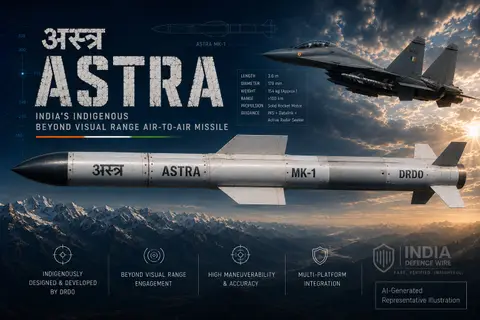
- Air-to-air: the Astra beyond-visual-range air-to-air missile, developed for the Su-30MKI, Tejas and other fighters
- Anti-tank and naval: the Nag anti-tank guided missile and its helicopter-launched variant, and Naval Anti-Ship Missile (NASM) variants
The IGMDP legacy
The Integrated Guided Missile Development Programme was conceived to end India's dependence on imported missile technology by developing five systems in parallel: the Prithvi short-range ballistic missile, the Agni technology demonstrator, the Trishul short-range surface-to-air missile, the Akash medium-range surface-to-air missile, and the Nag anti-tank guided missile. Prithvi was inducted in 1994, and Akash and Nag eventually entered service, while Trishul was discontinued as a standalone programme after its technology fed into other systems. The IGMDP was formally wound up around 2008, but the Agni and Prithvi lines continued to evolve as independent, strategically managed programmes.
Strategic and long-range missiles
The Agni family has grown into India's principal land-based strategic deterrent, progressing from the medium-range Agni-I and Agni-II to the longer-range Agni-III and Agni-IV, and culminating in the Agni-V, which has demonstrated intercontinental range and, following a 2024 test named Mission Divyastra, multiple independently targetable re-entry vehicle (MIRV) capability. Agni-Prime, a lighter, canisterised and rail-mobile missile, has been developed to eventually replace older Agni variants, with tests conducted from rail-based mobile launchers.
Cruise, air defence and precision-guided missiles
BrahMos remains DRDO's most commercially significant missile, fielded by the Army, Navy and Air Force in land-attack, anti-ship and air-launched versions, and exported to the Philippines under a contract delivered from 2024. Akash and its upgraded Akash-NG variant provide medium-range air defence, complemented by the shorter-reaction-time QRSAM for mobile army formations. For air-to-air combat, the Astra missile has replaced imported weapons on Indian fighters, while the Nag and its helicopter-launched Dhruvastra variant give the Army and Air Force a dedicated anti-armour capability from ground vehicles and helicopters. DRDO has also flight-tested the scramjet-powered Hypersonic Technology Demonstrator Vehicle, first flown successfully in September 2020, which is intended to seed a future generation of long-range hypersonic cruise missiles.
Ballistic missile defence
Alongside offensive missiles, DRDO has developed a two-tier Ballistic Missile Defence system comprising the exo-atmospheric Prithvi Air Defence interceptor and the endo-atmospheric Advanced Air Defence interceptor, designed to engage hostile ballistic missiles at different altitudes. Newer interceptors, including the AD-1, have since been tested as part of a more capable Phase-2 layer intended to counter longer-range and higher-speed threats. This shield has been tested to protect key cities and is being progressively expanded as part of India's layered air and missile defence architecture, run by DRDO's missile and strategic systems laboratories in coordination with the Strategic Forces Command.