
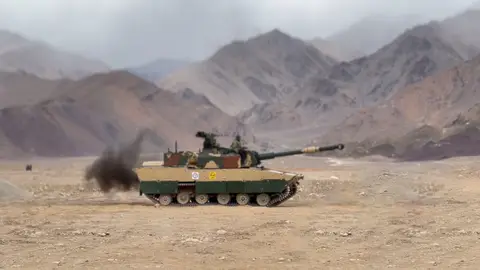
 DEFENCE INDUSTRYTata Zorawar light tank clears Army's L1 hurdle for Rs 20,000 crore contract
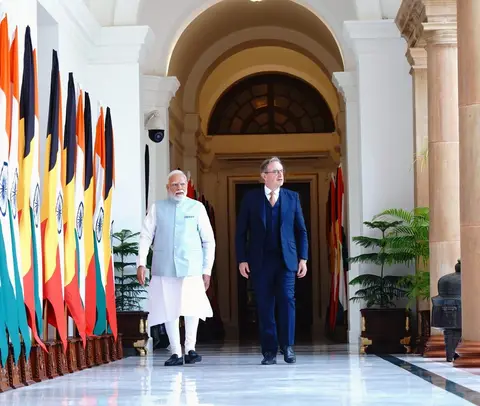 DEFENCE INDUSTRYIndia Belgium Defence Deals Sealed As PM De Wever Visits Delhi
 DEFENCE INDUSTRYAero India 2027 Dates Confirmed for February 8 to 12 in Bengaluru
 DEFENCE INDUSTRYJavelin missile co-production advances as Tata Advanced Systems signs Javelin Joint Venture pact
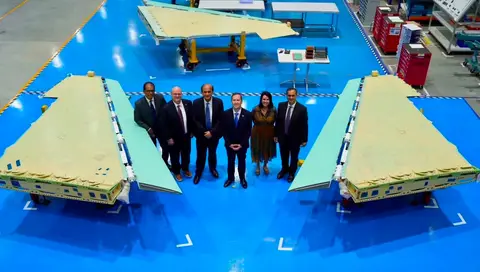 DEFENCE INDUSTRYTata Lockheed Martin MTA push gets a lift from US envoy's Hyderabad visit
The Defence Research and Development Organisation (DRDO) is India's premier military research and development agency, responsible for equipping the Indian armed forces with indigenously designed weapons, sensors and platforms. Functioning under the Ministry of Defence's Department of Defence Research and Development, DRDO has grown from a handful of laboratories in 1958 into one of the world's largest state-run defence research networks.
Key facts
- Founded: 1958, through the merger of the Defence Science Organisation with the Technical Development Establishment and Directorate of Technical Development and Production of the Indian Ordnance Factories
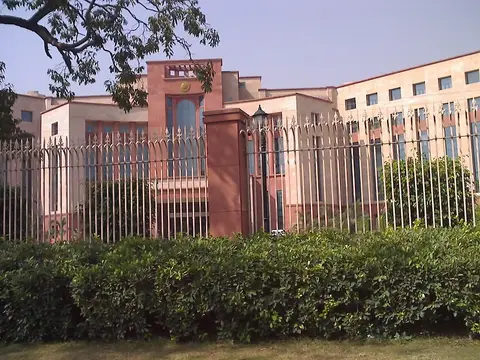
- Headquarters: DRDO Bhawan, Rajaji Marg, New Delhi
- Parent ministry: Ministry of Defence, Government of India
- Network: around fifty laboratories and establishments across India, plus five DRDO Young Scientists Laboratories set up in 2021
- Mandate: design and develop weapon systems and technologies for the Army, Navy and Air Force, and reduce dependence on imports
- Notable former chief: Dr APJ Abdul Kalam, DRDO chief from 1992 to 1999, later President of India, remembered as the Missile Man of India
Origins and mandate
DRDO was formed in 1958 when the Defence Science Organisation was merged with existing technical development units of the Indian Army's ordnance factories, bringing military science research under a single organisation for the first time. Its charter is broad: to give India's armed forces a decisive technological edge through self-reliant design and development of weapon systems, equipment and platforms, spanning missiles, aircraft, armoured vehicles, naval systems, electronic warfare, radar, materials and life sciences relevant to soldiers operating in extreme environments.
Structure and leadership
DRDO is headed by a Chairman, who also serves as Secretary of the Department of Defence Research and Development, reporting to the Defence Minister. Beneath the Chairman, DRDO's laboratories are grouped into technology clusters, including missiles and strategic systems, aeronautics, armaments and combat engineering, electronics and communication systems, and life sciences, each coordinated by a Director General. Dr Samir V. Kamat led DRDO from August 2022 until his retirement in May 2026; the Ministry of Defence subsequently assigned Defence Secretary Rajesh Kumar Singh additional charge of the Chairman's post pending a permanent appointment.
Major achievements
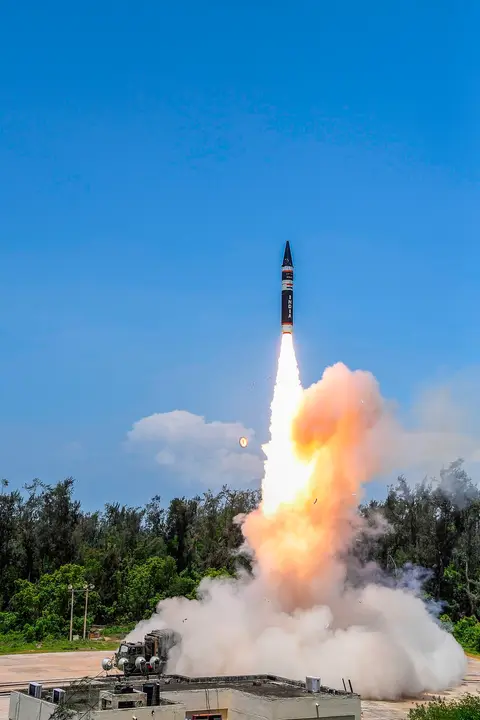
DRDO's most visible successes lie in missile development. The Integrated Guided Missile Development Programme, launched in 1983, produced the Prithvi short-range ballistic missile, the Agni family of ballistic missiles, the Akash surface-to-air missile, the Nag anti-tank guided missile and the Trishul short-range surface-to-air missile, laying the foundation for India's current missile arsenal. Building on this base, DRDO has since developed the nuclear-capable, MIRV-tested Agni-V, the canisterised, rail-mobile Agni-Prime, the BrahMos supersonic cruise missile developed jointly with Russia, and a two-layer Ballistic Missile Defence shield.
Beyond missiles, DRDO's Aeronautical Development Agency led design of the Tejas Light Combat Aircraft, inducted into the Indian Air Force in 2016, while its laboratories have delivered the Arjun main battle tank, the Akashteer air defence control network, the Rohini and Rajendra series radars, sonar systems for the Navy, and electronic warfare suites fielded across all three services.
Working with industry
DRDO increasingly develops technology for transfer to production partners rather than manufacturing directly. Designs move to defence public sector undertakings such as Hindustan Aeronautics Limited and Bharat Electronics Limited, and to private industry, under DRDO's Transfer of Technology arrangements. To draw private firms, MSMEs and startups into weapons development, DRDO also administers the Technology Development Fund, launched in September 2016, which grants funding for prototypes with defence application, complementing the wider Ministry of Defence iDEX initiative aimed at startups.
This model, reinforced through the Make in India and Atmanirbhar Bharat initiatives, aims to shorten the path from laboratory prototype to fielded equipment for the armed forces, positioning DRDO at the centre of India's push for self-reliance across missiles, aircraft, radars and next-generation defence technologies.