

 DEFENCE INDUSTRYBrahMos export orders: Vietnam deal worth about $100 million, Indonesia $200 million as Akash reaches Tajikistan, Turkmenistan
 DEFENCE INDUSTRYMahindra Embraer Nagpur facility to assemble C-390 if IAF picks the aircraft
 DEFENCE INDUSTRYSMPP Drone Manufacturing Push: Firm Shifts From Ammunition to Unmanned Warfare, Targets Integrated Defence Capabilities
 INDIA DEFENCEDhruv NG Helicopter Explained: What HAL Has Actually Put Into Pawan Hans Service
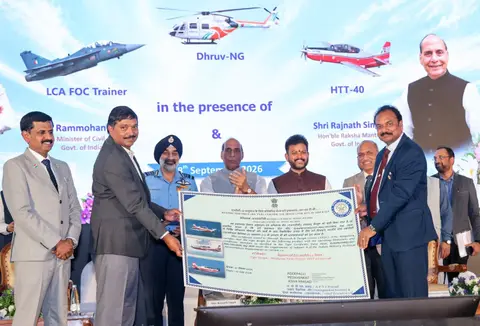 INDIA DEFENCELCA FOC Trainers Delivered With HTT 40 and Dhruv NG as Rajnath Singh Asks Engineers for Technologies That Do Not Exist
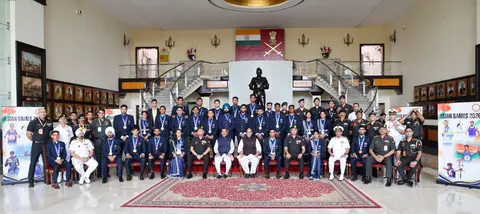
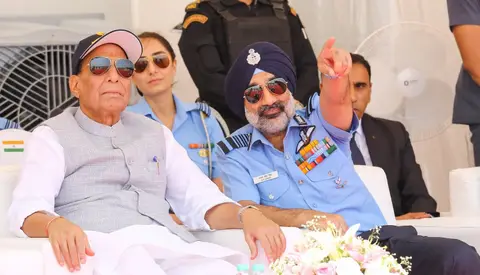
The first ASEAN-India Defence Think Tank Forum opened in New Delhi on Wednesday, with Defence Minister Rajnath Singh telling delegates that India wants an Indo-Pacific where every country, large or small, is free to make its own choices.
He called for building trust, respecting each other's sovereignty, following international law and keeping dialogue open to deal with what he called borderless challenges. He also said India is ready to explore cooperation with ASEAN partners on patrol vessels, radars, air-defence systems, helicopters and drones, in line with each country's needs.
"India seeks an Indo-Pacific where all countries, large and small, make their own choices, protect their interests and pursue development in peace," Singh said.
The two-day forum is being hosted by the Manohar Parrikar Institute for Defence Studies and Analyses (MP-IDSA) on October 14 and 15. Participants from all 11 ASEAN member states and India are attending. The idea was announced by Singh at the second ASEAN-India Defence Ministers' Informal Meeting in Kuala Lumpur on October 31, 2025, held on the sidelines of the 12th ADMM-Plus. Another outcome of that Kuala Lumpur meeting was a course for ASEAN women military officers in New Delhi this August.
Rajnath Singh asks ASEAN to settle differences before they turn into disputes
The Defence Minister said the region is changing fast. He pointed to growing strategic competition and the pressure and uncertainty created at times through actions at sea. Terrorism, cybercrime, piracy, trafficking, illegal fishing, climate-related disasters and risks to supply chains add to the load. No country can handle these alone, he said.
Differences should be discussed early and peacefully, before they become disputes, according to Singh. He backed a regional order in which countries work together without being forced to pick sides.
"India believes that security is strengthened when countries build capacity together, respect international law and maintain trust through dialogue," he said.
He described the Act East Policy as a long-term commitment to working with Southeast Asia as an equal partner, built on centuries of shared history, culture and trade. India's Act East policy and the SAGAR and MAHASAGAR visions run through ASEAN-led mechanisms, which sit at the centre of India's Indo-Pacific approach, the minister said. On regional groupings, his message was direct: "We should strengthen cooperation, not create competition between regional forums."
2026 is the ASEAN-India Year of Maritime Cooperation
Singh said the Indian Ocean and the waters of Southeast Asia form one connected maritime space that carries trade, energy, people and essential goods. Keeping it safe is a shared job. Better maritime domain awareness, interoperability and cooperation in underwater awareness will be key to a stable, rule-based order at sea, he said, a theme he also raised during his address in Colombo last month.
With 2026 named the ASEAN-India Year of Maritime Cooperation, he urged partners to turn shared interest into action.
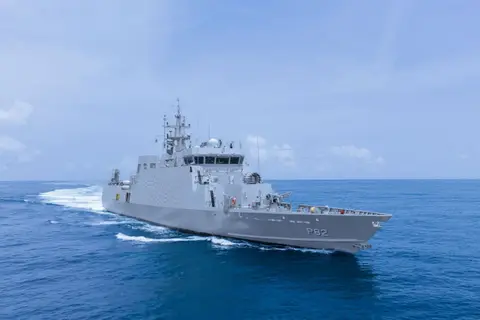
"We should improve the sharing of maritime information, strengthen cooperation among our navies and coast guards, and build the ability to respond together to emergencies," he said. INS Sahyadri and INS Kulish sailed with ASEAN maritime forces in the second ASEAN-India Maritime Exercise at Subic Bay in the Philippines in late September.
Low-cost drones can challenge expensive defence systems, Defence Minister says
Artificial intelligence, drones, cyber capabilities and space-based systems are growing in importance. Recent conflicts have shown that relatively cheap drones can take on costly defence systems, Singh said, and the answer has to be practical, affordable and adaptable.
He wants smaller players in the room. "India believes that innovation should not remain limited to a few large organisations. Start-ups, universities, research institutions and smaller companies can all contribute," he said, citing India's Innovations for Defence Excellence (iDEX) and the Technology Development Fund (TDF) as working models.
He suggested innovators from India and ASEAN work together on clearly defined problems such as counter-drone systems, cyber defence, maritime surveillance and disaster response.
Joint research with safeguards on sensitive information
Singh proposed joint research projects, shared testing, exchanges among young researchers and innovation challenges, with safeguards for sensitive information and intellectual property. "The aim should be to develop useful capabilities while strengthening trust between our countries," he said.
India ready to build defence equipment with ASEAN partners
The Aatmanirbhar Bharat initiative is about stronger domestic capability, Singh said, but self-reliance does not mean working in isolation. It can open the door for trusted partners to design, build, maintain and improve equipment together. He made a similar point at Tarang Shakti in Jodhpur last week.
Co-development, co-production, maintenance, repair and overhaul, training and long-term technical support can build local skills, support industry and make supply chains more reliable, according to the minister.
"Our researchers need to look closely at what makes such partnerships work: clear requirements, reliable after-sales support, appropriate technology safeguards, fair sharing of responsibilities and benefits, and opportunities for local companies and skilled workers. Our goal should be lasting partnerships, not one-time transactions," he said.
Disaster relief was the other area he flagged. Cyclones, floods, rising sea levels and extreme weather can damage ports, disrupt trade and threaten lives, so Humanitarian Assistance and Disaster Relief (HADR) should be a regular part of defence dialogue, he said. "We can learn from one another, share best practices and improve coordination before a crisis occurs."
ASEAN-India Defence Think Tank Forum asked to deliver pilot projects
Governments need good analysis, but they also need ideas that can be put into practice, Singh told the think tanks. He listed the outcomes he wants from the ASEAN-India Defence Think Tank Forum. First, a joint research agenda on maritime security, cyber threats, emerging technologies, disaster response and defence-industry cooperation. Second, regular exchanges among researchers, including young scholars, through fellowships, visiting programmes and joint publications. Third, a small number of pilot projects, such as a tabletop exercise on maritime disaster response, a joint study on counter-drone solutions or a research project on secure maritime information sharing.
He also called for Track 1.5 and Track 2 dialogues so that researchers, practitioners and policymakers keep talking between formal meetings, and for a short set of recommendations, with named institutions to take them forward and a review at a future meeting.
In his welcome address, MP-IDSA Director General Ambassador Sujan R Chinoy thanked the Defence Minister and called the forum an important institutional milestone in ASEAN-India defence engagement.
Over the two days, sessions will cover strategic stability, regional geopolitics, maritime security, grey-zone challenges, HADR, maritime domain awareness, artificial intelligence, cybersecurity, space, unmanned systems, defence industry collaboration and resilient supply chains, according to the Ministry of Defence.
COMMENTS
JOIN THE DISCUSSION