

 DEFENCE INDUSTRYBrahMos export orders: Vietnam deal worth about $100 million, Indonesia $200 million as Akash reaches Tajikistan, Turkmenistan
 DEFENCE INDUSTRYMahindra Embraer Nagpur facility to assemble C-390 if IAF picks the aircraft
 DEFENCE INDUSTRYSMPP Drone Manufacturing Push: Firm Shifts From Ammunition to Unmanned Warfare, Targets Integrated Defence Capabilities
 INDIA DEFENCEDhruv NG Helicopter Explained: What HAL Has Actually Put Into Pawan Hans Service
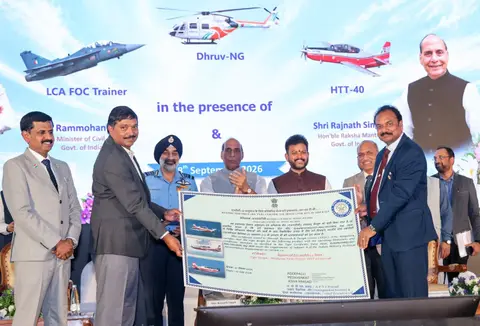 INDIA DEFENCELCA FOC Trainers Delivered With HTT 40 and Dhruv NG as Rajnath Singh Asks Engineers for Technologies That Do Not Exist
T-Series tank overhaul work formally began at Vehicle Factory, Jabalpur on Thursday, when Defence Minister Rajnath Singh and Madhya Pradesh Chief Minister Dr Mohan Yadav performed the Bhoomi Pujan for a Rs 472 crore facility built to service the Army's T-72 and T-90 fleets. The unit belongs to Armoured Vehicles Nigam Limited (AVNL), the Mini Ratna defence public sector undertaking that runs the factory.
The Army currently needs 230 tanks overhauled annually across its T-72 and T-90 regiments. Heavy Vehicles Factory, Avadi handles 150 of those a year at present, and the new Jabalpur line is designed to close that gap by overhauling 80 tanks annually once it is operational, cutting the wait for units returning from active service in the field.
https://x.com/SpokespersonMoD/status/2092929992279900489?ref_src=twsrc%5Etfw%7Ctwcamp%5Etweetembed%7Ctwterm%5E2092929992279900489%7Ctwgr%5E3bb1a008200e76040f32666d5caac4d7a50656d0%7Ctwcon%5Es1_c10&ref_url=https%3A%2F%2Fpublish.x.com%2F%3Furl%3Dhttps%3A%2F%2Ftwitter.com%2FSpokespersonMoD%2Fstatus%2F2092929992279900489
The T-Series Tank Overhaul Plan
Singh framed the project inside a wider argument about how warfare is changing. Drones, precision weapons, satellites, artificial intelligence and cyber tools have altered the battlefield, he said, but the tank's role has shifted rather than shrunk, and modern militaries now need integrated rather than standalone platforms.
"Modern warfare demands combined capabilities rather than dependence on a single platform. Tanks, infantry, artillery, drones, air power, surveillance, and precision weapons together form an integrated combat system," Singh said, pointing to the Army's Integrated Battle Group model as an example already in practice. He added that tanks need better sensors and closer coordination with drones, missiles and electronic warfare tools, and said the overhaul line would support that shift.
What Rajnath Singh Said
Singh noted that Heavy Vehicles Factory, Avadi has supplied around 4,400 tanks to the Army over four decades. He said the Jabalpur project would extend that legacy, positioning the city as a hub for tank technology, maintenance and modernisation alongside its existing manufacturing role. AVNL brings 25 years of experience overhauling T-72 and T-90 variants to the new facility, he said, adding that he expected it to set fresh benchmarks on quality, productivity, innovation and global competitiveness.
AVNL itself is a newer entity than the tank-building tradition it inherited. The company was carved out in 2021 when the government corporatised the erstwhile Ordnance Factory Board into seven separate defence public sector undertakings, folding Vehicle Factory, Jabalpur, Heavy Vehicles Factory, Avadi and three other units under one corporate structure. That restructuring was meant to sharpen accountability and let each unit compete for orders on its own merit, rather than operate as a department of the government answering only to file notes and budget cycles.
The Aatmanirbhar Bharat Numbers
Singh tied the project to the wider Aatmanirbhar Bharat push, citing a rise in annual defence production to around Rs 1.80 lakh crore in FY 2025-26 from Rs 46,000 crore in 2014, alongside defence exports climbing to about Rs 39,000 crore from under Rs 1,000 crore over the same period. Those figures build on the pace already logged in India's record defence production for FY 2025-26, and echo the design-to-scale argument Secretary Sanjeev Kumar made at an ASSOCHAM conference in New Delhi two days earlier, where he had urged the sector to move from manufacturing scale to indigenous design.
He said nations with advanced technology, resilient supply chains and strong industrial capacity are better placed to sustain prolonged conflicts, and that the government wants the forces to manufacture, repair, upgrade and eventually design new systems domestically rather than depend on foreign supply chains.
MSMEs and the Jabalpur Economy
The T-Series tank overhaul facility is expected to generate demand for mechanical, electrical, electronic and hydraulic components, assemblies and subsystems, much of which the government wants sourced from local MSMEs. Singh said the project should widen participation from small industry in and around Jabalpur and create jobs for farmers, workers, youth and small entrepreneurs in the region.
Madhya Pradesh's Wider Defence Push
Singh also praised the Madhya Pradesh government's work on industry and defence manufacturing, citing the state's Global Investors Summit 2025 and its Invest MP 3.0 approval system as signs of an improving investment climate. He pointed to 3,073 hectares earmarked for defence manufacturing in the Gwalior-Chambal region and more than Rs 16,960 crore in proposed investment there, calling it the foundation for Madhya Pradesh to become India's next major defence and aerospace manufacturing hub, alongside Jabalpur's older identity as a manufacturing town.
Chief Minister Dr Mohan Yadav credited Prime Minister Narendra Modi's leadership for India's rising global standing and said the state was ready to support the Centre's defence manufacturing goals. Secretary (Defence Production) Sanjeev Kumar, AVNL CMD Satyabrata Mukherjee and other senior officials from the Department of Defence Production and the armed forces attended the event alongside AVNL staff and local officials, a defence ministry statement said.
COMMENTS
JOIN THE DISCUSSION