

 DEFENCE INDUSTRYBrahMos export orders: Vietnam deal worth about $100 million, Indonesia $200 million as Akash reaches Tajikistan, Turkmenistan
 DEFENCE INDUSTRYMahindra Embraer Nagpur facility to assemble C-390 if IAF picks the aircraft
 DEFENCE INDUSTRYSMPP Drone Manufacturing Push: Firm Shifts From Ammunition to Unmanned Warfare, Targets Integrated Defence Capabilities
 INDIA DEFENCEDhruv NG Helicopter Explained: What HAL Has Actually Put Into Pawan Hans Service
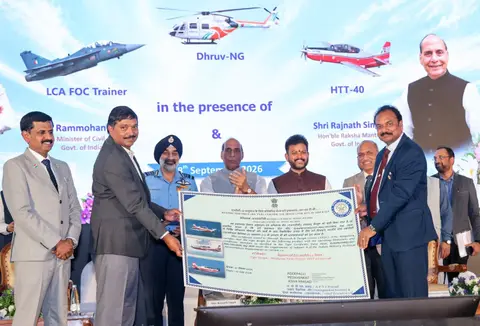 INDIA DEFENCELCA FOC Trainers Delivered With HTT 40 and Dhruv NG as Rajnath Singh Asks Engineers for Technologies That Do Not Exist
GSAT-7C Varunastra contracts worth around Rs 4,106 crore were signed by the Ministry of Defence on Thursday. One gives the Indian Air Force (IAF) its own dedicated communication satellite. The other buys indigenous heavyweight torpedoes for the Indian Navy.
Both orders went to Indian state-owned companies.
GSAT-7C Varunastra contracts signed in New Delhi
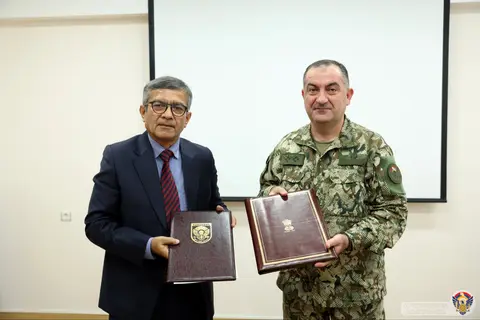
The satellite contract went to New Space India Limited (NSIL), Bengaluru, and the torpedo contract to Bharat Dynamics Limited (BDL), Hyderabad. They were signed in New Delhi in the presence of A Anbarasu, Additional Secretary and Director General (Acquisition), Department of Defence, according to the Ministry of Defence.
The ministry said both contracts would advance domestic defence manufacturing and promote self-reliance in critical technologies, in line with the Government's Aatmanirbhar Bharat and Make in India vision.
GSAT-7C deal worth Rs 2,563 crore goes to NSIL
GSAT-7C is the larger of the two deals, valued at Rs 2,563 crore. The satellite is indigenously designed, developed and manufactured, the ministry said. It will give IAF assets secure, resilient and seamless communication and strengthen the force's operational effectiveness.
NSIL is the commercial arm of the Department of Space and markets Indian Space Research Organisation (ISRO) products and services. More details on the company are on its official website. India's wider space sector has also grown, with a private rocket reaching orbit from Sriharikota earlier this year in Skyroot's Vikram-1 launch.
Defence Acquisition Council cleared the satellite in 2021
The project dates back to 23 November 2021. On that day the Defence Acquisition Council (DAC), chaired by Defence Minister Rajnath Singh, granted Acceptance of Necessity (AoN) of Rs 2,236 crore under the Make in India category, the ministry said at the time. The proposal covered the GSAT-7C satellite and ground hubs for real-time connectivity of the IAF's software defined radios. Design, development and launch were all to be carried out in India.
In plain terms, the satellite will let aircraft, ground stations and other IAF assets talk to one another securely beyond line of sight, in all circumstances. Five years on, the signed contract moves it from approval to build. The final contract value is Rs 2,563 crore.
GSAT-7C joins GSAT-7 and GSAT-7A in military service
The armed forces already use dedicated satellites in the same series. GSAT-7 went up in August 2013 for the Navy, and GSAT-7A followed in December 2018 for the IAF.
Varunastra contract worth Rs 1,543 crore strengthens Navy anti-submarine warfare
The second contract, worth Rs 1,543 crore, is for Varunastra heavyweight torpedoes. According to the ministry, Varunastra is an indigenous ship-launched anti-submarine torpedo developed by the Naval Science and Technological Laboratory (NSTL), a Defence Research and Development Organisation (DRDO) laboratory at Visakhapatnam. It has advanced manoeuvring capabilities and can engage enemy submarines at long ranges, the ministry said, adding that it will improve the Navy's anti-submarine warfare capability.
The ministry did not state how many torpedoes the order covers, which is usual for weapon contracts of this kind.
The Navy is adding anti-submarine assets on several fronts. On Monday it commissioned INS Mangrol, an anti-submarine warfare shallow water craft, at the Naval Dockyard in Mumbai.
Varunastra has served the Navy since 2016
The torpedo was inducted into the Navy in 2016. BDL signed a licence agreement with NSTL in April 2018 for its production, testing and maintenance, and the first production torpedo from BDL's Visakhapatnam unit was flagged off in November 2020.
Among the GSAT-7C Varunastra contracts, the torpedo order follows another BDL contract signed last month. On 23 September, the ministry placed a Rs 810.79 crore order with the company for 160 Satellite Smart Anti Airfield Weapons for the IAF. BDL, a Ministry of Defence public sector undertaking, produces missiles and underwater weapons, as listed on its official website.



COMMENTS
JOIN THE DISCUSSION