

 DEFENCE INDUSTRYBrahMos export orders: Vietnam deal worth about $100 million, Indonesia $200 million as Akash reaches Tajikistan, Turkmenistan
 DEFENCE INDUSTRYMahindra Embraer Nagpur facility to assemble C-390 if IAF picks the aircraft
 DEFENCE INDUSTRYSMPP Drone Manufacturing Push: Firm Shifts From Ammunition to Unmanned Warfare, Targets Integrated Defence Capabilities
 INDIA DEFENCEDhruv NG Helicopter Explained: What HAL Has Actually Put Into Pawan Hans Service
 INDIA DEFENCELCA FOC Trainers Delivered With HTT 40 and Dhruv NG as Rajnath Singh Asks Engineers for Technologies That Do Not Exist
Indigenous waterjet propulsion systems manufactured at the MJP India plant in Goa have cleared their maiden Factory Acceptance Trials, the Indian Coast Guard said on 15 July. Senior officers of the service watched the runs alongside a classification society and representatives of Mazagon Dock Shipbuilders Limited, the yard building the hulls these jets will drive. The Coast Guard has put the result down as a step in maritime self-reliance under Aatmanirbhar Bharat.
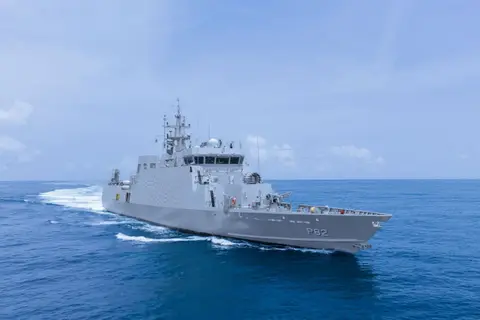
The jets are for the Coast Guard's 14 Fast Patrol Vessel project.
Indigenous waterjet propulsion on an Indian shipbuilding line
The Coast Guard describes the 14 FPV project as the first indigenous shipbuilding programme in the country to be fitted with indigenously manufactured MJP waterjets. That is the claim worth holding on to. Waterjets have driven Coast Guard hulls for years, in interceptor boats and fast patrol craft alike, but the units themselves arrived from abroad, and so did the test benches that signed them off. What changed is where the jet is built and where it is proved, not what it is bolted to.
Factory Acceptance Trials are the point where a manufacturer runs a unit against the contracted parameters in front of the customer and the classification surveyor, before it ever reaches a yard. Passing them in Goa rather than in Sweden compresses a step that used to involve shipping, scheduling and a foreign calendar.
What the FPVs are being built to do
The Ministry of Defence signed the 14 FPV contract with MDL on 24 January 2024, at Rs 1,070.47 crore, under the Buy (Indian-IDDM) category, with delivery of the full run inside 63 months, according to the Ministry's announcement at the time. The vessels are designed and built in India. Fisheries protection, monitoring and surveillance, anti-smuggling work, search and rescue including in shallow water, assistance to craft in distress and towing all sit in the brief. The Ministry also listed multipurpose drones, a wirelessly controlled remote water rescue lifebuoy and artificial intelligence capability among the fit.
MDL began construction on the first of the fourteen in December 2024.
A Swedish line, transferred
The Goa facility exists through a Transfer of Technology arrangement with MJP AB of Sweden, the Uppsala firm that has been building waterjets since 1987. It is a dedicated manufacturing and testing centre for waterjet propulsion, not a warehouse with a workshop attached. Director General Paramesh Sivamani opened it on 13 February this year, and at the time the Coast Guard said the plant made India the third country after the United States and South Korea to host production and testing of this kind under one roof.
DG Sivamani put the facility down to sustained engagement running back to 2023.
MJP India is a joint venture between Marine Jet Power and its long-standing Indian partner Corporate Alliances. The company has said it is working towards 53 percent local manufacturing and sourcing of components by the end of this year, and has framed the Goa operation as a supply point for spares, waterjets and PodJets across South Asia and the adjoining region rather than for the Indian fleet alone. Skilling engineers and technicians on the line is part of the same arrangement.
More than 100 MJP units already at sea
The Coast Guard operates over 100 MJP waterjet propulsion systems across its fleet, with another 42 earmarked for ships under construction. That installed base is the argument for the plant. Every one of those units eventually needs overhaul, spares and a test run against specification, and until February each of those events reached back to a European supply chain.
The service's shipbuilding pipeline has been busy. It commissioned ICGS Akshay at Goa Shipyard in June, and this month brought the major yards and design houses to Coast Guard Headquarters to convert broad requirements for future platforms into measurable specifications. Propulsion is one of the places where those specifications bite hardest.
What the trials settle
The Coast Guard's own reading is direct enough. The inaugural FATs mark a step towards indigenising a propulsion system that was until now imported, and the service expects supply chain resilience and lifecycle maintenance support to follow.
The wider indigenisation record for marine propulsion in India is uneven. Hulls and combat systems have moved faster than machinery, which is why the last Mazagon Dock Project 17A frigate to commission still runs on imported gas turbines. A waterjet is a smaller item than a CODOG plant and a simpler one to absorb, which is exactly why it is the piece of machinery that moved first. The Coast Guard buys them by the hundred, and the reorder cycle never stops.
Fourteen hulls. Trials cleared on the first jets. The FPVs are contracted to be in the water by mid 2029.

COMMENTS
JOIN THE DISCUSSION