

 DEFENCE INDUSTRYBrahMos export orders: Vietnam deal worth about $100 million, Indonesia $200 million as Akash reaches Tajikistan, Turkmenistan
 DEFENCE INDUSTRYMahindra Embraer Nagpur facility to assemble C-390 if IAF picks the aircraft
 DEFENCE INDUSTRYSMPP Drone Manufacturing Push: Firm Shifts From Ammunition to Unmanned Warfare, Targets Integrated Defence Capabilities
 INDIA DEFENCEDhruv NG Helicopter Explained: What HAL Has Actually Put Into Pawan Hans Service
 INDIA DEFENCELCA FOC Trainers Delivered With HTT 40 and Dhruv NG as Rajnath Singh Asks Engineers for Technologies That Do Not Exist
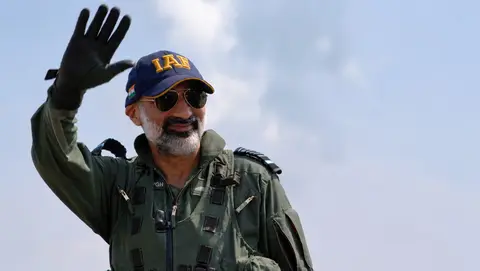
The Mount Kamet expedition organised to mark 200 years of the Regiment of Artillery ended in New Delhi on Friday, when General Dhiraj Seth, Chief of the Army Staff, flagged in the team of Gunners that climbed the 7,756 metre peak in Uttarakhand last month.
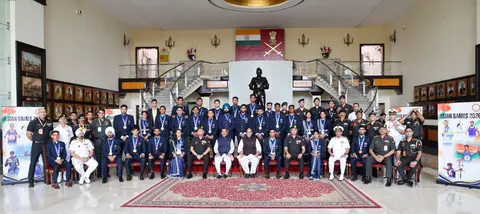
The climbers presented the expedition flag to the Army Chief at the ceremony.
The team reached the summit on 21 September, on its second try, according to the Army. Bad weather had forced the climbers off the upper mountain three days earlier.
Mount Kamet expedition reached the summit on its second attempt
The first push for the top came on 17 September. A day earlier, the team had launched a summit bid on Mount Abi Gamin, the 7,355 metre neighbour of Kamet, joined to it by a high saddle called Meade's Col.
Then the weather turned.
On 18 September, the climbers came down to Camp I. They regrouped, reassessed the situation and went back up, reaching the top of Kamet on 21 September, the Army said, crediting the team with sound judgment and resilience in demanding conditions.
Kamet was first climbed in 1931
Kamet stands in Chamoli district of Uttarakhand, close to the border with Tibet. It is the second-highest mountain in the Garhwal region after Nanda Devi.
A British party led by Frank Smythe made the first ascent on 21 June 1931. Kamet became the first peak over 25,000 feet ever climbed, and stayed the highest summit reached until Nanda Devi was scaled five years later. Its remoteness still makes it a long expedition rather than a quick climb.
The Army's own link with the mountain goes back to 1952, when the Bengal Sappers mounted a Mount Kamet expedition led by Major General H Williams. The Army counts that climb among the milestones of its mountaineering history.
Gunners trained at Gothing before the Golden Arrow flag-off
The expedition was organised from Ferozepur in Punjab, home of the Golden Arrow Division under Vajra Corps. Preparation started more than a month before the climb itself. The team acclimatised from 21 July to 7 August, then went through pre-expedition training at Gothing from 8 to 22 August.
The General Officer Commanding, Golden Arrow Division, formally flagged off the team on 24 August.
From there the climb moved in stages. The team set up Base Camp, moved to the Advanced Base Camp (ABC) and opened higher camps between 29 August and 8 September. From 9 to 15 September, it climbed from ABC to Camp I, Camp II and Camp III, putting the summit within reach.
Regiment of Artillery marks 200 years of its raising
The Indian Army said the expedition was meant to build the spirit of adventure, teamwork and professional excellence among troops while marking the bicentenary of the Regiment of Artillery.
The Regiment traces its raising to 28 September 1827, the date the Army marks each year as Gunners' Day. High ground has carried regimental meaning for the Gunners before. Point 5140 above Dras was named Gun Hill in honour of the artillery's role in the Kargil war, and an Army team climbed it in July in the Gun Hill expedition marking 27 years of Operation Vijay.
Army Chief receives the expedition flag in New Delhi
General Dhiraj Seth took over as the 31st Chief of the Army Staff on 30 June and has since reviewed formations including Central Command in Lucknow, which covers the Uttarakhand sector where Kamet stands. Receiving the flag in New Delhi closed an expedition that ran from late July to early October.
It is one of several long adventure ventures the services have completed this year.
In July, the tri-service all-women crew of the Samudra Pradakshina expedition aboard IASV Triveni was flagged in at Mumbai after sailing around the world, with the Ministry of Defence marking the voyage as a first for the armed forces.
COMMENTS
JOIN THE DISCUSSION