

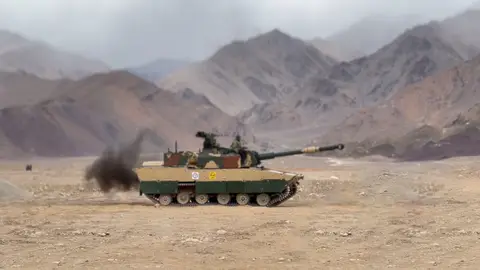
 DEFENCE INDUSTRYTata Zorawar light tank clears Army's L1 hurdle for Rs 20,000 crore contract
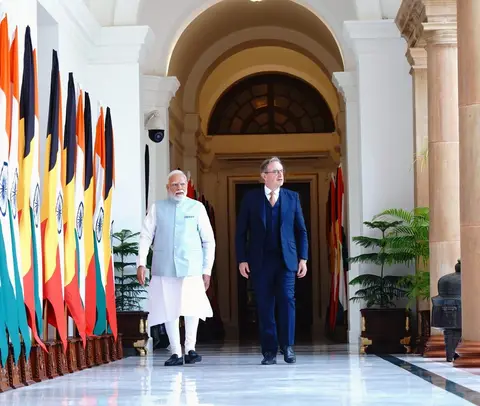 DEFENCE INDUSTRYIndia Belgium Defence Deals Sealed As PM De Wever Visits Delhi
 DEFENCE INDUSTRYAero India 2027 Dates Confirmed for February 8 to 12 in Bengaluru
 DEFENCE INDUSTRYJavelin missile co-production advances as Tata Advanced Systems signs Javelin Joint Venture pact
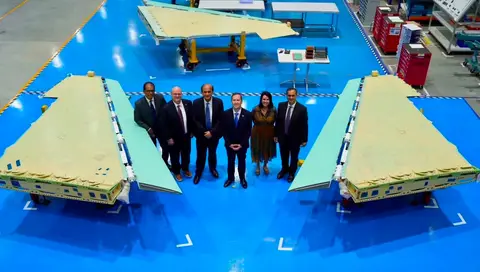 DEFENCE INDUSTRYTata Lockheed Martin MTA push gets a lift from US envoy's Hyderabad visit
SMPP Belarus drone deal draws scrutiny over sanctioned supplier and Rs 4,000 crore IPO
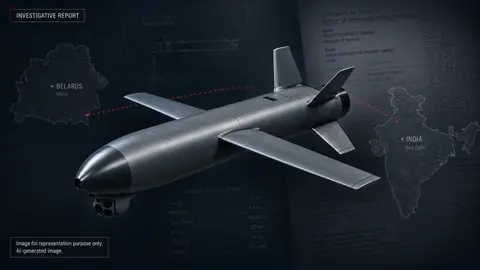
The SMPP Belarus drone deal that placed 106 Peacekeeper (Agniveg) kamikaze drones in the Indian Army's inventory this month ran through a Belarusian state arms enterprise that the United States Treasury has designated under its Belarus-related sanctions authority, according to contract documentation published by a Belarusian investigative group. The entity named as the buyer in those documents is SMPP Ammunition Private Limited, the same subsidiary that SMPP's pending Rs 4,000 crore public offering proposes to fund with fresh capital raised from Indian investors. The convergence of those two facts does not constitute evidence of wrongdoing. It does constitute exactly the kind of disclosure question that a company preparing to access public markets owes its prospective shareholders, and that an Aatmanirbhar Bharat procurement framework owes its institutional credibility.
What the SMPP Belarus drone deal involves
In January 2026, BELPOL, an investigative initiative of exiled former Belarusian security officials, published documents indicating that SMPP Ammunition Private Limited purchased approximately 100 Mirotvorets kamikaze drones from Belspetsvneshtechnika, known as BSVT, the state foreign trade enterprise of the State Authority for Military Industry of the Republic of Belarus. BELPOL said negotiations opened in August 2025, the contract was signed in October 2025, and acceptance procedures were conducted at the Belarusian end between 22 and 25 October 2025. The defence portal IDRW had separately reported that the Indian Army procured the Belarusian Berkut-BM unmanned aerial vehicle in its Mirotvorets configuration. ThePrint, citing sources within India's defence and security establishment, reported on 11 June that the Peacekeeper is based on a Belarusian design by KB Indela, with SMPP localising the warhead under a phased technology transfer arrangement tied to future order volumes. India Defence Wire has reported separately on the indigeneity questions surrounding the Agniveg programme, including the specification match between the Mirotvorets and the delivered system and the timeline evidence that cuts against a domestic manufacture claim.
BELPOL's character as an exile organisation with political opposition to the Lukashenka government requires the appropriate qualification. Its publications are attributed claims, not adjudicated facts. What gives this particular account its weight is the convergence of independent sourcing: the BELPOL documentation, the IDRW reporting on Berkut-BM procurement, the ThePrint establishment sourcing, and the technical specifications of the delivered system, which match the Mirotvorets precisely on range, speed and warhead class. The Army's decision to procure the Peacekeeper under emergency provisions was taken against a clearly defined operational requirement, on the basis of trial results at Pokhran, and within a compressed timeline that post-Operation Sindoor conditions imposed. Emergency procurement exists precisely for those circumstances. The questions here rest with the vendor's representations, not with the Army's acquisition decision. SMPP has not publicly responded to the BELPOL documentation, and this publication has sought the company's comment.
The designated seller and what that designation means
BSVT has been listed by the US Treasury's Office of Foreign Assets Control under Executive Order 14038, the Belarus-related sanctions authority, for being owned or controlled by the Government of Belarus and for operating in the defence and related materiel sector of the Belarusian economy. In February 2023, the Treasury designated a separate network of intermediaries accused of facilitating BSVT's arms sales abroad through front companies registered across Singapore, Cyprus, Bulgaria, Uzbekistan and Israel. Belarus's defence industrial base has been progressively isolated by Western measures since 2021 following the government's domestic crackdown and its enabling of Russia's invasion of Ukraine.
Why legal compliance does not exhaust the question
American sanctions do not bind Indian companies, and no suggestion exists that SMPP has acted in violation of Indian law. India's sovereign defence trade posture is not subject to American approval, and New Delhi has consistently declined to recognise the extraterritorial application of sanctions regimes imposed through foreign legal frameworks. That position is well established and is not the point under examination here. The point is exposure of the kind that flows from transacting with a designated entity even when doing so is entirely legal. Dollar-denominated banking channels become complicated when an OFAC-listed counterparty sits in the supply chain. Insurance arrangements draw scrutiny. Logistics intermediaries with Western banking relationships face secondary sanctions risk. These are operational supply chain complications, not merely narrative ones, and they are complications the Indian Army would reasonably want factored into any sustained dependency assessment for a system whose propulsion has not yet been indigenised.
The propulsion dependency deserves to sit alongside the sanctions exposure rather than after it. ThePrint's reporting makes clear that transfer of the turbojet engine technology is contingent on the volume of future orders. That means the Agniveg's propulsion system, the component that determines both its 450 kmph strike speed and its 180 kilometre reach, remains tied to a supply chain anchored in a Belarus that has integrated its defence industry with Russia's wartime economy and faces expanding Western export controls. A precision strike capability that cannot be sustained without that supply line is a capability with a critical dependency outside Indian control, in direct tension with the objective that drove the Aatmanirbhar Bharat framework in the first place.
The IPO structure and the subsidiary connection
SMPP filed its draft red herring prospectus with the Securities and Exchange Board of India in October 2024 for a public offering of Rs 4,000 crore. The structure is heavily weighted towards an offer for sale: Rs 3,420 crore of the total represents shares being sold by promoter Shiv Chand Kansal, who held a 50 per cent stake at the time of filing. The fresh issue component of Rs 580 crore is proposed primarily for capital expenditure of approximately Rs 437 crore towards a planned ammunition manufacturing facility through SMPP Ammunition Private Limited. SEBI granted its approval in January 2025. BELPOL's documentation names SMPP Ammunition Private Limited as the buying entity in the Belarusian drone contract. That is the same subsidiary the IPO's fresh capital is intended to develop.
The significance of that overlap lies in what the offer documents disclose. A draft red herring prospectus is required to set out material risks that would bear on an investor's decision. A foreign supply chain dependency routed through a state enterprise designated under American sanctions, with technology transfer milestones contingent on future order volumes and an engine localisation schedule that has not been publicly defined, would in most frameworks qualify as material to a company presenting itself as an indigenous precision strike manufacturer. Whether BSVT, the Belarusian sourcing or the associated exposure appears in SMPP's risk factor disclosures is a question for prospective investors and for the regulator's continuing scrutiny of the offer. The structural concentration of the offering in the promoter's exit rather than in company growth capital is a context retail investors would want alongside a complete account of where the company's most high-profile new product actually originates.
The raw material record and what it signals
The Agniveg is not the first SMPP product where the sourcing chain after award diverged from what the selection process implied. In 2018, SMPP won a Ministry of Defence contract for 1,86,138 bulletproof jackets at Rs 639 crore, the largest personal protection procurement of its kind at that time. During selection the company presented jackets manufactured with raw materials sourced from Western suppliers in Europe and the United States. After winning the contract, it shifted the supply of high-performance polyethylene, the primary ballistic material in the jackets, to Chinese manufacturers. The substitution came to public attention in 2020, prompting a letter from the PHD Chamber of Commerce and Industry to the Defence Secretary raising concern about the diversion of foreign exchange to Chinese ballistic material suppliers and the security implications of that dependency for combat equipment. Defence Minister Rajnath Singh confirmed in Parliament that no embargo existed on Chinese raw materials for protective jackets. Subsequent procurement tenders for protective equipment issued by central armed police forces began mandating declarations that ballistic materials must not originate from Chinese entities.
That episode established something the Agniveg procurement now echoes at a higher level of strategic consequence. It showed that SMPP's sourcing decisions after contract award can diverge materially from the sourcing presented during the selection process, and that the gap is not always identified before the product reaches soldiers. A bulletproof jacket with Chinese ballistic fibre and a kamikaze drone with a Belarusian airframe are separated by an enormous distance in capability terms. What they share is a vendor whose representations about the origin and indigeneity of its products have twice required examination after the contracts were signed.
India's private defence industrial base has built genuine production depth over the past decade across ammunition, protection systems and aerospace components, and that depth has served the armed forces and the Aatmanirbhar Bharat programme well. The framework that enabled those gains carries credibility because it has delivered results. That credibility depends on vendors representing their products and supply chains accurately, not selectively, at every stage of the procurement cycle, including in the prospectus documents that determine how their company is valued in the public markets.
India Defence Wire has sought a response from SMPP on whether the SMPP Belarus drone deal and the BSVT relationship are disclosed in the company's offer documents, on the current status of the proposed public offering, and on the schedule for domestic manufacture of the Agniveg's propulsion system. The company has not responded as of publication. The Ministry of Defence has been asked to describe the indigenisation verification and post-award sourcing oversight framework that applies to emergency procurement contracts for loitering munitions, and its response will be reported when received. SEBI has also been approached.


COMMENTS
JOIN THE DISCUSSION