

 DEFENCE INDUSTRYTata Zorawar light tank clears Army's L1 hurdle for Rs 20,000 crore contract
 DEFENCE INDUSTRYIndia Belgium Defence Deals Sealed As PM De Wever Visits Delhi
 DEFENCE INDUSTRYAero India 2027 Dates Confirmed for February 8 to 12 in Bengaluru
 DEFENCE INDUSTRYJavelin missile co-production advances as Tata Advanced Systems signs Javelin Joint Venture pact
 DEFENCE INDUSTRYTata Lockheed Martin MTA push gets a lift from US envoy's Hyderabad visit
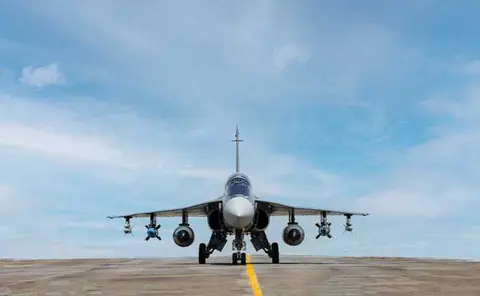
The Tejas Mk1A first squadron looks likely to reach the Indian Air Force by the end of the current financial year, provided GE Aerospace delivers the engines it has promised. Hindustan Aeronautics Limited says it can hand over a full squadron once 20 to 22 F404-IN20 engines arrive before the year closes, which on present plans points to March 2027.
Twenty Mk1A airframes are already built and through flight testing. Each needs only incremental checks once its engine is fitted, the company says.
The Tejas Mk1A first squadron is reachable now for a simple reason. An IAF fighter squadron runs to roughly 18 aircraft, and the airframes sitting finished in the shops are close to that number. Engines are the gate, not airframes.
The first LCA Mk1A was due in February 2024. On the revised schedule the first jet reaches the IAF about six years after the contract was signed in February 2021.
The engine backlog GE says it will clear
GE Aerospace has assured HAL of 20 to 22 additional F404-IN20 units before the year end, the supply that unlocks the built airframes. Deliveries have run slow through supply-chain trouble, and HAL has invoked the penalty clauses in its engine contract. IDW has tracked the ramp in detail, including GE's move to stand up a dedicated F404-IN20 production line to work through the backlog.
The numbers behind the engine order are large. HAL signed for 99 F404-GE-IN20 engines in 2021 to cover the first 83 Mk1As, a contract worth about 716 million dollars. A further 113 engines followed in November 2025, worth close to a billion dollars, with those deliveries scheduled across 2027 to 2032. HAL's own account of the airframes waiting on engines, given at Farnborough, is set out in our earlier report on the engine supply position.
The integration work still to finish
Engines are not the only thing between HAL and a delivered squadron. Reporting cited by the source points to unresolved system-level integration, specifically the linking of the radar to the weapon-firing controls and the electronic warfare suite. HAL and the Aeronautical Development Agency have to close that out, and the package then has to clear the Centre for Military Airworthiness and Certification.
Standalone firing trials for the Astra and ASRAAM missiles are reported complete. The full weapons package and the EW suite, taken together, still need integration approval before the aircraft can go to the IAF cleared for operations.
CEMILAC's certification route for airborne systems is the framework this package has to pass, the same route IDW covered at the recent DRDO aero cluster meet in Bengaluru.
A radar question that is not fully settled
There is also the radar. Defence Standard, citing The Eurasian Times, reports that the indigenous Uttam AESA planned for the Mk1A was set aside over technical delays and that HAL moved to fit the Israeli EL/M-2052 AESA instead. That sits against IDW's own earlier reporting, in which HAL described an in-house AESA radar still to be flight tested. The public record is that the initial Mk1A batch was contracted around the EL/M-2052 from the start, with the indigenous Uttam planned as a later insertion on subsequent aircraft. The radar picture is best read as reported rather than confirmed by HAL, and the shelved framing is worth holding with care until HAL states its own position.
An order book of 180 aircraft
The Indian Air Force has ordered 180 Mk1A fighters in all. The February 2021 order covered 83 aircraft, 73 single-seat fighters and 10 trainers, at a contract value of Rs 45,696 crore, about 6.5 billion dollars, with deliveries first slated to run from February 2024 to 2028-29.
A December 2025 order added the other 97, this time 68 single-seat fighters and 29 twin-seat trainers, at Rs 62,370 crore, roughly 7.5 billion dollars. That works out to about Rs 640 to 650 crore an aircraft. HAL says it will lift production to 24 to 30 jets a year, drawing on the Nashik plant alongside Bengaluru, to hold the delivery timeline.
Even on that ramp the full 180-aircraft programme looks set to stretch to around 2032-33, with the second batch starting to move about 2028.
What the Tejas Mk1A first squadron adds
The Tejas Mk1A is the upgraded build of India's indigenous light combat aircraft, developed by HAL and the ADA. It is a 4.5-generation, single-engine multirole fighter for air defence, ground attack and maritime strike, carrying an AESA radar, an advanced EW suite, air-to-air refuelling and better avionics and maintainability than the earlier Mk1.
For the IAF the point of the programme is squadron strength. The service is running below its sanctioned number of fighter squadrons, and the Mk1A is the aircraft meant to close that gap with an Indian platform rather than another import line. A first full squadron of a homegrown 4.5-generation fighter, built at home and flown by the IAF, is the return on more than a decade of work on the light combat aircraft.



COMMENTS
JOIN THE DISCUSSION