

 DEFENCE INDUSTRYBrahMos export orders: Vietnam deal worth about $100 million, Indonesia $200 million as Akash reaches Tajikistan, Turkmenistan
 DEFENCE INDUSTRYMahindra Embraer Nagpur facility to assemble C-390 if IAF picks the aircraft
 DEFENCE INDUSTRYSMPP Drone Manufacturing Push: Firm Shifts From Ammunition to Unmanned Warfare, Targets Integrated Defence Capabilities
 INDIA DEFENCEDhruv NG Helicopter Explained: What HAL Has Actually Put Into Pawan Hans Service
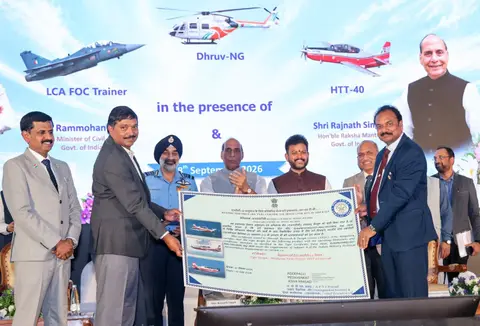 INDIA DEFENCELCA FOC Trainers Delivered With HTT 40 and Dhruv NG as Rajnath Singh Asks Engineers for Technologies That Do Not Exist
The defence blacklisting policy revised by the Defence Acquisition Council (DAC) will cap bans on vendors at five years, stretching to around seven in extreme cases, after which a sunset clause will apply, Defence Secretary Rajesh Kumar Singh said on Thursday.
The DAC approved the revised policy several months ago, the Defence Secretary said in an interview, pointing to firms that have stayed on the list for decades.
Defence blacklisting policy to end open-ended bans
"We have people who have been kept blacklisted for literally decades, and this is not helping anybody. It is also creating a situation where, in some areas, we are not able to sustain our own equipment from such vendors," he said.
Long bans also shrink the market India buys from, he said, leaving less competition and weaker price discovery in technologies where the number of global players is already very small. He described the result as a kind of strategic paralysis, in which capital acquisition projects get choked, supply chains dry up and technology suppliers are cut out.
"It's a kind of self-sabotage, in a way," the Defence Secretary said.
Past cases bear out the cost he described. The Army went roughly three decades without inducting a new towed artillery gun after the Bofors case of the late 1980s, a gap that indigenous guns such as Dhanush and the ATAGS, now also an export product, have since begun to close. India's line of German-designed HDW submarines stopped at four boats after HDW was blacklisted in 1990. HDW was later absorbed into TKMS, now the Navy's partner on the P75I submarine programme.
Sunset clause after five to seven years
The DAC took the view last year that blacklisting periods could be slightly longer in some cases, the Defence Secretary said. The intention is to keep them at not more than five years, and perhaps up to seven years in extreme cases. Beyond that, the sunset clause applies.
Cases will also be evaluated individually, and firms taken off the blacklist, without prejudice to court cases that may still be running.
The ministry's framework for vendor penalties dates to the Guidelines for Penalties in Business Dealings with Entities, issued in 2016 to replace the earlier practice of blanket ten-year bans, according to reports at the time. That framework also allowed India to keep buying from a banned firm where no alternative existed, the reports said. Updated supplier guidelines reported in May this year set out graded debarment, with up to five years for non-performance, longer periods for misconduct, and a 30-day window for vendors to respond to allegations. An initial debarment would be reviewed by a high-power committee, according to those reports.
MQ-9B and drone orders under delegated powers
On drones, the Defence Secretary said the number and size of orders could not be given, because many are placed under delegated financial powers at the command and Vice Chief levels.
The larger drone orders are placed centrally. The biggest is the 31 MQ-9B high-altitude long-endurance drones, worth about $3.5 billion and ordered about two years ago, he said. The Ministry of Defence signed that deal with the US government in October 2024. The Indian Navy is to receive 15 Sea Guardians and the Army and the Indian Air Force eight Sky Guardians each, with a separate contract for depot-level maintenance, repair and overhaul in India, according to reports at the time. The new drones add to two MQ-9Bs the Navy had already leased.
All three services have also placed many smaller orders under delegated powers. After Operation Sindoor, they placed large orders for both drones and counter-drone systems under emergency procurement as well, the Defence Secretary said. Emergency procurement lets the services sign contracts quickly within a per-contract ceiling, which has been reported at Rs 300 crore.
Fast-track route for drone buys
"Since drones have a very short technological cycle, there is no point in undertaking multi-year procurement for them. We will try to procure these mostly through the fast-track process," he said.
The fast-track procedure under the Defence Acquisition Procedure is meant for urgent operational requirements and shortens the time between approval and contract. Using it as the default route for drones would match the short technology cycle the Defence Secretary described. It sits alongside the regular capital acquisition route, which can take years.
Indian firms are already in that pipeline. The Army has placed loitering munition contracts with Tata Advanced Systems and Nibe, and has sought industry responses for a long-range loitering munition able to reach 1,000 km.
Private drone makers testing at Pokhran
Noida-based IG Defence, one of several private firms now building strike drones in India, carried out a Pokhran trial of its KAL one-way attack drone last month. The DAC, which approved the revised blacklisting policy, has also continued to clear capital acquisition proposals for the services through the year.
COMMENTS
JOIN THE DISCUSSION