

 DEFENCE INDUSTRYBrahMos export orders: Vietnam deal worth about $100 million, Indonesia $200 million as Akash reaches Tajikistan, Turkmenistan
 DEFENCE INDUSTRYMahindra Embraer Nagpur facility to assemble C-390 if IAF picks the aircraft
 DEFENCE INDUSTRYSMPP Drone Manufacturing Push: Firm Shifts From Ammunition to Unmanned Warfare, Targets Integrated Defence Capabilities
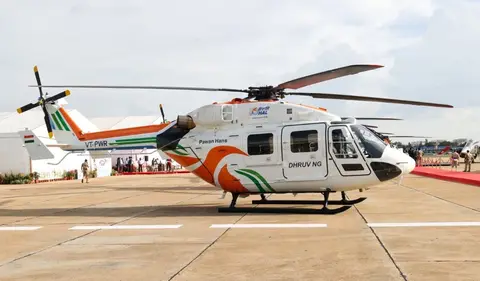 INDIA DEFENCEDhruv NG Helicopter Explained: What HAL Has Actually Put Into Pawan Hans Service
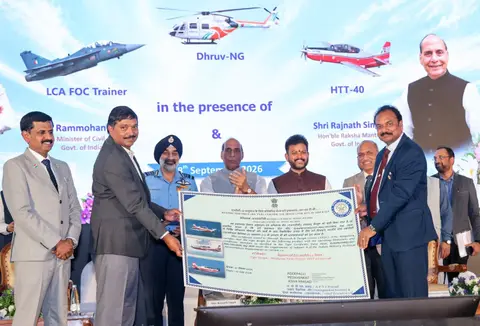 INDIA DEFENCELCA FOC Trainers Delivered With HTT 40 and Dhruv NG as Rajnath Singh Asks Engineers for Technologies That Do Not Exist
Defence Export SOP reforms unveiled by the Department of Defence Production on Friday simplify both the export standard operating procedure and the Open General Export Licence framework, changes the ministry linked to Prime Minister Narendra Modi's vision of India as a reliable, competitive and trusted global defence manufacturing and export partner. The department said the overhaul also advances the objectives of Make in India and Aatmanirbhar Bharat.
The changes were carried out under the guidance of Defence Minister Rajnath Singh. Officials said the reforms are meant to cut procedural requirements, speed up access to international markets and let Indian defence companies respond more quickly to global business opportunities, while keeping national security considerations fully safeguarded.
Defence Export SOP reforms drop a consultation step
Two changes anchor the SOP side of the reform. Stakeholder consultation has been dropped for exports of non-lethal defence items to most destinations, though appropriate safeguards remain for sensitive countries. The same consultation requirement has also been dispensed with for exports of all items meant for international tenders and exhibitions, a change meant to let Indian companies showcase their products and pursue overseas opportunities more quickly.
OGEL framework consolidated into a single SOP
The Open General Export Licence is a standing, one-time authorisation that lets eligible exporters generate export clearances for multiple consignments on their own, rather than seeking approval for each shipment.
Three separate OGEL SOPs, covering major platforms and equipment, parts and components, and intra-company transfer of technology, have now been folded into one unified SOP, giving exporters a common framework. Validity has also been extended, from two years to three, cutting the frequency of renewals and the compliance work that comes with them.
Coverage widens from 41 countries to nearly the whole world
OGEL coverage has been expanded from 41 countries to all countries, according to the ministry, barring negative and sensitive nations and those facing UN Security Council sanctions or arms embargoes. A new provision also covers Indian companies with long-term contracts or agreements with Foreign Original Equipment Manufacturers. Under it, an OGEL can be granted for eligible items tied to a specific FOEM, with validity aligned to the underlying contract, subject to prescribed conditions.
Small-calibre parts brought into civil-end-use scope
The range of items eligible under OGEL has been broadened too. The revised framework permits civil-end-use exports of specified parts and components of small-calibre arms, along with protective equipment, opening business avenues that sat outside its scope earlier.
MSMEs named among the biggest beneficiaries
The Department of Defence Production said the Defence Export SOP reforms push India's export regime toward a more facilitation-based system without giving up safeguards on sensitive items, technologies and destinations. Indian manufacturers, including MSMEs, are expected to gain the most, with faster access to tenders and exhibitions, lighter repetitive authorisation requirements and quicker entry into new export markets.
The changes follow a year in which domestic defence production reached an all-time high of Rs 1.78 lakh crore, while defence exports touched a record Rs 38,424 crore, continuing a run Rajnath Singh flagged at an ASSOCHAM gathering and in his recent export remarks.
COMMENTS
JOIN THE DISCUSSION