

 DEFENCE INDUSTRYBrahMos export orders: Vietnam deal worth about $100 million, Indonesia $200 million as Akash reaches Tajikistan, Turkmenistan
 DEFENCE INDUSTRYMahindra Embraer Nagpur facility to assemble C-390 if IAF picks the aircraft
 DEFENCE INDUSTRYSMPP Drone Manufacturing Push: Firm Shifts From Ammunition to Unmanned Warfare, Targets Integrated Defence Capabilities
 INDIA DEFENCEDhruv NG Helicopter Explained: What HAL Has Actually Put Into Pawan Hans Service
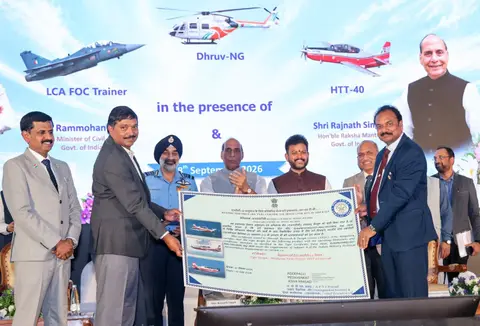 INDIA DEFENCELCA FOC Trainers Delivered With HTT 40 and Dhruv NG as Rajnath Singh Asks Engineers for Technologies That Do Not Exist
The Koizumi New Delhi visit will bring Japan's Defence Minister, Shinjiro Koizumi, to the Indian capital for comprehensive bilateral talks with Defence Minister Rajnath Singh. The trip follows a stretch of institutional dialogue between the two sides and is meant to carry that groundwork into concrete outcomes.
What the Koizumi New Delhi visit will cover
Central to the agenda is the acceleration of defence equipment and technology partnerships between India's Ministry of Defence and its counterpart in Tokyo. Officials on both sides are expected to take up frameworks for advanced military hardware co-development.
Maritime domain awareness and joint industrial initiatives aimed at a stable Indo-Pacific framework round out the agenda, extending threads that have run through India Japan defence talks for several years now.
The two countries have carried these conversations forward under the Special Strategic and Global Partnership they elevated to in 2014, a framework that now touches the army, navy and air force alike. On the Indian side, the hardware co-development push also sits alongside the broader Aatmanirbhar Bharat drive, which has pushed the Ministry of Defence to favour partnerships that build capacity at home over straightforward imports.
Fighter jets head to India next month
Beyond the diplomatic table, the air forces of both countries are due for their own moment. Fighter aircraft from the Japan Air Self-Defense Force are slated to fly into India next month for a joint air combat exercise, giving the two sides a chance to fine tune tactical coordination, share best practices and build operational familiarity in the air.
Gen Takehiro Morita, Chief of Staff of the Japan Air Self-Defense Force, is expected to travel to India to observe the drills and meet senior Indian military leadership.
The two air forces have flown together before. Their maiden bilateral fighter exercise, held in Japan in January 2023, saw IAF Su-30MKI jets exercise alongside JASDF F-15 and F-2 aircraft, with C-17 and IL-78 support flying in behind them.
The exchange has widened since. Each fresh edition has doubled as a check on how far interoperability between the two air arms has come, and a Japanese deployment onto Indian soil this time marks a shift from the earlier pattern of the IAF doing the travelling to Japan instead.
Hardware co-development already under way
The push for hardware co-development is not starting from zero. Earlier this year, India and Japan signed their first defence co-development pact, under which Bharat Electronics Limited will build Japan's UNICORN integrated stealth mast for Indian Navy warships, with the underlying design supplied by Japanese industry. That deal gave both sides a working template for handling technology transfer on sensitive military hardware, one officials are likely to draw on as the conversation widens to other platforms. Officials from both capitals are expected to build on that template during the Koizumi New Delhi visit, extending co-development talks beyond the naval domain and into new areas altogether.
Standing channels behind the visit
India and Japan run their defence relationship through a set of standing bilateral channels, from the annual summit between the two prime ministers to the 2+2 ministerial dialogue between foreign and defence ministers. The fourth edition of that 2+2 dialogue is due in Tokyo before the year is out, a separate track from the New Delhi visit.
The navies of the two countries meet just as often, with the Indian Navy and the Japan Maritime Self-Defense Force exercising annually under JAIMEX and both fleets sailing together in the wider Malabar and MILAN drills.
Tokyo eased its own arms export rules earlier this year, widening what Japanese industry is permitted to sell abroad, India among the countries that stand to benefit. For a country long guarded about exporting finished military equipment, that shift is part of what has made hardware co-development with India possible in the first place.
A pattern of high level contact
This would be the second meeting between Singh and Koizumi inside two months. The two defence ministers last met in Tokyo in July, where discussions covered regional security, maritime cooperation and defence industrial collaboration, and where Singh laid a wreath at the Self-Defense Forces Memorial Stone.
COMMENTS
JOIN THE DISCUSSION